The Economics of Buffer Capacity at Multi-Room Franchises
What Buffers Actually Cost
A 10-room franchise that adds 10 minutes of buffer after every session leaves roughly 100 minutes of potential booking capacity on the floor during a typical Saturday. Across 50 operating Saturdays, that's 5,000 room-minutes — approximately 83 room-hours of foregone revenue per year per location. At an average ticket value of $28 per player and four players per room, a single location sacrifices over $9,000 annually from that single buffer decision.
That number sounds like a clear case for reducing buffers. But reducing them without understanding your specific flow variance creates the opposite exposure: a reset station that can't complete a room in the allocated time pushes the next group's briefing past the 10-minute window, which delays their start, which cascades into the photo op queue and the subsequent session's reset cycle. The guest who waits 18 minutes after their scheduled start time doesn't care about your throughput economics — they leave a one-star review.
Escape Room KPIs for Profitability (Financial Models Lab) identifies 70% utilization during peak hours as the target threshold above which bottlenecks begin to form. Most 10-room franchises run above 70% on Saturdays by design — that's where the revenue is. The buffer question therefore isn't about whether you're exposed; it's about which junctions need protection and how much.
Capacity Utilization vs Service Level Trade-Off (POMS) formalizes this as the central tradeoff in service operations: increasing utilization improves revenue per hour but degrades service level through longer and more variable waits. The optimal point depends on your flow variance — specifically, the standard deviation of your session completion times across room types.
The Three Buffer Types and Their Economics
Supply Chain: Buffers and Trade-offs (University of Arkansas) identifies three ways to absorb variability in any service system: inventory (pre-positioned resources), capacity (excess throughput ability), and time. Multi-room escape room franchises use all three, but rarely price them correctly.
Time buffers — the gap between session end and next booking — are the most visible and most expensive. They're booked against every reservation, making their revenue cost immediate and concrete. Most franchises default to a uniform time buffer across all rooms regardless of reset complexity. A beginner room with minimal prop resets needs 8 minutes; a heavily themed room with physical puzzle resets needs 20. Uniform 15-minute buffers underperform in both directions.
Capacity buffers — extra staff available to absorb overflow — have an hourly labor cost. Protective Capacity and Capacity Buffer (Schragenheim) defines buffer capacity as fast-response reserve that must be weighed against the cost of carrying unused throughput ability. A franchise staffing two extra GMs every Saturday "just in case" is paying a predictable cost to hedge an uncertain risk. If the risk is low-variance and the buffer rarely gets used, the cost is pure waste.
Inventory buffers — pre-staged reset materials, extra photo op props, standby briefing capacity — have a setup cost but zero incremental cost per use. These are often underinvested because they require upfront capital rather than recurring labor, even though they're cheaper over a full season.
The pressurized-water-in-pipes model clarifies the correct intervention for each junction. A briefing room bottleneck is a pipe diameter problem — you need more throughput capacity there (capacity buffer), not more time between sessions (time buffer). A reset station contention issue is a flow sequencing problem — staggering session starts (time manipulation) costs nothing, while adding a third reset staffer (capacity buffer) has a weekly labor cost.
PressurePath models each junction separately, showing which type of buffer applies and what the marginal cost of each increment is. Rather than applying a uniform 12-minute buffer across ten rooms, the simulation tells you: Room 4 needs 8 minutes, Room 7 needs 18 minutes, and the briefing room needs a second slot on Saturday afternoons but not on weekday evenings.
Buffer Capacity Allocation for Desired Throughput (Springer) provides the mathematical foundation: optimal buffer sizing achieves the target throughput with minimum buffer cost, which varies by system configuration. The same principle applied to escape room franchises means the optimal buffer at each junction is a function of your specific room mix, session length distribution, and peak booking density — not a generic industry recommendation.
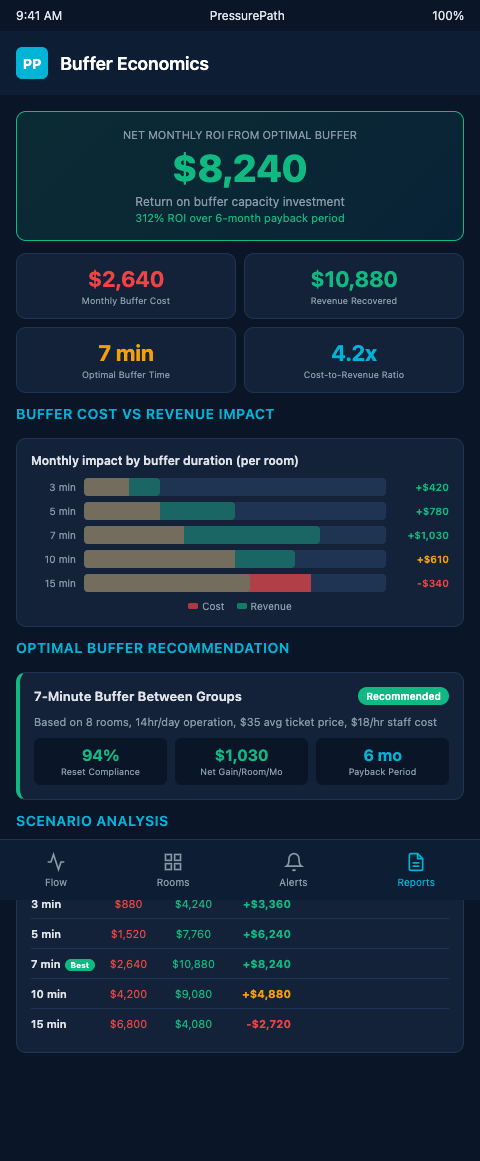
The 10-room case study recovered 180 staff hours per month specifically by replacing uniform capacity buffers with targeted flow sequencing — a direct application of this economic logic. The labor cost of the excess buffer was far higher than the cost of the 7-minute booking grid stagger that replaced it.
When Buffers Are Worth Their Full Cost
Not all buffers should be minimized. Some are genuinely load-bearing.
A franchise running adjacent to a high-traffic attraction — a theme park, a convention center, a stadium — experiences walk-in demand spikes that predictive modeling can anticipate but not fully control. For those locations, a 15-minute open slot between 2 PM and 3 PM every Saturday isn't waste; it's an intentional revenue valve for late-arriving groups who would otherwise be turned away.
Similarly, a franchise with rooms that have complex mechanical reset requirements — hydraulic props, elaborate set changes, timed audio sequences — has higher reset variance than average. For those rooms, a longer time buffer is load-bearing insurance against the reset that takes 24 minutes instead of 14. The question is whether the buffer is sized to the 90th-percentile reset time or the average. Most franchises use the average and eat refunds during the 10% of resets that run long.
Smart Scheduling with AI — McKinsey shows AI scheduling tools dynamically tune buffer allocation to demand fluctuations — the commercial equivalent of running the PressurePath simulation weekly rather than once at season start.
Understanding pacing simulations vs booking buffers as complementary rather than alternative tools is the mature operator's framing. The simulation shows you where variance is high enough to justify a buffer; the booking system implements it. Operators who try to manage buffer economics through booking rules alone, without the simulation layer, are pricing their buffers against gut feel rather than observed flow data.
For context on how other high-throughput entertainment operators handle the same tension, haunt ticket cap economics documents how haunted attraction operators use hard capacity constraints rather than time buffers — a different mechanism addressing the same fundamental trade-off between throughput and service level.
The Calculation That Changes the Decision
The franchise owner who runs a PressurePath simulation and discovers that the briefing room bottleneck on Saturday afternoons is costing three delayed sessions per week can price that precisely: three delayed groups averaging 12 minutes each, across 50 Saturdays, equals 18,000 minutes of schedule disruption annually. Translated to labor cost, refund exposure, and repeat-booking friction, the number justifies a targeted fix.
The same owner who discovers that Room 4's 18-minute reset buffer could be reduced to 12 minutes without service level impact has found 300 additional bookable room-hours per year. At four players per session and a $28 average ticket, that's over $33,000 in recoverable revenue.
These calculations only exist if you've modeled the flow. Without the simulation, buffer decisions default to the same logic that produced the original problem: uniform rules applied without understanding where the variance actually lives.
The franchise that models its buffer economics before next season's Saturday grid is set has a concrete financial document to bring into operational planning: room-by-room buffer assignments, expected revenue impact of right-sizing, and the labor cost reduction from eliminating excess capacity buffers. That document changes the budget conversation from "how much buffer do we need" — a question nobody can answer precisely without data — to "here is what each buffer costs and what it buys us." That precision is the difference between operational intuition and operational management.
PressurePath generates this analysis from your booking data in a single simulation pass. If your franchise has been using the same buffer rules for two or more seasons without reviewing their economic basis, the cost of that habit is almost certainly larger than the cost of the analysis that would replace it. Most operators who run the buffer economics simulation for the first time find at least one room where a 5-minute buffer reduction would recover $8,000-12,000 in annual bookable capacity — without any detectable change in guest experience. That discovery is waiting in your session timing data right now.
The operators who get buffer economics right are the ones who treat buffer allocation as a continuous optimization problem rather than a one-time scheduling decision. Each season brings changes in booking mix, group size averages, and reset complexity — all of which shift the variance profile that buffer sizing must absorb. A buffer calibrated correctly for last year's room configuration is not automatically correct for next year's expanded portfolio. Running the buffer economics simulation at the start of each season, and whenever the room mix changes materially, keeps the allocation current and the revenue calculation honest.
For a multi-location franchise, the compounding effect is significant. Five locations each recovering $10,000 in annual buffer efficiency equals $50,000 in system-wide recovered revenue — from an analysis that takes hours, not months. The economic case for PressurePath's buffer simulation pays for itself in the first season it's applied, across every location in the franchise network.