Economics of Ticket Caps: Why Pacing Beats Just Selling Less
The Reflexive Cap and Why It Costs More Than the Complaint
After a bad peak night, the first thing most haunt owners do is reduce next year's ticket cap. It feels like the responsible correction. The economics tell a different story.
The Frightening Economics of Haunted Houses (The Hustle) puts the structural problem plainly: haunted house fixed costs are massive and the revenue window is a single month. A haunt with $180,000 in annual fixed costs cannot afford to reduce ticket count by 15% as a quality-control measure. At $22 average ticket price, that 15% reduction costs $21,000 in a season where the margin was already thin. 2024 Guide to Haunted House Ticket Prices (HauntPay) adds the context: over 80% of haunts charge under $30, and the publication notes directly that when a haunt is selling out, the better move is to raise price rather than cap volume.
That guidance is correct in isolation. The problem is that most haunt owners do not know whether their complaints stemmed from selling too many tickets or from failing to pace the tickets they already sold. Those are different problems with different solutions, and confusing them is expensive.
The Midwest haunt complaint spike case study documented a haunt that ran 647 tickets on its worst night and rebuilt its pacing for under $400 in physical modifications — then ran 668 tickets the following year with zero pacing complaints. That haunt did not need a lower cap. It needed a flow model.
The Pacing-Revenue Optimization Framework
The correct economic framing for the ticket-cap question treats your haunt as a constrained throughput system with a maximum viable spawn rate. Think of it as a pressurized pipe with a rated flow maximum. The pipe does not care how many tickets you sell — it cares how many groups per hour it can move through each scare chamber without losing pressure. If you sell 600 tickets but your pipe can only sustain 540 at peak scare quality, you have two choices: restrict to 540, or expand the pipe.
Expanding the pipe is pacing optimization. It means identifying your three highest-friction scare chambers, computing the spawn interval each chamber requires for full actor performance, and either widening those chambers, inserting buffer corridors, or adjusting your spawn sequence so the chambers receive groups at the interval they need. Economic Guide to Ticket Pricing (ResearchGate) establishes that entertainment venues can apply yield management principles from capacity-constrained industries — the same principle used by airlines and hotels to maximize revenue across variable demand states.
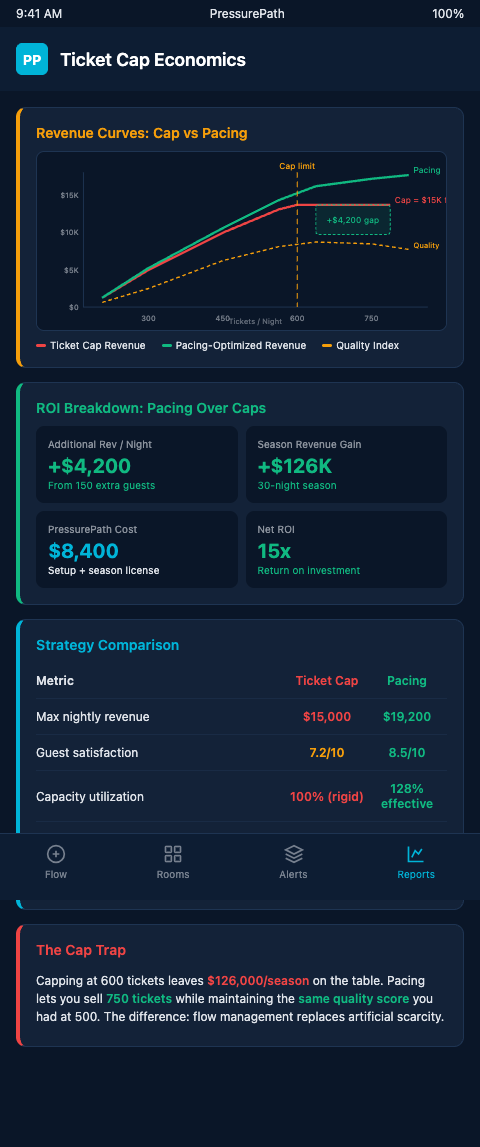
Dynamic Pricing with Updated Demand (ResearchGate) shows that flexible pricing with demand learning yields up to 8.15% revenue increase over static cap strategies. For a haunt at $22 average ticket price running 600 tickets per peak night over 20 peak nights, that 8.15% gain is approximately $22,000 in additional season revenue — more than the cost of a full pacing optimization rebuild.
The pacing-revenue optimization framework runs on three numbers: your maximum viable spawn interval per scare chamber, your current ticket count, and your target ticket count. PressurePath's simulation converts those three inputs into a specific gap — the number of additional tickets you can sell if you expand specific chamber capacities — and assigns a physical modification requirement to each gap closure. That is your investment case: here is the revenue unlock, here is the modification cost, here is the payback period.
Sequential Capacity Expansion Options (INFORMS) formalizes this as a sequential compound option: optimal capacity decisions require modeling when incremental flow investment beats volume restriction. For haunts, the practical translation is that you should not cap tickets until you have first modeled whether a $400 to $2,000 physical modification would let the same ticket count perform cleanly.
The most common outcome of running this analysis is that haunts discover their highest-friction chamber is not their highest-investment scene. The Butcher Room with elaborate effects often has adequate corridor geometry. The fog transition corridor between the Butcher Room and the Clown Alley — built as an afterthought — is the actual bottleneck, and a single false wall installation costing $300 adds 60 viable tickets per peak night. That $300 investment at 20 peak nights and $22 per ticket generates $26,400 in additional season revenue. No pricing strategy produces that return at that cost.
The second-most common discovery is that actor fatigue limits the economic upside before geometry does. At 640 tickets per night with 20 active scare positions, each actor performs 32 or more full scare arcs per hour across a four-hour peak window. Beyond the geometry-optimized spawn interval, actor performance degrades from fatigue before the physical flow model breaks down. PressurePath's actor fatigue layer models this separately from the density simulation, so the revenue optimization framework accounts for both physical and human limiting factors simultaneously.
When Capping Is the Right Answer
The pacing-first framework does not mean never cap tickets. There are scenarios where the economics of a cap genuinely outperform optimization. The primary case: when your highest-friction scare chamber requires a physical modification that costs more than the revenue from the additional tickets it would unlock, and the modification's benefit is limited to that single chamber. If fixing the Clown Alley bottleneck requires a $14,000 structural change to widen a corridor that is constrained by the building's load-bearing wall, and the fix enables 40 additional tickets at $22 each over 20 peak nights — a $17,600 gain — the payback period is over a year with no guarantee of demand growth. In that specific case, capping at 560 and investing the construction budget in marketing is a defensible choice.
The test for whether a cap is the right answer is specific: run the PressurePath simulation at your proposed cap and at your uncapped target, then calculate the modification cost to close the gap. If the modification cost exceeds two seasons of revenue from the additional tickets, the cap is probably correct. If it is under one season of revenue, optimization almost always wins.
Advanced Economics: Tiered Pricing and Pacing-Enabled VIP
Once your base pacing model is solid, tiered pricing creates a second revenue layer that was not previously available. 7 Strategies to Boost Haunted House Profit (FinancialModelsLab) documents that VIP and skip-line tiers show revenue per head rising when pacing creates differentiated experiences. If your haunt has a consistently well-paced flow at standard ticket count, you can sell a VIP spawn window — a guaranteed minimum interval before any VIP group — at a $10 to $15 premium. That premium is only credible if your pacing model actually delivers it.
Evolution of Ticket Pricing Strategies (Applied Economics) reports that multi-tier pricing averages $20,000 additional revenue per show compared to uniform pricing — a 4.2% gain. For a seasonal haunt, the equivalent gain depends on how many of your nightly tickets can be moved into a premium tier without disrupting the standard-interval flow model. PressurePath's tier simulation lets you test different VIP spawn ratios against your current flow model to find the maximum premium-ticket share that preserves standard-group scare quality.
The buffer capacity question — how much headroom to build into your flow model above your base ticket count — connects directly to how franchises and multi-location operators manage peak-night variance. Buffer capacity economics in multi-room franchises covers the same optimization problem across venues that run daily rather than seasonally, which provides a useful baseline for understanding where haunt economics diverge from year-round operations.
For scaling decisions above 600 tickets — where the economics of expansion versus restriction become materially different — scaling beyond 600 tickets per night maps the specific flow modifications required at each capacity tier.
The Compounding Effect of Pacing Credibility
There is a second-order revenue benefit to pacing optimization that does not appear in a single-season ticket cap calculation: pacing credibility compounds into premium pricing power. A haunt that consistently delivers high-quality scare experiences at 600 tickets per night earns the review profile that supports a $28–$32 ticket price rather than the industry standard $18–$22. The difference between a well-paced 600-ticket night at $30 and a flat-scare 600-ticket night at $22 is $4,800 in a single night — $96,000 across 20 peak nights, before accounting for advance ticket momentum from prior-season reviews.
This is why pacing optimization is not just a cost-control strategy but a revenue-growth strategy. The flow model does not just prevent bad nights — it creates the conditions under which guests post reviews that raise your ceiling price for subsequent seasons. PressurePath's revenue model includes a review-quality projection layer that estimates how improved scare delivery at your target ticket count translates to review score, and how that review score change affects the following season's pricing power and advance sales.
Build Your Revenue Model Before You Set Next Season's Cap
PressurePath's revenue-versus-pacing simulation shows you the exact ticket count your current flow design supports, the modification cost to unlock additional capacity, and the revenue difference between capping versus optimizing. Join the waitlist for haunted attraction designers and run your ticket-cap economics before you finalize next season's ticketing configuration.