Building a Franchise-Wide Flow Standard Across Locations
Why Flow Consistency Fails Across Locations
The franchise owner who opens a second location copies everything visible: the room designs, the prop inventory, the GM script. What rarely gets copied is the invisible operational logic — the specific stagger between room start times that prevents briefing room collisions, the reset station priority sequence that prevents Saturday afternoon backup, the photo op timing protocol that keeps groups moving through the exit corridor.
Those invisible decisions exist at the first location as institutional knowledge. The GM who's been there three years knows not to run rooms 4 and 6 with back-to-back starts because the exit corridors merge at the photo op. The new location opens without that knowledge encoded anywhere.
How to Design Your Franchise Operations Manual (Franchise Creator) documents the pattern: franchises with an operations manual have a 10% failure rate versus 60% for independent operators — and the operations manual is only as useful as the operational logic it encodes. A manual that documents room setup procedures but not flow sequencing decisions leaves the most operationally consequential knowledge in the head of the original GM.
The franchise standard for flow shouldn't be a static document — it should be a simulation that each location can run against its own booking grid. Quality Control Checklist: Franchise Standards (Franchise Creator) reports franchises with robust quality control see 35% higher revenue than those without — but quality control in escape room operations means pacing quality, not just cleanliness or prop condition.
Escapology reached 100 locations in 2025 according to Room Escape Artist Industry Report December 2025, meaning franchise-scale operators are now managing flow consistency at a scope where any single location's Saturday performance can affect the brand perception of the adjacent twenty.
Building the Standard: What It Covers and How
A franchise-wide flow standard has four components: the metrics definition, the simulation baseline, the deviation threshold, and the escalation protocol.
Metrics definition. Every location must measure the same things to compare them meaningfully. The standard specifies: briefing room wait time (from group arrival at the door to briefing start), session start variance (actual start time minus scheduled start time), reset cycle time by room type, and photo op throughput (groups per hour through the exit corridor). Multi-Location Analytics for Franchise Operators (VisionWrights) identifies consistent metric definitions as the prerequisite for meaningful multi-location comparison — without them, one location's "on time" is another location's "acceptable delay."
Simulation baseline. The standard includes a canonical PressurePath simulation run on a theoretical 10-room, 70% utilization Saturday — the benchmark every location is compared against. When a new location opens, its first simulation run is compared to the baseline to identify structural divergences before opening day.
The pressurized-water-in-pipes model makes the baseline intuitive. The standard defines expected pressure at each junction — the briefing room, reset stations 1 and 2, the photo op — under standard conditions. A location that shows higher pressure at the briefing room than the baseline during simulation hasn't built the stagger protocol correctly. A location showing higher reset cycle times has a different room type that needs a different buffer assignment.
Deviation threshold. When a location's actual Saturday performance metrics diverge from the baseline by more than a defined margin — say, briefing wait time exceeds 8 minutes consistently for three Saturdays — it triggers a formal review. Without defined thresholds, the franchise compares subjective impressions rather than measured outcomes.
Escalation protocol. The standard specifies what happens when a deviation is confirmed: re-run the PressurePath simulation with that location's actual booking grid, identify the specific junction causing the deviation, and apply the corresponding fix from the standard fix library.
Service Blueprinting FAQ (Nielsen Norman Group) establishes service blueprints as the tool for mapping frontstage and backstage actions across multi-step journeys — a service blueprint for escape room flow is the human-readable companion to the PressurePath simulation, showing which staff action corresponds to each pipe junction in the model.
The multi-location pacing consistency framework provides the structural foundation for the franchise-wide standard — defining what consistency means operationally and how to measure it across locations with different room configurations.
The scale challenge of scaling from 4 to 12 rooms is the intra-location version of the same problem — as you add rooms within a location, the standard must evolve to cover the new junctions that scaling creates. A franchise that standardizes at eight rooms and then opens locations with ten rooms is operating with a baseline that doesn't cover the last two rooms' contribution to briefing room and photo op pressure.
Implementing the Standard Without Alienating Local Operators
The tension in franchise standardization is always between the franchisor's need for consistency and the local operator's need for flexibility. A flow standard that leaves no room for local adaptation gets ignored; one that allows unlimited local variation defeats its purpose.
The resolution is standardizing outcomes, not inputs. The standard specifies that briefing room wait time must stay under 6 minutes on Saturdays, not that every location must use the same exact start stagger. Local operators can choose the scheduling mechanism that achieves the outcome within their specific room layout and booking density.
Franchise Operations Consistency (Delightree) makes this principle explicit: compliance comes from convenience, not mandate. If the standard is easy to implement and produces visible local benefits — fewer Saturday afternoon emergencies, lower staff overtime — local operators adopt it without enforcement.
How Operations Management Software Transforms Multi-Location (FranConnect) documents that operations software addressing consistency while scaling is most effective when it surfaces the performance gap clearly — so local operators see exactly where they're diverging from the standard and why it matters.
The standard also applies to new openings. The repertory touring standard used across venues illustrates the pattern: new venues receive the production's flow standard as a simulation baseline, run their first dress rehearsal against it, and identify deviations before opening night. The same structure applies to escape room franchise openings — the simulation runs on opening-week booking data before the first Saturday rather than after.
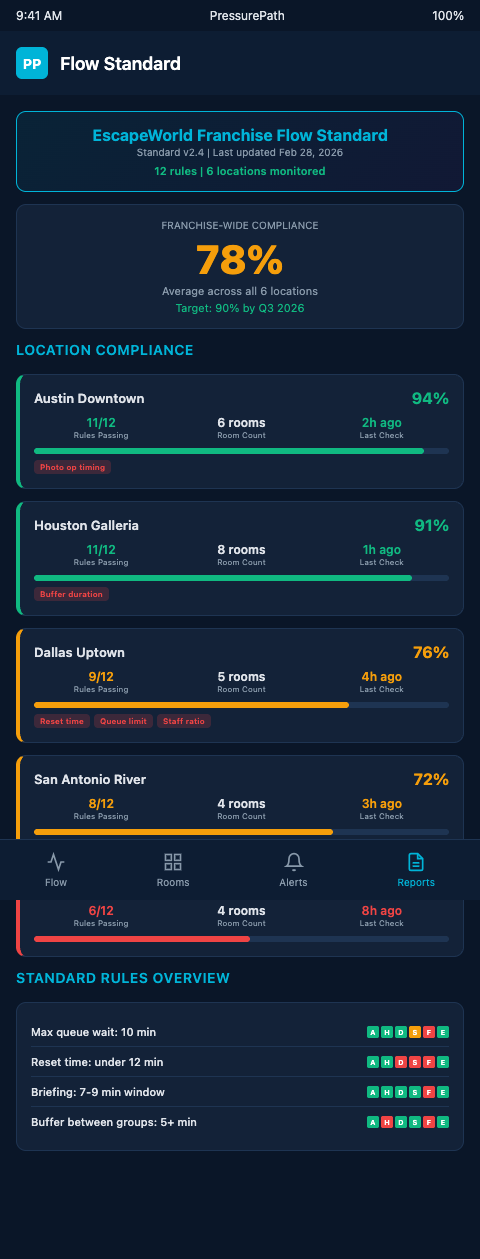
PressurePath's franchise dashboard gives the corporate operations team a single view of all locations' pacing performance against the standard. When Location 3's briefing wait time exceeds threshold on three consecutive Saturdays, the dashboard surfaces the deviation, and the simulation re-runs automatically against that location's current booking grid to identify the root junction.
Making the Standard Stick Across Turnover
The practical failure point of most franchise flow standards isn't the initial rollout — it's staff turnover. A GM who helped design the stagger protocol understands why it exists. Their replacement, six months later, may see it as an arbitrary constraint and gradually stop enforcing it. Within a quarter, the briefing room collision pattern returns and the Saturday afternoon schedule begins running long again.
A flow standard that lives only in a manual or a training document degrades with every staff change. A flow standard embedded in the PressurePath simulation is self-reinforcing: the simulation runs the booking grid each week and shows whether the recommended stagger is in place. When a new GM sees the simulation output and the labeled junction pressure that results from skipping the stagger, the reason for the protocol becomes self-evident rather than inherited wisdom.
Service Blueprinting FAQ (Nielsen Norman Group) establishes service blueprints as the tool for mapping backstage actions across multi-step journeys — for escape room franchises, the simulation serves as the executable version of the service blueprint, one that stays current as booking patterns change and can be re-run by any staff member without specialized training.
The franchise standard should include an onboarding simulation run as part of GM training. New GMs load the current booking grid, run the simulation, and walk through the output with a senior operator: here's what the briefing room looks like without the stagger, here's what it looks like with it, here's the number those two lines represent in Saturday guest experience outcomes. That single 30-minute exercise communicates the protocol's value more effectively than any written explanation.
Franchises that build the simulation into the onboarding workflow find that protocol adherence is higher, standard deviation between locations narrows, and the Saturday metrics that matter to corporate — briefing wait time, session start variance, photo op throughput — stay closer to baseline even as individual staff members rotate in and out. The standard holds because the model that validates it travels with the brand, not with the person who created it.
The franchise-wide flow standard is ultimately a competitive asset, not just an operational checklist. A franchise whose ten locations all run within 10% of the same Saturday pacing metrics delivers a consistent guest experience that standalone operators and loosely coordinated franchise networks can't match. That consistency converts into repeat bookings, cross-location referrals, and the kind of review profile that drives organic growth faster than any marketing spend.
PressurePath's franchise-standard module is built for this exact purpose: define the baseline once, validate it across all locations continuously, and maintain it through staff turnover and portfolio expansion without rebuilding from scratch each time. If your franchise is ready to replace location-by-location pacing intuition with a shared standard backed by simulation data, the framework is ready to receive your booking grid and deliver your first baseline within a single analysis session.