The Best Practices Checklist for Multi-Location Pacing Consistency
The Consistency Gap That Franchise Operations Manuals Miss
Once operators cross 10 units, manual checklists lead to compliance failures, according to Operandio's guide to managing and scaling multi-unit franchises. The operations manual defines what to do. Compliance failures happen when the how — the specific flow management behaviors that make the what work — isn't documented with enough precision to transfer across locations.
Pacing standards are exactly the category of operational knowledge that sits between operations manual documentation and lived GM practice. The Orlando location's Saturday GM knows, from experience, that rooms 3 and 7 should never start simultaneously because they both exit into the single shared briefing room at roughly the same time. She adjusts starts automatically. The Tampa location's GM doesn't have that knowledge yet — he's running the default booking grid, and rooms 3 and 7 are both starting at 2:00 PM every Saturday.
American Franchise Academy's research on multi-unit consistency confirms that the most common failure mode is operational compliance becoming personality-dependent rather than system-dependent. A pacing consistency checklist converts the experienced GM's implicit knowledge into an explicit, transferable standard.
IFA's technology challenge research identifies technology integration as the central challenge for maintaining cross-location standards — not because technology replaces process, but because without a shared data platform, each location's pacing standards drift toward whatever its GMs have figured out independently.
The Multi-Location Pacing Consistency Checklist
The checklist below is structured around the five pacing standard categories that diverge most frequently across multi-location escape room franchises.
1. Start-Time Offset Protocol Document the minimum offset between parallel room starts for each room pairing in your configuration. At a 10-room franchise, this means defining: which rooms share a downstream briefing room or photo wall exit path, what the minimum start gap is between rooms sharing that exit path, and who is responsible for verifying compliance before each Saturday shift. The checklist item: "Parallel room start gaps verified against offset protocol before shift open — signed by opening GM."
2. Reset Station Throughput Standard Define your maximum sustainable room turnover rate for each shift configuration: 2 staff, standard Saturday, maximum 10 rooms per 4-hour window. If the booking grid would push resets above that rate, a booking adjustment is required. The checklist item: "Reset load for next shift calculated against throughput standard — overloaded windows identified and flagged for booking adjustment."
3. Briefing Room Capacity Threshold Document your briefing room's maximum concurrent group load and minimum clear time between cohorts. The checklist item: "Briefing room pressure index for next 2-hour window checked against threshold — amber windows noted in GM handoff log."
4. Photo Wall Queue Maximum Set a maximum acceptable photo wall queue depth (typically 2 groups or 8 minutes wait, whichever is smaller) and define the GM intervention that fires when the threshold is crossed. The checklist item: "Photo wall queue protocol reviewed with shift GM — intervention trigger and responsible staff confirmed."
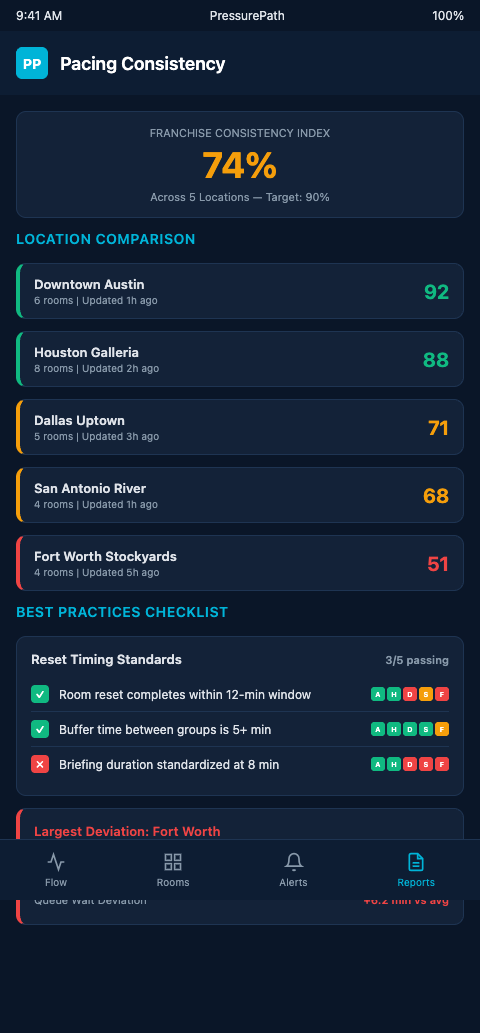
5. Cross-Location Audit Cadence Multi-location consistency degrades without comparison data. Define a monthly cross-location pacing audit: pull Saturday pressure data from both locations, compare briefing room pressure index and reset station lag across equivalent time windows, and identify which location is performing outside standard on either metric. The checklist item: "Monthly cross-location pacing audit completed — variance locations flagged for protocol review."
Think of each location as a separate pipe network drawing from the same corporate pressure source (booking volume and standards). If one network's junction nodes (briefing rooms, photo walls) are running at different pressures than the other, the system isn't consistent — it's two independent systems that happen to share branding. PressurePath runs each location's Saturday grid through the same pressure model, so cross-location comparison uses the same measurement framework rather than GM impressions.
A typical two-location comparison at 10 rooms per site surfaces 4-8 meaningful divergences on the first run: different briefing room wait averages during the 2-4 PM window, different reset station lag patterns at peak, and different photo wall retention times. Each divergence represents 5-12 minutes of cumulative Saturday latency at the location that's underperforming — which translates to 20-48 minutes of avoidable queue exposure per peak Saturday per site.
For the long-term standard that governs how these checklist items evolve as the franchise grows, the franchise-wide flow standard is the destination — a codified set of pacing benchmarks that every location must meet and that serves as the baseline for new location onboarding.
Building and Maintaining Pacing Standards Across a Growing Franchise
Franchise Creator's quality control checklist research establishes that standardized audit forms are foundational for cross-location operations compliance. The pacing consistency checklist works the same way — it's not a one-time document, it's a recurring audit form that GMs complete before each peak shift and that operations managers review monthly.
The challenge as a franchise grows is that each new location adds a new set of pacing variables: different room configurations, different briefing room layouts, different photo wall positions. MSA Worldwide's operations manual documentation notes that operations manuals must set detailed specifications that franchisees can follow independently. For pacing standards, that means the checklist must be specific enough to apply without interpretation — not "verify room starts are appropriately spaced" but "verify that rooms sharing the main briefing room exit path have starts offset by at least 12 minutes."
Restaurant management consistency research from MBB found that documented procedures are the foundation for cross-location consistency, and that 68% of businesses report brand consistency adds 10–20% to revenue. For escape room franchises, the revenue mechanism is consistent 5-star review rates across locations — a location that produces Saturday briefing room collisions generates lower average scores than one that doesn't, regardless of room quality.
Building the first flow map is the prerequisite for the checklist — you can't document start-time offset protocols without first mapping which rooms share downstream assets and what the pressure relationships between them are.
How touring immersive theater productions maintain pacing consistency across venues offers a useful reference point. Repertory touring flow standards address the same cross-location consistency challenge — maintaining flow standards when each venue has different physical constraints — and the documentation approach translates directly to escape room franchise expansion.
RosterElf's multi-site franchise pacing research identifies the central tension in multi-location pacing: balancing corporate uniformity (the same briefing room collision thresholds everywhere) with local autonomy (location-specific start-time offsets that reflect each venue's physical configuration). The checklist accommodates both: the threshold standards are corporate, the room-specific offset values are local.
Deploying the Checklist Across Your Franchise
Multi-room escape room franchise operators with two or more locations can deploy the five-item pacing consistency checklist this week. Document your offset protocols for each location's specific room-to-briefing-room mapping, set the reset throughput standard based on your current staffing configuration, and assign the monthly cross-location audit to a single operations lead. The first audit typically takes 90 minutes per location and surfaces the specific protocol gaps that explain recurring Saturday differences between sites. PressurePath provides the pressure data that makes the audit quantitative rather than impressionistic — same tool, same measurement framework, applied to each location's Saturday grid. If your franchise currently has one location that runs cleanly and another that generates recurring Saturday complaints, the consistency checklist is the diagnostic that identifies which pacing standard is missing at the problem location. Join the waitlist and bring your multi-location booking data; the cross-location pressure comparison runs in a single session.