Case Study: How One Director Rescued a Failing Immersive Show With Flow Data
Week Three: The Show Was Hemorrhaging Audiences in Act 2
The production had opened to strong reviews and near-full houses. By week three, the stage manager was tracking a persistent problem on her walkie-talkie log: the Greenhouse scene, positioned as the emotional center of Act 2, was running at 6-10 audience members during its climactic confrontation. The director had designed it for 20-28 sightlines. The rest of the audience — 60 to 80 people — were clustering in the Observatory two rooms over, which had no Act 2 function whatsoever.
Exeunt Magazine documented directors stripping and redesigning shows mid-run over 3-4 months, with erratic changes that ultimately compromise quality. That's the reactive spiral: notice a problem, gut a scene, lose something else, notice another problem. The director in this case study chose a different approach.
Stage managing immersive theater (HowlRound) requires stage managers to track audiences across non-linear spaces — constant walkie-talkie reports identifying which rooms are overcrowded and which are empty. The SM's logs from week three became the raw data for a structured flow audit. Rather than instinct-driven redesign, the director asked a specific question: where does the audience go, and at what transition points does the distribution break from the call sheet's intended layout?
Mapping the Failure: From SM Logs to Flow Diagnosis
The SM logs showed a consistent pattern across 14 performances: the Solarium scene in Act 1 ending at minute 47 was creating an audience surge. When the Solarium's climactic sound cue dropped, audience members flowed out through the north corridor — the only lit exit — and the Observatory, which sat at the north corridor's terminus, absorbed everyone. The Greenhouse was accessible only through the south corridor, which was unlit and didn't signal any magnetic pull.
This is a classic valve failure. The north corridor acted like a pressurized pipe with a wide outlet — once the Solarium emptied, fluid followed the path of least resistance directly to the Observatory. The south corridor had no counter-pressure: no audio bleed, no light gradient, nothing to draw bodies away from the obvious path.
Malthouse Theatre's "Because the Night" used 360° documentation to build iterative design knowledge (The Immersive Archive, Tandfonline) — the principle is the same: documented performance data produces better redesign decisions than aesthetic instinct alone. The director ran the flow audit through PressurePath, mapping the venue as a pressure network: three scenes in Act 2, two corridor connections, sightline density ceilings per room.
The model confirmed what the SM logs suggested and added a quantified prediction: given the corridor geometry and the magnetic pull differential between Observatory (large, bright, residual Act 1 energy) and Greenhouse (small, dark, no audio signature), 70% of audience members would route to the Observatory on a cold transition. At 90 bodies in the house, that meant the Greenhouse would receive 27 people maximum — and if even 10 of those paused in the north corridor to watch other audience members move, the Greenhouse dropped to 17.
The simulation also identified a secondary failure: the Greenhouse's scene timing was 18 minutes long, which meant anyone who missed the opening 5 minutes experienced a narrative fragment rather than a complete arc. Late arrivals to the Greenhouse weren't getting the scene — they were getting the end of the scene, which read as incomprehensible.
The Interventions: What Actually Changed
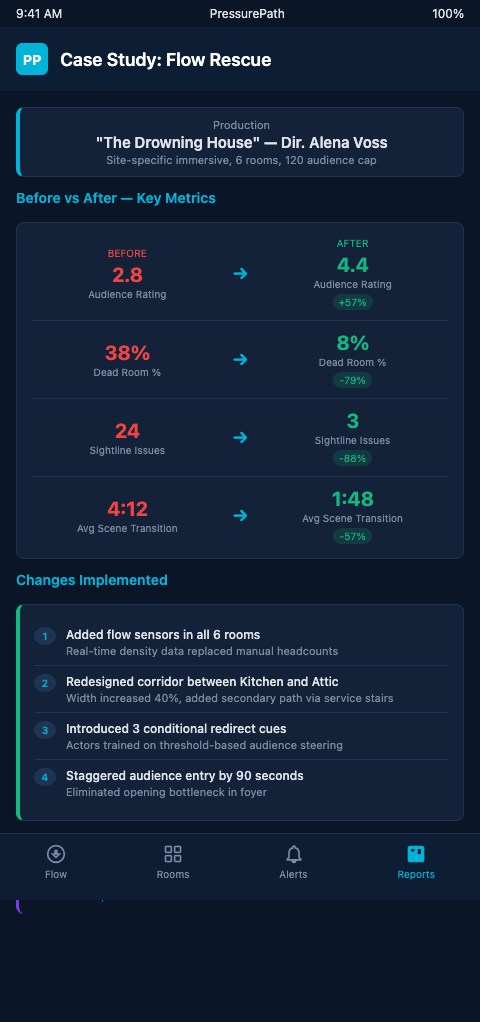
The director made four changes, each targeting a specific node in the pressure model rather than the narrative content.
First, south corridor lighting: a low warm glow was added to the south corridor exit from the Solarium, creating a competing visual pull. This alone shifted the baseline corridor split from approximately 80/20 north-south to 55/45 north-south in simulation, and 58/42 in the first post-change performance.
Second, audio bleed from the Greenhouse: a 40-Hz bass tone — inaudible as music but felt as physical resonance — was added to the Greenhouse starting at minute 44, three minutes before the Solarium's sound cue. This created a pre-signal that pulled bodies south before the north corridor pressure built. Analyzing reactions to past performances lets producers adjust scripts and staging (Exploring Data in Theater, Captitles) — the audio bleed functioned as a non-verbal pre-cue that the SM logs later confirmed changed arrival timing.
Third, a loop structure for the Greenhouse scene: the confrontation sequence was restructured to run in a 12-minute loop starting at minute 47, with a brief ambient pause at minute 59. Late arrivals now entered a repeating arc rather than a fragment. Sightline count requirements held across the loop because the confrontation's peak moment occurred at minute 51 in each cycle.
Fourth, cue exit re-timing for the Observatory: the Observatory's Act 2 ambient soundtrack dropped in intensity at minute 49, signaling — without explicit instruction — that the room was transitioning. PressurePath had flagged that 8% of audience members were staying in the Observatory across the entire Act 2 window because no exit cue existed. The intensity drop created a soft exit cue that the SM logs confirmed reduced Observatory retention from 8% to 2%.
The comparison with how pacing simulators outperform usher instincts is precise: the stage manager had instinctively known the south corridor needed something, but without a quantified model of how much that intervention needed to counteract the north corridor pull, the solution remained vague. PressurePath provided the counterbalancing math.
After four performances with all changes in place, the Greenhouse scene averaged 23 audience members during its confrontation — within the director's 20-28 blocking target. A four-year research program synthesized lessons to refine flow and narrative structure (Immersive Storytelling Experiences Methodology, Tandfonline) — in this production's case, the refinement happened within two weeks because the model identified the specific pressure nodes rather than requiring full redesign.
Replicating This Diagnosis in Your Production
The conditions for this kind of flow failure are common: any immersive production with multiple Act 2 or Act 3 scenes, unequal corridor lighting, and scenes of differing magnetic pull will produce distribution problems that SM intuition alone cannot resolve. The director's ability to fix this show quickly depended on having quantified baseline data before the crisis — 14 performances of SM logs mapped to a pressure model rather than described anecdotally.
There is a broader lesson here about how directors relate to flow data. The reactive spiral documented by Exeunt — strip scenes, redesign mid-run, compromise quality — is driven by uncertainty. When the director doesn't know what's causing the problem, changes are large, exploratory, and expensive. When the director has a quantified pressure model, changes are targeted, minimal, and testable within a single performance cycle. The four interventions in this case study each took less than two hours to implement. The week-three crisis went from "the show needs a major overhaul" to "four specific changes with expected results" in one diagnostic session.
Seven lessons from creating an immersive whodunit (HowlRound) describe managing audience distribution across scenes as one of the core iterative design challenges — directors who have worked through it once describe the learning as the hardest part of immersive directing to absorb. A flow model short-circuits that learning by making the distribution dynamics explicit from the start of the run rather than through accumulated post-mortem intuition.
The case study methodology for analyzing how immersive decisions affect engagement (Texas State) also applies to the diagnostic process: the structured case study approach — defining the problem, mapping the evidence, testing the intervention, measuring the result — is the same rigor that a flow audit applies to a production's distribution failures. Treating each intervention as a hypothesis, with expected results from the model and measured results from the post-change SM logs, produces a body of knowledge that accumulates across the run.
The touring flow standard post discusses how this kind of data also travels with the show: if this production went to a second venue, the flow audit data becomes the input for the new venue's pressure model, which means the Glasgow opening doesn't repeat the Bristol week-three problem from scratch.
This case illustrates what children's museum bypass rates taught exhibit designers about magnetic pull: when 60% of visitors bypass a designed experience, the problem isn't the experience — it's the flow architecture around it. The same principle applies to dead-room scenes in immersive theater.
Directors running productions with stubborn scene-distribution problems are the exact audience PressurePath was designed for. If your SM logs show consistent undercount in specific scenes, that's a pressure model waiting to be built. Immersive theater companies interested in a structured flow audit of their current run can join the waitlist and apply for early access to a PressurePath diagnostic session — bring your SM logs and your venue floor plan.
One additional dimension worth noting for productions in multi-week runs: the interventions in this case study were all physical and sonic rather than narrative. The director didn't change any dialogue, any performer blocking, or any scene content. The changes were entirely to the flow infrastructure: lighting gradients, audio bleed, scene loop structure, ambient intensity. This distinction matters because it preserved the production's artistic integrity while correcting the distribution failure. Directors who have been told they need to "redesign the show" to fix audience flow problems may not need to. They may need to redesign the pipes around the show — and that's a fundamentally less disruptive and less expensive intervention.
PressurePath identifies which category of intervention addresses each flow problem. Some distribution failures require structural scene changes; most require infrastructure adjustments. Knowing the difference before committing to a redesign is the diagnostic value that a pressure model provides over instinct-driven mid-run changes.