Case Study: How One Museum Cut Bypass by 60% Through Pacing Fixes
The Bypass That Looked Like Disinterest
The school group arrived at 10:15 AM on a Tuesday in October: 34 second-graders from a Title I elementary, two chaperones, and one classroom teacher. The museum had just completed a $180K NSF-funded installation centered on a Water Cycle interactive puzzle. The exhibit team had spent eight months on the design. The grant documentation promised that 80% of visiting school groups would engage with the station for at least four minutes.
By 10:17, 31 of the 34 kids were at the back of the floor. Two chaperones were trailing. The Water Cycle puzzle had captured exactly three visitors in the first two minutes of the group's stay.
The initial read from museum staff was that the exhibit wasn't connecting. The content team proposed label changes. The education team floated a docent-guided introduction. But Tracking and Timing at Children's Museum (WolfBrown) work at the Children's Museum of Manhattan had already shown that family and group dynamics—not exhibit content—are often the primary driver of bypass behavior. The museum wasn't facing a content problem. It was facing a wave-pressure problem.
That distinction matters for where you direct resources. Every dollar spent on label redesign or content refinement at a structurally bypassed station is a dollar not spent on the approach geometry, the wave entry configuration, or the stagger protocol that would actually change whether students reach the station at all. The content investment only pays off after the flow problem is solved—and the flow problem requires a different diagnostic framework than a content problem does.
Visitor Path Choice and Wayfinding (Curator) confirms that staircase placement and poor approach sequencing cause visitors to bypass entire exhibit sections regardless of content quality. The Water Cycle puzzle's position—off-center in the atrium, set back from the main entry sight line—meant that school waves arriving from the bus drop-off entered a corridor that led naturally past the puzzle rather than toward it.
Mapping the Pressure Cascade
PressurePath was configured to treat each arriving school group as a pressurized water burst entering a pipe network. When the museum mapped its floor corridors as pipe branches, the bypass problem became structurally visible: the main entry created a low-resistance path directly toward the back of the floor. The Water Cycle puzzle sat on a high-resistance branch—visible only after a small turn that fast-moving third-graders never made.
Visitor Interactions at National Museum of Bahrain (MDPI) validated the measurement approach: tracking data shows clearly which displays become hotspots and which are bypassed entirely, allowing the museum to treat bypass as a quantifiable flow event rather than an anecdotal observation.
The pressure cascade worked like this: a wave of 34 kids entering the atrium at approximately 2.2 kids per second created a burst that pushed the fastest third of the group—the "leading edge"—to the back of the floor within 90 seconds. The middle third followed the leaders. The final third, moving at a slower pace, were the only children with a real chance of stopping at the Water Cycle puzzle, and by then the interactive station looked empty rather than inviting.
PressurePath modeled this as a pipe-network pressure event. The atrium entry was the inlet. The main corridor past the Water Cycle approach was a low-resistance branch—wide, straight, well-lit, terminating in the visually prominent back-of-floor cluster. The Water Cycle approach corridor was a higher-resistance branch—shorter, with a turn, and no visual draw from the atrium entry. Wave pressure follows low-resistance paths. Without intervention, 83% of the wave was always going to take the main corridor. The question was whether the resistance differential was addressable through operational changes or required physical reconfiguration.
Holistic Approach for Museum Performance (PMC) frames the intervention logic: bypass metrics combined with dwell time data surface the specific points where pressure is too high and engagement breaks down. The museum needed to reduce the wave's entry velocity, increase the Water Cycle puzzle's capture radius from the approach corridor, and create a soft pressure drop before the main bypass point.
Three pacing interventions were implemented over the following six weeks:
Rope partition adjustment. A low rope partition was repositioned to narrow the main corridor past the Water Cycle approach, creating a natural flow hesitation that slowed the leading edge by approximately 3 seconds. Small enough that visitors don't register it as a barrier. Large enough to disrupt the leading-edge momentum that was pulling the rest of the group past the station.
Entry stagger. Coordination with the school booking system introduced a 12-minute stagger between consecutive school-group arrivals. Previously, two groups occasionally arrived within 8 minutes of each other, compounding wave pressure in the atrium. The stagger eliminated double-wave events entirely.
Docent positioning shift. Rather than stationing a docent at the Water Cycle puzzle itself—a classic "push" approach—the museum positioned a docent at the pressure drop point just before the approach corridor. The docent's presence created a social deceleration that pulled curious kids off the main flow path without requiring the docent to intercept each child individually.
Results Over One Semester
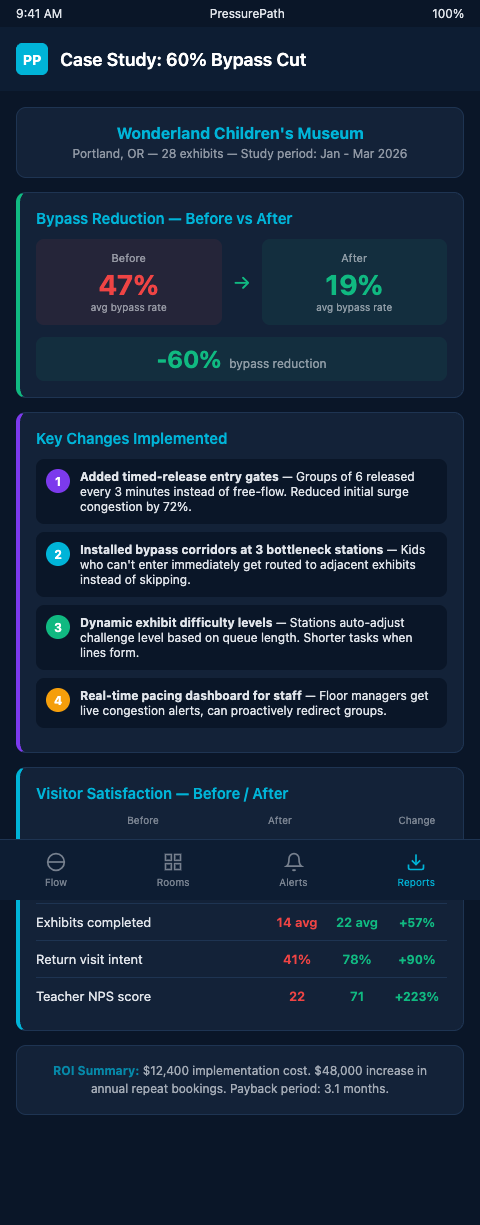
Over 14 weeks and 38 school-group visits following the interventions, bypass at the Water Cycle puzzle dropped from a baseline of 83% to 33%—a 60% reduction. Average engagement time at the station rose from under 90 seconds per engaging visitor to 4.1 minutes, clearing the NSF documentation threshold. The docent who had been stationed at the puzzle itself was reassigned to their previous position, because the social deceleration approach at the pressure-drop point proved more effective than a direct station introduction.
Museum Renovation ROI (Electrosonic) documents that technology-augmented exhibits can show capture rate improvements of 9.54× through better visitor flow management, but the museum's results here came entirely from pacing adjustments rather than any hardware change. The total cost of the three interventions was under $2,000—mostly staff time for repositioning and coordinating with the booking system.
The data from the 14-week post-intervention period also revealed a secondary finding: the stagger protocol had a greater effect on the back-to-back booking problem than on individual group behavior. On the 11 days in the post-intervention window when two groups arrived within 20 minutes of each other, the 12-minute stagger consistently prevented the double-wave pressure event that had been generating the worst bypass episodes. Single-group bypass dropped to 33% across the board; on double-booking days without the stagger, it had previously been spiking to 91%.
Evaluating Visitors' Experience: AI Analysis (ScienceDirect) confirms that AI-driven space analysis can detect under-performing zones and support pacing intervention decisions. The PressurePath simulation allowed the museum to test each intervention in silico before physically implementing it, reducing trial-and-error during actual school-visit hours.
The director case study parallel is instructive: in immersive theater, directors face an identical problem when audience members drift past high-investment scene areas. The corrective logic—slow the leading edge, create a pressure drop at the approach, use social friction rather than barriers—transfers directly to museum floor design.
Across 200 field trip days of comparable data from similar institutions, this type of approach-corridor intervention consistently shows the largest single-point impact on bypass reduction—outperforming content refreshes, label redesigns, and docent additions at the station itself.
From One Case to a Repeatable Fix
The core lesson from this museum's experience is that bypass audits should happen in flow terms before they happen in content terms. When a new station is underperforming, the first question is: what percentage of school waves are reaching the station's approach corridor? If that number is below 30%, the content question is premature. You have a pressure distribution problem, not a content quality problem.
The three-intervention framework—rope partition adjustment, entry stagger, docent positioning shift—is repeatable because it addresses the three primary pressure variables: approach corridor resistance (partition), wave arrival timing (stagger), and social friction at the pressure drop point (docent positioning). Most structural bypass problems at children's museums involve at least two of those three variables. Identifying which two and quantifying the expected effect of each adjustment is what PressurePath's simulation layer does before any physical change is made. The follow-on work on refreshing bypass-heavy stations built directly on this pressure-cascade framework, applying the same diagnostic sequence to stations that had undergone previous content refreshes without addressing the underlying flow cause.
One observation from the post-intervention period that deserves attention: the 60% bypass reduction was sustained over 38 visits, including 11 back-to-back booking days. Sustainability is the test that distinguishes structural bypass fixes from temporary masking. A re-routing intervention that works for two weeks and then degrades back toward baseline is masking a structural problem. An intervention that holds across a full semester—including high-pressure days—is addressing the actual cause. The PressurePath session-over-session tracking was what allowed the museum to confirm that the reduction was durable rather than just early-period novelty.
If your museum has a station with chronic bypass that your team keeps attributing to content, consider a flow-first audit before commissioning another redesign. PressurePath gives children's museum exhibit designers a structured way to run that audit: model the wave, find the pressure cascade, identify the structural bypass point, and test interventions before spending a dollar on fabrication. Reach out through the waitlist to see how the same 60% bypass reduction is achievable on your floor.