Pacing Simulators vs Usher Instincts: Where Each Wins
Night 47: The Usher Who Knows
An experienced usher on night 47 of a long run has seen the Act 2 corridor cluster form at 9:14 PM for six weeks straight. They position themselves at the Scene 8 entry twenty minutes early. They redirect the first cluster with a gesture before it becomes a crowd wall. They know from the previous night that the drawing room runs hot on Fridays and cool on Thursdays. Their body is the algorithm, and it is well-calibrated for this specific show on this specific night.
Now consider night 1 of a new production. The ushers have done the venue walkthrough and attended tech notes. They know the rooms and the rough scene sequence. But they have never seen this audience in this show — they do not know that Scene 6 in the garden will consistently overload at minute 18, or that the corridor between Scene 3 and Scene 5 creates a dead-end clustering effect every time more than 30 viewers enter that section. They are working on instinct without data. Their instinct is good — but the structural patterns are invisible until they have happened enough times to be learned.
Mastering Crowd Control: Event Ushers (Emora) identifies ushers' primary strengths as real-time judgment, verbal de-escalation, and responsive repositioning — capabilities that simulators cannot replicate. Self-Organized Pedestrian Crowd Dynamics (INFORMS) documents precisely where predictive models break down under live conditions: when crowd behavior diverges from the aggregate patterns the model was trained on, human judgment recovers faster than any recalibration cycle.
These are not arguments against simulation. They are arguments for understanding what simulation actually does and does not provide.
The framing question that most productions ask — "should we use a simulator or trust our ushers?" — is a false dichotomy that produces the wrong answer regardless of which option is chosen. A production that relies exclusively on simulation produces excellent structural predictions but struggles when live conditions deviate from model inputs. A production that relies exclusively on usher instinct learns everything it knows through live performance at audience expense. The useful question is not which approach to choose but how to design the boundary between them.
Where Simulators Win, Where Ushers Win
The division of competence between pacing simulators and usher instincts is not about sophistication — it is about time horizon and pattern scope.
Simulators win on structural pattern detection. A flow model like PressurePath runs the production across hundreds of simulated performance cycles before the first preview, identifying which scenes chronically overload, which corridors create bottleneck effects, and which act transitions carry the highest drift risk. Pathfinder Crowd Movement (Thunderhead) and uCrowds demonstrate that pre-event simulation surfaces bottlenecks and density patterns that human observers cannot evaluate before the show opens. An experienced usher reaches the same structural knowledge — but only after 30 to 50 live performances. Simulation compresses that learning curve to zero.
Simulators win on pre-show deployment planning. Where to position ushers, which scenes need deck supervisor coverage, which corridors need hold protocols — these decisions made before doors open determine the floor from which instinct must operate. A deployment plan based on the PressurePath simulation gives ushers a structurally optimal starting position. Instinct then operates from that optimized starting point rather than from an unexamined default. The difference is not whether ushers use judgment — they always do — but whether that judgment is applied from a well-calibrated baseline or from an arbitrary one. A PressurePath deployment map gives every usher a starting position calibrated to that night's predicted pressure pattern. The starting position is not a constraint on instinct; it is the platform from which instinct operates most effectively.
Ushers win on real-time anomaly response. A cluster forms at an unexpected location because a scene ran long and a corridor audience pivoted unexpectedly. The flow model did not predict this because it requires inputs — actor performance variance, audience composition — that cannot be modeled for any individual night. An experienced usher at that location redirects before the cluster becomes a crowd wall. Mastering Front of House in Theater (Number Analytics) argues that a culture of FOH accountability is critical precisely where live crowd variability exceeds model predictions.
Ushers win on interpersonal navigation. Verbal de-escalation when a viewer refuses a redirect, managing accessibility needs mid-show, reading group dynamics within a cluster — these require human judgment at a social and emotional resolution that no simulation addresses.
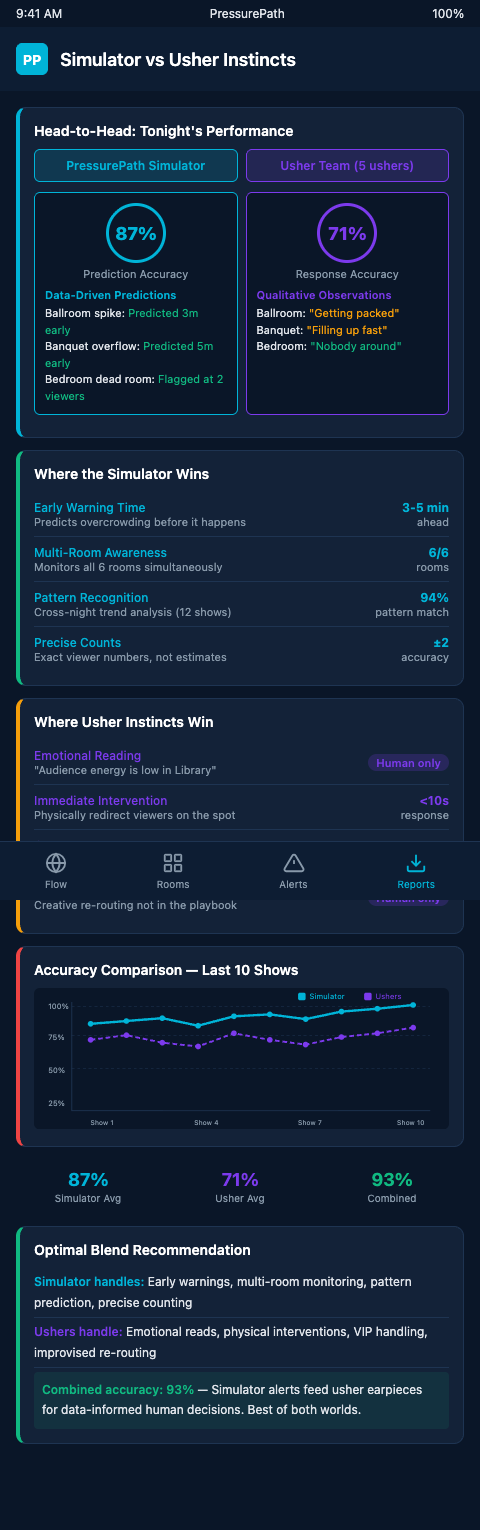
Immersive trends in 2024 (Blooloop) document that automated flow tools in scaled immersive productions are augmenting human judgment rather than replacing it — the productions using simulation most effectively are those where ushers and simulators operate in distinct domains with clearly defined handoffs. The call sheet modeling approach puts the simulator's structural predictions into the documents ushers use, creating a natural integration layer.
Advanced Tactics: Designing the Handoff Protocols
The breakdown happens at the handoff: when do ushers trust the deployment plan and when do they override it? Productions without explicit handoff protocols default to one of two failure modes — ushers who override the plan on instinct regardless of conditions, making the deployment plan irrelevant; or ushers who follow the plan rigidly through a live anomaly that the plan did not anticipate, producing a crowd wall the simulation predicted would not form.
The handoff protocol is a short written document — one page per scene — that every usher carries during the running show. It specifies the nominal deployment position, the three override conditions, the SM communication procedure for each override (does the usher report before acting or act and then report), and the return-to-nominal condition that signals the anomaly has passed.
Writing handoff protocols requires the production to make explicit decisions that are otherwise left to usher discretion: how much deviation from the deployment plan is acceptable before reporting, whether ushers have independent redirect authority or only advisory authority, and whether two ushers can coordinate a spontaneous response to an anomaly without SM approval. These decisions should be made in tech, not in the moment when a 42-viewer cluster forms at Scene 9 at 9:22 PM on opening night.
The deployment plan itself improves with each night of data. After five performances, PressurePath's post-show deviation logs identify which positions were in the right location but wrong timing, which positions never engaged their override conditions, and which positions had high override frequency — suggesting the nominal position was incorrectly assigned. Systematic deployment improvement is only possible when deployment assignments were documented to begin with; improvised usher positioning cannot be improved because it was never recorded.
Explicit handoff protocols define the override threshold. An usher's deployment position is nominal until one of three conditions triggers: the zone headcount exceeds the pressure threshold by more than 20%, a viewer requests intervention, or the corridor visibility drops to near-zero. Any of these conditions activates the usher's discretionary authority and they respond without waiting for SM direction.
The sim vs docent instinct comparison in museum settings maps nearly identical dynamics — docents have deep exhibit knowledge but limited structural pattern visibility, exactly mirroring the usher competence profile. The hybrid model's success in museum contexts confirms the framework applies across venue types.
Proven Crowd Control Techniques (Fielddrive) describes the hybrid approach directly: simulation for pre-show deployment, human instinct for unanticipated behavior in-show. This is not a compromise between two approaches — it is the correct assignment of each tool to the domain where it performs best.
PressurePath generates pre-show deployment maps, pressure-threshold alerts, and post-show deviation logs that feed back into the next night's deployment plan. The director case study demonstrates what the full hybrid system looks like at scale across an extended run.
Build the Hybrid System Before Previews
Productions that wait until previews to evaluate whether simulation or instinct is working have already burned several performances of learning time. The hybrid framework — simulation setting deployment, instinct managing anomalies, explicit handoffs defining the boundary — installs cleanly during tech when both the flow model and the usher team are being calibrated simultaneously.
The tech week installation sequence has three components. First, the simulation output generates the initial deployment map: which ushers stand where, which corridors need coverage, which scenes need deck supervisor presence. Second, the usher team walks the deployment map with the production manager and confirms that each position is physically workable — that sightlines from each station support the intervention the position is assigned to execute. Third, the handoff protocol document is distributed and reviewed in a single team meeting, establishing shared language for override conditions and SM communication procedures. This three-component install takes half a day during tech and produces a deployment plan that is ready for the first preview rather than being discovered through trial and error during the first week of performances.
One additional calibration step worth noting: the production should run a single performance of the deployment plan as a dry run — ideally the invited dress rehearsal — during which ushers execute the plan without acting on the override conditions. The dry run lets the SM observe which positions are overloaded, which are underused, and which override conditions fire more or less often than the simulation predicted. Adjustments made after the dry run are based on live-performance observation rather than simulation output alone.
Immersive theater producers and FOH managers who want their experienced ushers operating at full effectiveness from night one — not night thirty — need deployment plans that encode structural pattern knowledge before it has been earned in live performances. Join the PressurePath waitlist for pre-show deployment tools built for immersive FOH workflows.