How to Audit Your Photo Op Flow Without Camera Installations
Why the Photo Op Creates the Last Bottleneck Every Time
Research on theme park photography systems confirms that photo stations at ride exits create secondary bottlenecks, as documented in INFORMS operations research on managing capacity at theme parks. The pattern is consistent: guests exit the primary experience, cluster at the photo moment, and create a density spike exactly where the venue needs the space clear for the next group.
At a 10-room franchise, the photo wall operates as the last shared asset in the session pipeline — downstream of the room exit, upstream of the lobby departure. When three groups exit parallel rooms within a 12-minute window and all three queue at the same photo wall, the backup isn't just a guest experience issue. It's a reset blocker. The reset team can't begin staging the next cohort's arrival while the prior group is still occupying the corridor between the room exit and the photo station.
PMC research on crowding around photo sales areas found that crowding at exit photo zones disrupts guest experience and reduces intent to revisit. For escape room franchise operators, that correlation between exit photo backlog and review quality is observable without camera data — it shows up in comment card language and star ratings that cluster around Saturday afternoon sessions.
The audit challenge is that most operators don't have camera installations at the photo wall. They can't pull timestamped footage to measure dwell time by group. What they do have is booking data, session completion timestamps, and game master observation logs.
The No-Camera Audit Methodology
A structured audit of photo op flow without cameras starts with exit reconstruction. Your booking system records session start times. Your room completion logs (or GM timestamps) record when each group exits. The gap between those two timestamps is your session duration. Apply your known photo op dwell time average — typically 3–6 minutes per group at a small franchise, 5–10 minutes for groups of 6+ — and you can reconstruct the photo wall queue depth for any Saturday window.
The methodology mirrors what hotel exit-pattern analytics research from RoomRaccoon documents: exit-pattern data from booking systems can reconstruct guest flow without cameras when combined with known service time parameters. For escape rooms, the service time parameter is photo dwell — and that can be estimated from your GM observations without precision instrumentation.
Think of the photo wall as the terminal discharge point in PressurePath's pipe network. Every room upstream pushes fluid (groups) toward this single exit node. When upstream rooms discharge simultaneously, the terminal node receives a pressure surge. The no-camera audit reconstructs that surge from booking data: if rooms 3, 5, and 7 all completed within a 12-minute window on last Saturday, you know the photo wall received three groups simultaneously. Your average dwell time tells you how long the backup lasted.
The mystery guest methodology adds a qualitative layer. Action Audit's research on mystery guest audits documents how this approach captures authentic timing and flow data without surveillance infrastructure. A designated staff observer — or a mystery shopper — stationed near the photo wall during two or three peak Saturday sessions can timestamp actual group arrival at the photo station, dwell duration, and departure. Three sessions of structured observation produces enough data to calibrate the booking-data reconstruction model.
ResearchGate's academic evaluation of mystery shopper methodology confirms it as a structured, cost-effective service monitoring approach. The key is structured timestamps rather than impressionistic notes — a clipboard with six fields (session ID, photo wall arrival time, group size, departure time, queue depth observed, reset team arrival time) produces actionable data.
PressurePath incorporates photo op flow into its end-of-game pressure model. Input your room exit timestamps and photo dwell parameters, and the simulator flags which Saturday windows produce photo wall queues that overlap with the next cohort's scheduled arrival at the lobby. The output identifies whether your current photo station configuration is the bottleneck — or whether it's the symptom of a scheduling gap upstream.
A practical audit at a 10-room franchise typically surfaces 3-5 Saturday windows per week where the photo wall acts as a terminal pressure node absorbing discharge from 3 or more parallel rooms within a 10-minute span. Each window generates a 5-9 minute standing queue at the wall, and that queue bleeds upstream into the corridor for roughly 12 minutes before draining. Across 4 peak Saturdays per month, those windows compound into 60-80 minutes of corridor blockage that the reset team absorbs as delayed room entries. The no-camera audit quantifies this without any hardware purchase — you start with the booking timestamps you already have, add 30-60 minutes of structured GM observation, and the resulting dwell time distribution feeds the simulation as a calibrated pipe discharge rate.
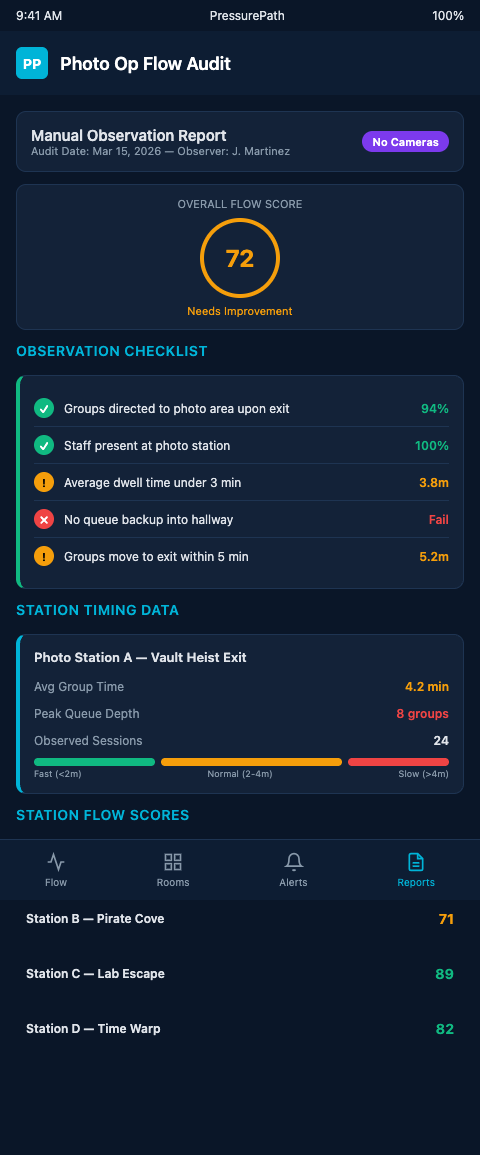
For operators who've documented photo op pile-ups, the no-camera audit provides the diagnostic data to determine whether the pile-up is a scheduling problem (too many parallel exits), a physical layout problem (photo wall too close to reset corridor), or a staff coordination problem (photo GM not cuing groups to move on).
Calibrating the Audit With Group-Size Segmentation
Photo dwell time isn't uniform. A 4-person group at the photo wall takes an average of 3.5 minutes. A 10-person group takes 7–9 minutes: more individual shots, more group configuration attempts, longer departure delay. When your booking grid mixes large and small groups in adjacent Saturday slots without accounting for photo dwell variation, the booking-data reconstruction model will systematically underestimate queue depth for large-group sessions.
Leap Event Technology's convention photo op documentation describes how group-slot systems eliminate bunching and cut photo wait times from 60+ minutes to under 10 — specifically by separating large-group slots from small-group slots rather than routing all groups through the same sequential queue. The principle applies directly to escape room photo walls: a tiered dwell time model, calibrated by group size, produces more accurate queue projections.
Data from 60,000+ group runs provides the aggregate benchmarks for photo dwell time by group size and room type that operators can use to calibrate their reconstruction model without needing their own historical data first.
For operators building a broader understanding of how performance auditing works across venue types, dead rooms audit methodology from immersive theater offers a parallel approach: structured observation over 30 performance runs to identify consistent flow failures without surveillance infrastructure.
Image Insight's automated photo tagging system documentation shows that timed screen releases tied to exit timestamps — the most sophisticated version of photo flow management — depend on the same exit-timing data that the no-camera audit reconstructs manually. If you ever invest in photo display automation, the audit methodology you build now becomes the data foundation for that system.
Running Your First Photo Op Audit This Weekend
Multi-room escape room franchise operators can run a no-camera photo op audit this weekend with a GM and a clipboard. Identify your three highest-volume Saturday slots, assign an observer to timestamp photo wall arrivals and departures during each session, and compare the observed dwell times to your booking-data reconstruction model. The gap between model and observation tells you exactly where your photo flow assumptions are wrong — and in most cases, the first audit reveals that large-group dwell times are 40-60% longer than the averages operators carry in their heads.
That single correction changes which Saturday windows the pacing model flags as high-pressure and which it clears as safe. PressurePath incorporates corrected dwell time parameters into its Saturday pressure model, so your next booking grid review reflects accurate photo wall load rather than assumed averages. If your Saturday afternoons consistently produce photo wall backups that delay reset starts, join the waitlist — the photo op flow analysis is built into the core pacing simulation.