Photo Op Pile-Ups: Why the Last 90 Seconds Matter Most
The Exit Experience Is the One That Gets Remembered
Your guests just escaped "Reactor Core" with 4 minutes left on the clock. They're elated. They want the photo. They walk out of the room, through the corridor, turn the corner — and find two other groups already queued at the photo wall, one of them mid-session with props still being arranged. The queue will take 9 minutes. Their high is already fading.
Kahneman's peak-end rule — documented in its original formulation on Wikipedia and extended in empirical research published on ResearchGate — establishes that people judge an experience by two moments: the peak intensity moment, and the final moment. For escape room groups, the peak moment is the puzzle solve or the escape itself. The final moment is the photo op exit.
A 9-minute photo queue doesn't erase the room experience. But it significantly downgrades the memory of it — because the final moment is now "waiting in a line," not "celebrating our escape." And that memory is what drives the review, the rebooking, and the social share.
The Decision Lab's CX analysis of peak-end framing notes that practitioners who've applied peak-end thinking to service design consistently find that the exit touchpoint is the highest-leverage moment for loyalty impact. Your photo wall is not decoration — it's a loyalty driver, and it's failing you every time a queue forms.
The Flow Mechanics Behind Photo Op Congestion
A photo wall that takes 4 minutes per group can handle 15 groups per hour — 1 group per 4 minutes. If your 10-room franchise completes 3-4 rooms within any 15-minute window during peak Saturday hours, and those rooms all converge on the same photo wall, you have 3-4 groups arriving in 15 minutes while the wall can only clear 3-4 groups in 15-16 minutes. That's a utilization rate of 94-100% — and at that level, queueing theory predicts non-linear queue growth from the slightest variation in photo session time.
A group that takes 6 minutes at the photo wall instead of 4 — because they brought more people, because they wanted multiple shots, because the host encouraged additional prop arrangements — creates an 8-minute lag that reverberates through the next 60 minutes of photo wall demand. Two such sessions in a row and you have a structural queue that won't clear until the booking wave ends.
This is the same pressure-in-pipes dynamic that operates at every shared asset in your franchise. The photo wall is a narrow-diameter pipe receiving high-volume flow during peak hours. When the inlet rate (group completions) temporarily exceeds the outlet rate (photo session throughput), pressure accumulates — and it takes significantly longer to drain than it took to build.
ROLLER's research on end-to-end guest experience specifically identifies exit flow as critical: smooth exits improve overall guest perception disproportionately, and venues that design exit flow deliberately report meaningfully higher satisfaction scores than those that treat it as an afterthought.
QueueAway's hospitality queue statistics add a behavioral dimension: wait-time perception matters more than actual wait duration, and exit queues feel worse at the end of high-emotion activities than they would in a neutral context. Your guests aren't neutral when they hit the photo wall — they're at peak emotional activation. A 9-minute wait at that moment feels like 20.
PressurePath models photo wall congestion as part of the post-game flow simulation. When you load your Saturday booking grid, the simulator calculates the photo wall arrival rate for each 15-minute window based on room completion distributions, flags every window where utilization exceeds 85%, and identifies the 2-3 booking slots whose start-time adjustments would most reduce photo wall congestion during peak hours.
The pressurized pipe analogy becomes concrete at the photo wall junction. Each room upstream is a segment of pipe discharging groups into a single terminal node. When three rooms discharge within a 9-minute window, the terminal node receives roughly 3 groups per 9 minutes, or 20 groups per hour — which exceeds the photo wall's 15-group-per-hour throughput by 33%. That overflow doesn't vanish; it accumulates as standing pressure in the corridor leading to the wall. A 10-room franchise running six parallel peak sessions with mixed group sizes typically generates 2-3 such overflow windows per Saturday, clustered between 2:30 PM and 4:00 PM. Each window costs 6-9 minutes of guest exit friction, and those minutes compound into the photo wall's structural queue that doesn't drain until the booking wave ends around 5:30 PM.
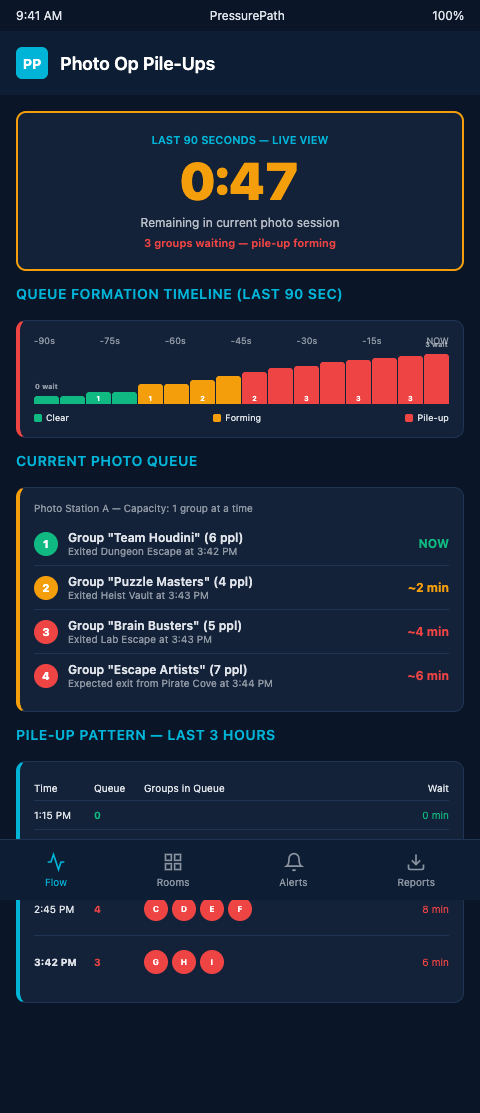
The photo op audit methodology provides a manual version of this analysis — using host observation timing and booking log timestamps to reconstruct the photo wall arrival rate without any new hardware. That audit gives you the baseline data that PressurePath then models forward.
Structural Fixes for Photo Op Pile-Ups
The most effective structural fixes operate on the inlet side, not the photo wall itself.
Stagger the rooms that complete within the same 15-minute window. Identify which room clusters consistently complete in the same 15-minute band during your peak Saturday wave and offset one of them by 5-8 minutes. This doesn't reduce throughput — it shifts the photo wall inlet rate from a 3-group burst to a 2-1-2 distribution, which the wall can clear without queuing.
Create a secondary staging zone. If your physical layout allows it, designate a corridor segment as a "decompression zone" where groups wait before the photo wall, with visual entertainment (a scoreboard, a mural, a prop display). Groups perceive the wait as part of the experience rather than a queue. QueueAway's retail exit flow research documents that venues using self-serve elements at exit queues see up to 40% of guests bypass the queue entirely — and the staging zone equivalent produces similar perception improvements without throughput changes.
Set photo session maximums by group size. Larger groups take longer at the photo wall — not because they're slower, but because they generate more arrangement combinations. A booking-level flag that routes groups over 7 players to a larger photo wall area, or schedules them with a 5-minute photo buffer instead of 4, prevents the variance that creates the cascade.
The reset station backlog dynamics in 8-room franchises operate through the same structural logic: shared assets that receive variable-rate inputs from multiple sources need inlet rate management on the upstream side, not just throughput optimization at the asset itself.
The audience gating techniques between acts apply a formalized version of this inlet management — holding audiences in a controlled pre-transition zone to prevent simultaneous convergence at the next stage — and the principle adapts directly to post-game photo wall management.
Xola's post-2020 industry data documents private bookings as the dominant format for escape room experiences — which means your photo wall is not a nice-to-have amenity, it's a core product deliverable for the private group that booked your experience as a social event. A pile-up there isn't just an operations problem. It's a product failure.
Claim Your Operator Spot
If you operate a multi-room escape room franchise and your photo wall regularly generates queues during Saturday peak hours, PressurePath can show you exactly which booking slots are causing those pile-ups and what 3-5 minute adjustments would prevent them. Join the waitlist — we're specifically onboarding operators who've identified photo op congestion as a recurring guest satisfaction issue.
The photo op flow analysis models your photo wall as a terminal node in the pressure pipe network and calculates its arrival rate from every upstream room's completion distribution. The output identifies the 2-3 booking slot clusters that generate the highest photo wall congestion each Saturday and recommends specific start-time offsets for the upstream rooms feeding those clusters. Operators who implement the recommended adjustments typically eliminate the structural photo queue entirely during peak hours, converting the exit experience from a wait into the celebration moment it was designed to be.