How Casino Hosts Track Emotional-Labor Debt With Gardens
The VIP Host Who Logged No Overtime
The casino host on the Caribbean megaship finished an 11-day voyage with three high-roller guests who had required near-continuous attention — dinner companions, shore excursion escorts, late-night drinks, morning coffee check-ins. Her shift timesheet showed 8.5 hours per day, fully compliant with MLC rest requirements. Her tip reports were excellent. Her guest-feedback scores were perfect. Eleven days after disembarkation she called her regional manager and cancelled the next three contracts on her rotation. The manager read her timesheet, found nothing flagged, and logged her as "personal reasons."
Hochschild's foundational work on emotional labor in The Managed Heart coined the term for exactly this dynamic — the performance of managed feeling that depletes the worker in ways the clocked-in hours don't capture. Casino hosts live inside this dynamic at higher intensity than most hospitality roles. The Anatolia study on work stress antecedents among casino dealers links job insecurity and work-family conflict to burnout and depression. The International Journal of Hospitality & Tourism Administration study on casino dealer incivility found uncivil customer interactions trigger maladaptive coping and persistent emotional-labor debt that compounds across shifts.
The casino environment concentrates three emotional-labor compounding factors that most cruise beds experience only individually. First, hosts must maintain a continuous affect of warmth and attention under conditions where guests are often losing money — a baseline loss aversion that translates into guest-directed frustration the host absorbs. Second, the guests with the heaviest host attachment are also the ones whose gambling intensity puts them in the highest emotional states, amplifying the host's absorbed load per hour with that guest. Third, the gaming-floor calendar has no cruise-day off — unlike specialty dining which has dark nights, or cabin-service which has port-day reductions, the casino runs every night the ship is at sea.
The host's timesheet was accurate. The timesheet was also the wrong lens.
Emotional-Labor Debt As a Shadow Garden
Verdant Helm models emotional-labor debt as a shadow garden running underneath the schedule garden. The schedule garden shows clocked hours, section assignments, and breaks. The shadow garden shows performed-feeling intensity per guest interaction, aggregated per perennial, across the voyage. A host clocked for 8.5 hours against three VIP guests has carried a very different load than a host clocked for 8.5 hours against 40 casual players — and the shadow garden renders that difference.
The ResearchGate Macau casino dealer study found emotional-labor overload drives turnover intention, which matches the Caribbean host's pattern exactly. The SAGE review of 15+ years of emotional-labor research since Hochschild confirms the construct extends cleanly from restaurant servers to service-industry frontline workers including gaming staff. The debt is real, measurable, and currently invisible on most cruise operations.
The difficulty in making it visible isn't technical — the instrumentation for wearable-based fatigue and state monitoring has been available for years. The difficulty is cultural. Casino teams historically pride themselves on performing unflappably regardless of internal state. "Never let them see you tired" becomes an informal team norm. Verdant Helm's shadow-garden rendering works within that norm rather than against it: the reading stays private to the perennial and the pit manager, doesn't appear on team-wide leaderboards, and produces actionable recommendations rather than public judgments. The goal is to make the debt operable without forcing cultural change the team isn't ready for.
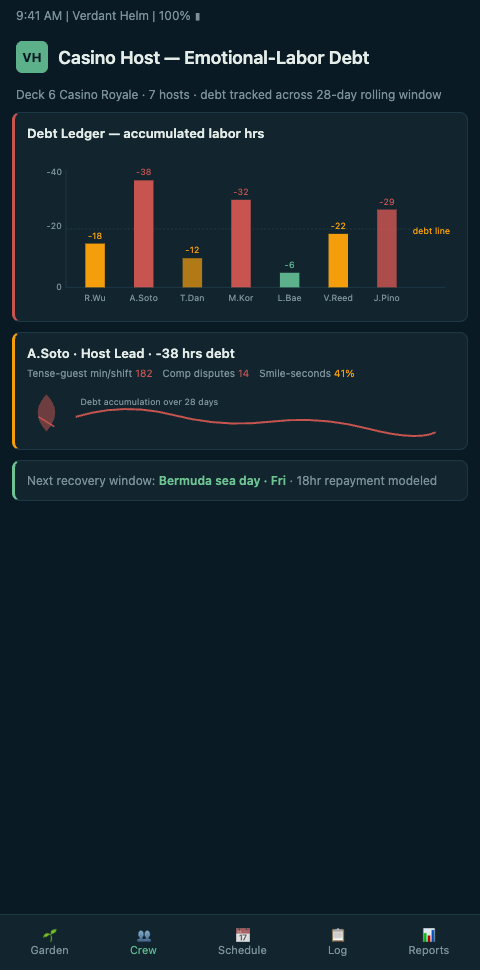
The shadow garden builds three debt streams per host or dealer. First is surface-acting hours — the hours where the perennial performed feeling that didn't match internal state. Deep acting is sustainable. Surface acting is not. Verdant Helm reads surface-acting intensity from behavioral proxies: end-of-shift energy-reading delta from predicted, post-shift social-withdrawal signals, next-shift start-state depression relative to baseline. Second is guest-intensity weighting — each logged guest interaction carries an intensity score based on guest profile, session duration, and complaint-load history.
Third is contract-phase compounding. The PMC narrative review of occupational exposures among US casino workers notes shift-related hazards compound over time, and cruise casino contracts run long — the JobMonkey description of shipboard casino staff work confirms Caribbean-run hours stretch across multi-month contracts. A host in month six of contract rotation carries shadow-garden debt that accumulates faster than in month two. The compounding stream captures this phase effect.
When the three streams combine, the shadow garden produces a debt reading per perennial expressed in recoverable units. A host carrying 42 debt units is in a bed that will wilt within two voyages. A dealer carrying 18 debt units is sustainable for another full voyage without intervention. The units make the invisible measurable, which is the necessary precondition for making it actionable.
The botanical frame is load-bearing here. Numeric dashboards that show "emotional labor index: 78" trigger management fatigue — the number feels like yet another KPI to track. A perennial visibly wilting in a shadow bed triggers a different response. The wilt reads as physical, even though the physicality is metaphorical. Managers who see the wilt act. Managers who see a number usually don't.
Verdant Helm's shadow garden runs as a second layer on the existing casino ops dashboard, not as a replacement. The pit manager still sees table coverage, game volumes, tip reports. Beneath those, he sees debt distribution across his named staff, with wilt flags on perennials approaching recovery thresholds. The two views coexist — ops above, shadow below — and the pit manager reads them together when deciding who to put on which VIP that night.
Advanced Tactics for Shadow Garden Management
The shadow view privacy-protects the individual perennial. Raw surface-acting readings carry sensitivity — they describe internal emotional state the crew member may not want peers to see. Verdant Helm renders shadow-garden data at two layers of fidelity: the pit manager sees perennial-level debt readings for operational decision-making, while peers see only aggregate bed-level conditions. The crew member viewing their own reading sees the full picture. This three-tier access respects the dignity of the emotional-labor data while keeping it operationally useful. The same tiered-access pattern appears in the bar manager crew-fatigue cheat sheet for bar team surface-acting data.
Three tactics extend the shadow garden into concrete pit-floor decisions.
The first is guest-handoff coordination with F&B and bar teams. A VIP guest absorbing three hours at the casino before moving to a specialty dining venue drains two shadow beds sequentially. The F&B waitstaff rotation playbook details the rotation that prevents the post-casino dinner shift from landing on already-depleted servers. Verdant Helm orchestrates the handoff so the debt spreads rather than concentrating.
The second is SOV-pattern transit-cycle learning. The offshore wind SOV masters transit-cycle playbook describes how offshore vessel masters track recovery across repeated transit cycles. The same mathematical pattern — sustained intensity followed by partial recovery, repeated across a contract — governs casino host shadow debt across repeated VIP engagements. Verdant Helm ports the SOV transit-cycle model into the casino bed, with hospitality-specific tuning.
The third is surface-to-deep conversion tracking. The ScienceDirect cross-level hotel study found deep acting boosts service quality while surface acting degrades it. Verdant Helm tracks which hosts and dealers sit in which mode across specific guest types and proposes assignment patterns that keep perennials in deep acting as long as possible — a long-term strategy for reducing shadow debt at its root rather than only managing the depletion.
A fourth tactic disentangles emotional-labor debt from tip earnings. Casino hosts and dealers often carry a cultural association between "good night" (high tips, strong engagement) and "healthy perennial" — the assumption being that a host making strong tips must be thriving. Verdant Helm deliberately separates the streams. A host can be generating top-quartile tips while simultaneously accumulating top-decile emotional debt. The co-occurrence of high earnings and high debt is specifically how the Caribbean host arrived at her 11-day cancellation — she was rewarded right up to the breaking point because the reward system didn't see the debt.
Run the Shadow Reading Against One Voyage
Pit managers and Hotel Directors who want to see their casino's shadow garden should pull the last VIP-heavy voyage and let Verdant Helm reconstruct the three debt streams for each named host and dealer. The reconstruction runs against existing shift logs, tip reports, and guest-profile data — no new instrumentation required for the first pass. The shadow reading that comes out usually surfaces one or two perennials carrying more debt than the pit manager knew, and the contract-phase compounding usually flags the specific staff member heading toward the Caribbean host's 11-day cancellation path. One voyage, one reading. Start there, decide whether to extend coverage across the full casino team.
The conversation that follows the reading is the hinge. A pit manager handed a debt chart for his top-earning host will instinctively default to "but her numbers are strong" — the same reward-signal the regional manager used to log the Caribbean host's exit as "personal reasons." The Hotel Director has to walk the pit manager through the decoupling: top-quartile tips and top-decile debt are compatible, and the debt is what ends the contract. Once the pit manager accepts the decoupling, the rotation decisions that follow are straightforward.
The host with the three highest-intensity VIPs gets off late-night floor duty for two voyages. The dealer with accumulated contract-phase debt gets paired with deep-acted peers on the busiest table rather than solo assignments. Cruise HR Leaders should read the shadow-garden output alongside the next contract-renewal window so they can intercept the exit decision before it forms. The Caribbean host would have been retained had the reading been in the pit manager's hands two voyages earlier. That is the value the first reading exposes.