A Bar Manager's Cheat Sheet for Reading Crew Fatigue
Three Tells in 90 Minutes
The bar manager at the Schooner Bar on a 2,900-guest vessel sailing the western Mediterranean watched his senior bartender — 11 years on ships, two months into a 217-day contract — deliver three tells inside a single Tuesday afternoon service. The jigger swap between gin and vodka got skipped on a Negroni, a regular guest asking about tonic selection drew a snapped "same as last time," and a Mai Tai recipe that the bartender could assemble blindfolded came out short on orgeat. The service window was 90 minutes. The tells were the bar equivalent of a cabin steward skipping a mini-bar audit.
The senior bartender would not fill out a fatigue survey honestly. The craft culture does not permit it. Industry writing on bartender burnout is direct about the pattern — the best bartenders hide fatigue behind muscle memory until muscle memory cracks. On cruise ships, the hiding is reinforced by the contract economics. A PMC survey of bartenders found workplace violence exposure and pressure to drink during shifts, and cruise bars layer emotional labor on top — repeat guests, destination-wedding groups, and late-night disputes. Tales of the Cocktail's analysis puts long hours, emotional labor, and loss of control as the three pillars of bar burnout. All three are elevated on ships.
The bar manager does not need another survey. He needs a cheat sheet that reads the tells already happening in his bar.
The Bar as a Perennial Bed
Treat the bar team as a bed of perennials that bloom in service shifts. Each bartender has a bloom cycle — an opening ramp, a peak, and a wind-down. Verdant Helm's bar cheat sheet watches three leaves of the plant. The first is output variance: drinks-per-hour relative to each bartender's own 30-day baseline, not a fleet average. The second is the recipe-fidelity read: specific SKUs where the error rate spikes (orgeat in Mai Tais, bitters count in Old Fashioneds, sherry volume in Negronis). The third is the guest-interaction tone read, aggregated from peer observations and complaint logs, never from a single incident.
When all three leaves wilt in the same week, the bartender is not having a rough day; the bed is drying. When one leaf wilts in isolation, it is often a schedule or craft issue solvable in the next huddle.
The cheat sheet has six tells worth memorizing. First, missed jigger swaps between high-contrast spirits — a muscle-memory task that falls off first. Second, order truncation with regulars — the five-word response where a fifteen-word riff used to live. Third, SKU confusion on low-frequency pours — when a bartender who served 400 Manhattans last voyage reaches for sweet vermouth on a rye Manhattan. Fourth, eye-drift during guest conversation — a peer-observable cue that maps to emotional-labor depletion. Fifth, sudden change in shift-end clean-down time — either too fast (cutting corners) or too slow (can't transition). Sixth, break compliance drift — the bartender who used to take a clean 12-minute break is now taking 6 or 22.
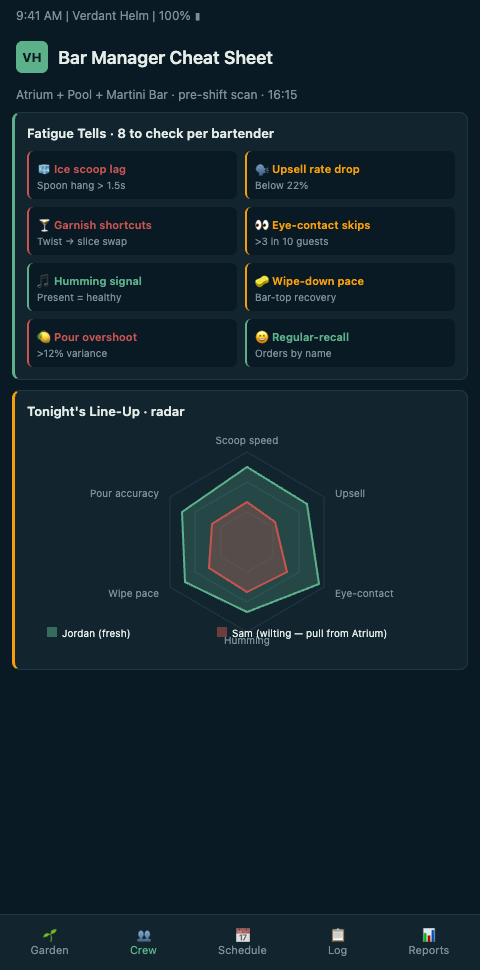
Verdant Helm captures these tells passively where possible. Output variance comes from the POS system; recipe fidelity comes from inventory reconciliation; break compliance comes from clock data. The two inputs that require human signal — guest-interaction tone and peer observation — use a rotating observer pattern so no bartender is ever identified by a named peer. Research on yacht crew burnout shows the same structural story as cruise bar teams: irregular shifts and passenger emotional demands drive the wilt, and the passive signals catch it before self-report does.
The cheat sheet is not a disciplinary tool. It is a gardening tool. When a bartender hits three tells in a week, the intervention is a prune — shift off the highest-labor bar (Schooner, Lido, Sky), route the next port day into a shoreside recovery window, and plant a fresher perennial into the bed for one voyage. When the pattern reverses in the following week, the bed is back in bloom. When it does not, the next intervention layer is a longer recovery rotation. Academic work on burnout, engagement, and coping in service employees finds that coping strategies mediate burnout outcomes — meaning the bar manager's intervention choice, not just the workload, determines whether the bed recovers.
Scaling the Cheat Sheet Across Bars
The first scaling move is to calibrate per-bar. The Schooner Bar, the Sky Bar, and the Champagne Bar all pull different emotional-labor profiles even within the same ship. The Schooner often hosts repeat guests on multi-cruise loyalty programs; the Sky Bar draws destination-wedding energy; the Champagne Bar runs high surface acting. Verdant Helm calibrates the fatigue thresholds per bar so a bartender's wilt score on the Schooner isn't compared directly against a Sky bartender. Without this calibration, the Schooner team reads chronically high and the Sky team reads chronically low.
The second move is to integrate the cheat sheet into the bar manager's pre-shift huddle, not a weekly report. The tells matter in real time. A bar manager who catches the jigger-swap miss in hour one of a five-hour shift can trade stations with a lighter bar for the remaining four hours and rescue the bloom. A bar manager who reads the report on Friday already lost three shifts. Verdant Helm surfaces the cheat sheet as a mobile view the bar manager pulls up during shift walk-through.
The third move connects bars to the broader guest-facing garden. Emotional-labor burnout patterns in guest-facing crew show up in bars with a two-week lead on stateroom attendant patterns because bartenders face the most concentrated emotional-labor bursts per hour.
When the bar team's wilt score climbs, the next wilt wave typically hits the excursion desk within two weeks. The excursion desk's burnout pattern runs on a similar cadence and often precedes guest-services complaints.
Reading the bar is reading the leading edge of the whole hospitality garden.
The adjacent parallel outside cruise is sharp. Roustabouts on offshore rigs log fatigue through task-variance and tool-handling cues that mirror bartender recipe-fidelity reads. The industry surface is different; the signal structure is the same. Both are craft roles where muscle memory masks depletion until a threshold breaks.
One edge case worth calling out: when the bar manager is the drained perennial. The cheat sheet reads the team; it does not read the manager. Hotel Directors and F&B leads should set a parallel read on bar managers themselves, because a wilted bar manager misses the tells in their team. That read lives one level up in Verdant Helm's role hierarchy and should be reviewed in the Hotel Director's weekly.
A second edge case is new bartenders entering their first contract. First-contract bartenders have no established baseline for output variance or recipe fidelity, so the wilt score calibration has to pull from a role-and-contract-stage reference curve rather than personal baseline until week four. Verdant Helm's onboarding module blends the reference curve with the bartender's emerging baseline so the score stays meaningful from day one without generating false positives during the learning curve. Bar managers who skip this calibration tend to over-flag first-contract bartenders in weeks two and three, eroding trust in the cheat sheet.
A third edge case is special-event bars — pool-deck party nights, gala dinners, sail-away events. The emotional-labor profile of a special-event shift is 2 to 3x a standard shift, compressed into two to four hours. Treating a special-event shift as a single data point in the wilt calculation under-weights the strain. Verdant Helm's cheat sheet scales the per-hour labor weight for event shifts based on guest count, music volume, and ticket-inclusive drink complexity. Bars that skip this scaling systematically under-read wilt on their most demanding nights — exactly the nights where the next voyage's exit-inquiry seed is planted.
The fourth and sharpest edge case is craft culture resistance. Senior bartenders are often the hardest to introduce to any fatigue-reading tool because the craft self-image rejects the premise that fatigue is observable externally. Verdant Helm's rollout model addresses this by positioning the cheat sheet as a rotation-and-rest tool owned by the bar manager, never as an individual scorecard. Senior bartenders who see the cheat sheet produce earlier shoreside rotations and better shift pairings typically convert to advocates inside the first four voyages.
For Hotel Directors and Cruise HR Leaders
Your bar managers already have the tells in front of them — they are reading jigger swaps and recipe fidelity in their heads without calling it that. What they do not have is a shared language and a rotation lever. Hotel Directors who adopt the cheat sheet and the weekly bar bed-state review see their F&B non-renewal rate drop inside two voyages; Cruise HR Leaders who pull the fleet view spot which bars are running as sinks season after season. The starting move is one ship and one bar. Run the cheat sheet for four voyages and compare the bar's wilt trajectory against its NPS contribution. The pattern will be obvious enough to change next quarter's scheduling logic.
The operating rhythm that makes the cheat sheet stick is a short pre-shift bar-by-bar walk — Schooner, Lido, Sky, Champagne, pool — by the bar manager with the cheat sheet open on his tablet. Two minutes per bar, reading the three leaves since the last shift, marking the bartender who needs the lighter station tonight. Hotel Directors should expect the bar F&B Director to show up to the weekly leadership huddle with the wilt trajectory for each bar, not just covers and spend-per-guest.
Cruise HR Leaders who treat the bar as a leading indicator for the rest of the guest-facing garden gain a two-week lead on stateroom and guest-services trouble; they also stop wasting the retention budget on signing bonuses for roles that would stay if the station rotation were sound. When the Schooner's senior bartender declines his month-six extension, the post-mortem should not start with compensation. It should start with the last four voyages of his output variance, recipe fidelity, and shoreside recovery days. That is where the decision was made.