Why Excursion Desk Staff Hit Empty Before Anyone Else Notices
The Desk That Nobody Was Watching
Two excursion agents on the Caribbean ship resigned within three weeks. Both had been promoted in the last 18 months. Both had 9+ prior contract tours. Both had glowing quarterly reviews three months before the resignation. The Hotel Director reviewed their rounds logs, their shift timesheets, their incident reports. Nothing flagged. Then she read the exit interviews and found the same line in both: "The desk has been drowning since the Mexico itineraries started."
The Mexico itineraries had added two port days per voyage with higher-than-average excursion bookings. The desk had absorbed the increase without a headcount change. The agents had absorbed the increase without a schedule change. The sign that appeared, week after week, was exhaustion that registered in the agents' bodies long before it registered in any dashboard the ship was running. By the time the quarterly review caught up, they were already mentally gone.
The MDPI cruise traveler service perceptions study found excursions rank among the lowest-satisfaction touchpoints across the cruise journey — meaning the desk staff absorb guest frustration at a higher baseline rate than most frontline beds. The All Cruise Jobs industry description of shore excursion roles reinforces that long standing hours, heavy port-day dispatch, and constant guest triage define the position. The combination produces early wilt that doesn't show in the standard metrics.
Excursion Desk As a Bed That Drains Faster
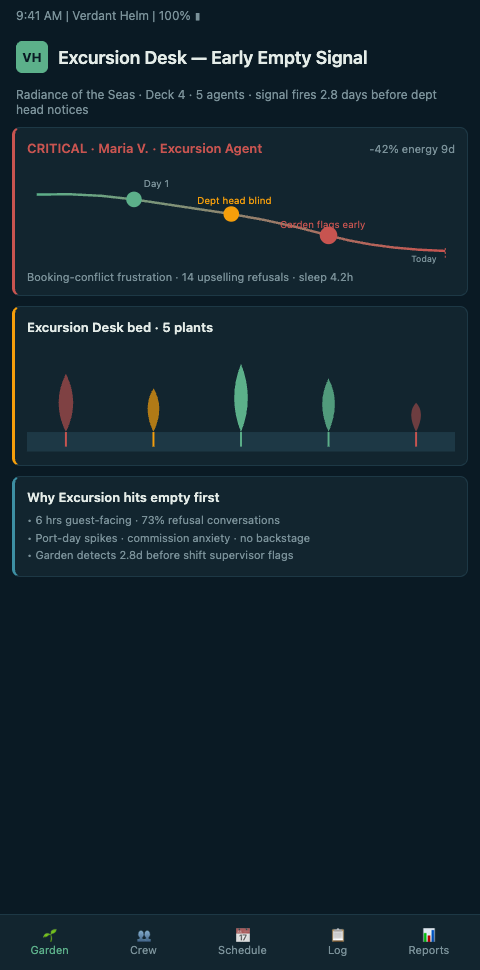
Verdant Helm models the excursion desk as a garden bed with structurally faster drainage than most other guest-facing beds. Four characteristics drive the early wilt. First is guest-frustration density — excursion bookings concentrate complaint load because shore itineraries can change for weather, berth availability, or tour-operator issues, and every change goes through the desk. Second is port-day amplitude — the desk runs near-idle at sea and full-intensity at port, so perennials planted there absorb a sawtooth load that the Frontiers research on role stress and frontline hotel turnover describes as structurally harder than sustained-level stress.
Third is the customer-incivility profile. The International Journal of Tourism Research study on customer incivility and turnover found that uncivil customer interactions and emotional labor jointly drive emotional exhaustion in hospitality — and the excursion desk absorbs a disproportionate share of uncivil interactions because guests who have had a disappointing shore excursion return directly to the desk. The ScienceDirect study on customer incivility and restaurant frontline burnout confirms the same pattern in F&B — desk work just concentrates it harder. Fourth is information asymmetry. Agents field guest questions they often don't have an answer to — tour operator behavior is outside their control — and the FIU Hospitality Review paper on role stress, emotional exhaustion, and job satisfaction documents that this kind of role-induced powerlessness precedes visible performance drops.
The garden view of the desk treats each agent as a perennial planted in unusually porous soil. Normal watering cadences that keep stewards or F&B crew green leave excursion perennials in dry soil by mid-voyage. The MDPI hospitality stress matrix classifies high-interaction desks as a distinct stressor category, which Verdant Helm reads as a distinct bed type rather than a variant of the generic guest-services bed.
The operational consequence is that the early-wilt threshold for excursion perennials has to be set lower than for other beds. A cabin steward showing 82% of baseline energy on day five of a voyage is on the normal voyage curve. An excursion agent showing 82% of baseline on day five of a heavy-port voyage is on an accelerated trajectory that will end in contract non-renewal if it repeats across three voyages. The same number means different things in different beds, and the garden view preserves the bed-specific reading rather than averaging it away.
Another structural feature of the excursion bed that compounds the drainage is communication fragmentation. Agents field guest questions on three different channels simultaneously — the walk-up desk, internal phone calls from guest-services referrals, and the ship's app messaging queue. A traditional rounds check might see "one agent at the desk, looks fine." The live load on that same agent could be three open conversations across three channels with different tempos. The garden view ingests the channel-level interaction data and surfaces the fragmentation load as a separate reading, because fragmentation drain is not the same as sustained-interaction drain.
Verdant Helm also models the compounding that spans voyages. An excursion agent finishing a heavy-port itinerary with energy at 79% of baseline doesn't return to 100% on turnaround day — typical return is 91-93% depending on the port-day recovery window. The next voyage starts from that depressed baseline. Over three consecutive heavy-port voyages, the agent can descend from 100% to 68% without any single voyage looking abnormal. The compounding view is the one the Hotel Director didn't have when she was reviewing the exit interviews.
The compounding also shows distinct signatures by itinerary type. Alaska itineraries run different port-load profiles than Caribbean loops — fewer, longer ports with heavier per-port guest engagement at the desk. Caribbean loops run more, shorter ports with faster guest turnover per port day. The compounding slope differs: Alaska itineraries produce a slower descent with occasional sharp drops on tour-operator incident days; Caribbean loops produce a steadier, smoother descent with less day-to-day variance but faster overall decline. Verdant Helm reads the itinerary and tunes the alert thresholds to the compounding signature that matches the ship's run pattern — integrating with the port-day recovery planning framework for the paired rebuild windows.
The botanical frame makes the bed-type difference visible in a way spreadsheet averaging cannot. An excursion agent at 82% looks "fine, slight dip" on a flat numeric dashboard. The same agent rendered as a perennial in a fast-draining bed looks distinctly amber next to green perennials in slower-draining beds. The visual forces the Hotel Director to read bed type and perennial together, which is the only reading that catches early wilt.
Advanced Tactics for Excursion Desk Protection
Three tactics specifically protect the excursion bed from the structural wilt.
The first is paired shoreside recovery. An excursion agent who has absorbed the port-day peak benefits more from a shoreside release on the following sea day than a sea-day nap. Verdant Helm ties excursion-agent schedules to the recovery-window engine, so the board shows the recovery block alongside the port-day shift for each agent.
The second is bar-venue load redirection. A guest who had a disappointing excursion often arrives at the bar before the desk — the pattern is well-documented in passenger research. The bar manager crew-fatigue cheat sheet explains how bar crew can absorb the initial frustration conversation, lowering the incivility load that reaches the excursion desk. The garden view coordinates the two beds so the bar manager's staffing reflects the port-day excursion profile.
The third is handover-signal protection from the offshore playbook. The handover-signal leak pattern shows how failing desk handovers compound load on the incoming shift. The same pattern applies to excursion desk handovers at 16:00 on port days — the outgoing agent often passes under-surfaced guest-complaint context to the incoming agent, who absorbs it cold. Verdant Helm structures the desk handover to surface the complaint-load context, which reduces the incoming-agent incivility exposure measurably.
A fourth tactic that matters for specific itineraries is tour-operator issue buffering. On some itineraries, specific shore-excursion operators have a track record of running late, overbooking, or missing promised inclusions. When those issues happen, the desk absorbs the complaint volume. Verdant Helm tracks operator-by-operator incident rates and flags when an upcoming port day will feature a high-risk operator. The Hotel Director can then pre-staff the desk with an additional agent during the high-risk window, or pre-position guest-services support to absorb overflow before it reaches the primary agent. The shift from reactive to anticipatory staffing reduces the agent-level absorption without changing the tour-operator contracts themselves.
Run the Cross-Voyage Compounding Report Once
A Hotel Director or Cruise HR Leader worried about excursion turnover can run a single diagnostic. Pull the last six voyages of excursion-desk energy data by named agent. Plot each agent's start-of-voyage baseline against the prior voyage's end-of-voyage reading. Verdant Helm renders this as a trend line per perennial. Agents whose lines descend across the six-voyage window are the ones heading toward the same exit the two agents in the Caribbean example took. One report, six voyages, names on the line. That's the minimum case for deciding whether to extend the coverage across the guest-services bed.
The conversation that should follow the report is with the shore-excursion manager, not the agents themselves. The manager owns the port-day dispatch tempo, the operator contract review cycle, and the desk-staffing decisions that the descending lines actually reflect. Walking the manager through the compounding view — particularly the fact that a 91% turnaround-day baseline becomes a 68% baseline in three voyages without any single voyage looking abnormal — tends to land as operational reality in a way that retention statistics never do.
Hotel Directors who run this report once typically schedule a follow-up four voyages later with the same manager, showing whether the rotation adjustments, shoreside recovery blocks, and operator-risk buffering actually bent the trend lines back. Cruise HR Leaders folding the report into the quarterly itinerary-review meeting catch the systemic pattern where specific Mexico or Alaska itineraries produce faster wilt on excursion beds than the ship's generic port-load numbers suggest. That itinerary-level insight is almost always invisible from fleet-average metrics, and it points directly at the staffing decision the scheduler needs to make for the next season's itinerary bookings.