Port Day Recovery Planning for Shoreside Energy Rebuilds
The Shoreside Release That Wasn't
The Hotel Director pulled the port-day release roster for her cabin stewards on the 3,200-guest Caribbean ship. Every eligible steward had a scheduled four-hour shoreside window over the voyage's three port days. The roster looked compliant. When she cross-referenced the gangway swipe data, 68% of the stewards had never swiped off the ship. They stayed onboard through their release window, caught up on laundry, answered guest bells that came in on their deck, napped for 40 minutes, and went back to evening service. The release existed on paper. The rebuild didn't happen.
The Mission to Seafarers Happiness Index Q1 2025 report identifies port-state audits, documentation, and watchkeeping as major fatigue contributors — all of which extend into port days. The Cardiff SIRC 2024 study found fatigue was worse for cruise hotel and catering staff working long hours and split shifts than for other maritime sectors. Port days are the designated recovery window, and they're often the least recovery-effective part of the voyage.
The disconnect often stems from how port-day release is budgeted. Shipboard scheduling typically treats port-day crew as "available" unless they're formally on a release block, which means any guest demand that appears — a stateroom emergency, a late-arriving provision shipment, a lounge setup for an afternoon private event — gets routed to whichever off-duty crew member happens to be within reach. The release block dissolves not by policy but by the accumulation of small ad-hoc draws. Compliance paperwork still shows the release as taken. The rebuild didn't occur because the block didn't hold.
Port Day As a Garden Watering Window
Verdant Helm models port days as the main watering window in the voyage garden — the only block long enough and structured enough to rebuild soil moisture across every bed. The ITF Seafarers fatigue resource describes in-port rest windows as foundational to recovery, and the PMC fatigue risk management maritime framework advocates structured recovery windows as a core FRM control. The garden view makes the structure concrete: a port day isn't four free hours, it's a specific soil-rebuild window that requires specific conditions to actually work.
Three conditions turn a scheduled release into a real rebuild. First is gangway separation — the perennial has to physically leave the bed. A steward who stays onboard gets intermittent guest contact and low-intensity task recurrence. The Maersk Training case on cruise industry exhaustion interventions documented lower exhaustion and cynicism among crews that received structured off-ship rest. Verdant Helm tracks gangway swipes per named perennial and flags when scheduled releases are going unused.
Second is circadian alignment. A four-hour release window scheduled 12:00-16:00 after a 05:00 turnaround rise is not the same as a release window scheduled 08:00-12:00. The Arendt review in Occupational Medicine on shift work and biological clock coping describes light and melatonin-timed recovery as the anchor of circadian rebuild. The garden view matches the release window to the perennial's most-depleted circadian hour, so the rebuild happens in the right part of the body clock, not just the right part of the clock on the bulkhead.
Third is post-release bed re-entry load. A perennial returning from shoreside at 16:00 and being asked to run first-seating service at 17:30 has had its water partially drained before it reached the bed. Verdant Helm structures a 90-minute soft re-entry — desk-side prep, reduced section load, light service bloom — for the first voyage shift after a shoreside release. The structure lets the rebuild stick rather than draining back out in the re-entry.
The cruisePAL Sea Roster tool tracks work/rest compliance under STCW/MLC and supplies the compliance scaffolding the garden rebuild layers on top of. The compliance paperwork ensures the release is scheduled. The garden view ensures the release actually works. Those are complementary, not redundant.
The rebuild-effectiveness reading also exposes which port days work better than others for specific crew beds. Some ports — those with safe, walkable proximate neighborhoods, favorable weather, and predictable logistics — produce higher swipe-off rates and deeper rebuilds. Others — remote anchor ports with tender transfers, or ports with political or safety advisories — produce much lower engagement. Verdant Helm reads rebuild-effectiveness by port and crew bed across multiple itinerary histories, then recommends which crew members should be prioritized for release on which port day of an upcoming itinerary. The planning stops treating all port days as interchangeable and starts treating them as different-quality watering windows.
The botanical frame matters here because the temptation with recovery planning is to treat it as a binary — release scheduled, release taken, done. Rebuild isn't binary. A perennial can be released and still not rebuild, as the gangway-swipe data shows. The garden view insists on reading rebuild outcomes, not just release events. A rostered release that didn't rebuild the perennial is a release that needs restructuring, not a compliance win.
Recovery also responds to social conditions, not just physical rest. A crew member released alone into an unfamiliar port city often returns tenser than they left. A crew member released with two colleagues who share language and context returns actually rebuilt. Verdant Helm supports pairing recommendations — suggesting compatible release-pair combinations based on language, department, tenure, and prior shoreside pattern — so the release block gets matched with a social context that makes rebuild more likely. The recommendation is advisory, not mandatory. Crew can decline pairings. But making the option visible increases rebuild-effective uptake in practice.
Verdant Helm also models port-sequence effects. A three-port itinerary with ports spaced as port-sea-port-port is structurally different from port-port-sea-port. The spacing changes which release windows matter most and which perennials should be prioritized into which windows. The garden engine reads the itinerary and proposes a bed-specific release plan rather than applying a generic rotation.
Weather-driven itinerary changes add another layer. A port cancellation converts a planned recovery day into an unplanned sea day with higher-than-usual onboard guest density — guests who expected to be ashore are now onboard all day, spiking touchpoint volume across F&B, bars, and entertainment. Crew members whose release was scheduled against that cancelled port lose the block and simultaneously face higher load. Verdant Helm reads itinerary changes as they're announced and rebalances release planning in real time, reassigning recovery windows to the next viable port opportunity and flagging the compounding effect on affected perennials. The cancellation response pattern connects directly to the excursion desk early-burnout playbook, where the agents handling refund conversations are precisely the ones losing their own scheduled recovery.
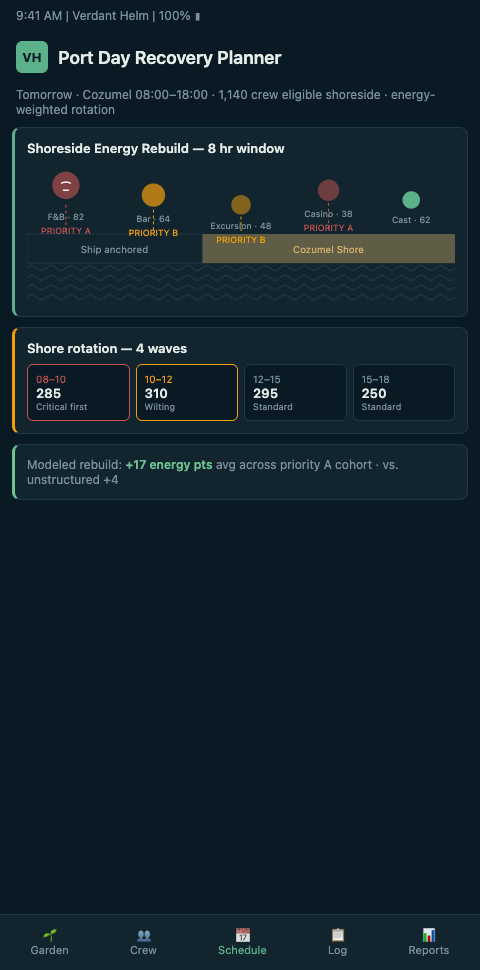
Advanced Tactics for Rebuild-Effective Port Days
Three tactics make port-day recovery actually recover.
The first is excursion-desk coordination. The port-day peak lands hardest on the excursion desk, and the recovery planner schedules excursion agents' release windows as paired rebuilds on the following sea day rather than same-port releases that get swallowed by port-day peak. This redistributes the calendar so the bed that drains fastest gets the most rebuild-effective window.
The second is embarkation-day sequencing. A perennial returning from shoreside release on the last port day of the voyage should not be the same perennial absorbing the heaviest turnaround-day load. The embarkation desk emotional-labor scheduling playbook details the turnaround-day load pattern, and Verdant Helm aligns port-day release schedules so rebuilds don't get immediately drained by turnaround bloom. Perennials released early in the voyage handle turnaround; perennials released late rest through turnaround.
The third is cross-niche circadian pattern learning. Cargo-crew ballast-watch scheduling uses predictive circadian modeling that applies directly to cruise recovery planning — the ballast watch predictive circadian playbook describes the model architecture Verdant Helm extends into hospitality port-day release planning. The same body-clock model that schedules watch rotation on a tanker schedules release rebuild on a cruise ship, with bed-specific tuning.
A fourth tactic is the shore-side support partnership with port agents. Some cruise lines have quietly begun building small shoreside crew-rest partnerships — a nearby cafe, a quiet park bench with crew-only access, a shuttle-stop-based rest area — that give crew a low-friction off-ship destination for their release window. The gangway swipe shows crew leaving the ship; the partnership ensures they have somewhere to actually go. Verdant Helm integrates shoreside-partnership availability by port and surfaces nearby options to crew on the morning of release days, which research shows substantially increases gangway swipe-off rates.
Read the Next Port Day's Swipe Data
A Hotel Director or Cruise HR Leader who wants to see whether scheduled releases rebuild should pull the gangway swipe data for the most recent port day alongside the release roster. Match swipes to scheduled releases by named crew member. Verdant Helm produces this report in minutes and highlights perennials whose scheduled release went onboard-only. The gap between roster and rebuild is the gap the rebuild engine closes. One port day of data is enough to see whether the gap exists on this ship. If it does, extend the planner to the next voyage and watch the gap narrow.
The follow-up that moves the needle is a short conversation with three cabin stewards whose swipe data shows they stayed onboard through their release block. The question is simple: what pulled you back in? The answers cluster into three categories — a section bell the steward felt obligated to answer, a laundry turn that would not get done otherwise, or an unspoken expectation from the supervisor that release means "available if needed." Each of those has a different operational fix. The bell-response reflex gets addressed by a paired-deck coverage arrangement during release blocks. The laundry turn gets absorbed into the pre-release schedule rather than being left to the release window.
The supervisor expectation gets addressed by the Executive Housekeeper, who almost always does not realize her team reads release that way. Hotel Directors who make these three fixes on one ship across two voyages typically see the gangway swipe-off rate climb from around 30 percent to above 65 percent, and the mid-voyage wilt trajectory on that ship's steward bed flattens visibly in the same window. Cruise HR Leaders who track the swipe-off rate as a retention leading indicator catch the unused-release pattern across the fleet before it compounds into the month-four non-renewal wave. The release is only worth scheduling if the rebuild actually happens — the swipe data tells you which is which.