Ballast Watch Planning With Predictive Circadian Data
The ballast leg is where cognitive debt grows unobserved
On a VLCC leaving Rotterdam in ballast for Ras Tanura, the loading terminal stress is over. The port-call paperwork is filed. The next charterer conversation is 15 days away. The ship-time of the bridge team drops. Watches still happen, but the pressure to perform them sharply often drops with them. Masters reduce daywork. Chief Mates catch up on paperwork. Second Mates sleep whenever they can. The watch board still shows a 4-on-8-off structure, but the informal tempo of the ship has gone soft.
This looks like recovery. The PubMed simulation study on six-on-six-off sea watches and the PMC paper on circadian misalignment in non-24-hour environments say otherwise. Watchkeepers on a non-24-hour watch pattern do not recover from circadian debt on a ballast leg; they accumulate it differently. The sleep periods stretch but split across odd-hour blocks. The perennial does not bloom. The ship looks slack and the watchkeepers read the slackness as rest, but the circadian phase keeps drifting. On a ULCC ballasting west across the Pacific, the drift can compound across 21 days until the bridge team arrives at the loading terminal with a starting perennial worse than the one they had at departure. The bosun and the deck gang, whose daywork has been reduced rather than structured, often show the deepest drift because the loose tempo erodes sleep-timing discipline without replacing it with anything anchoring.
The Nautical Institute paper on sleep and circadian phase (Arendt and colleagues) measured onboard sleep and melatonin across a full passage and found only partial circadian adaptation. The PMC study on sleepiness of day workers and watchkeepers at high seas confirms that watchkeepers carry measurable sleepiness even in periods that look operationally calm.
When the ballast leg ends and the next loaded leg begins, the bridge team is not rested. The new voyage starts from a debt the ballast leg did not clear. The loaded leg's STCW and MLC records will still show compliant rest hours, because the watchkeepers did rest — but the rest was the wrong shape for the circadian recovery the bodies needed. A Master on his fourth voyage of the year reading those compliant records feels the debt the numbers are not reporting, and a DPA trying to explain a near-miss a month later has the paper compliance but not the operational reality.
Treat the ballast garden as an investment window
The Verdant Helm approach converts the ballast leg from passive recovery to active circadian investment. The ship's botanical garden during ballast shows the same perennials, blooms, and wilts as the loaded leg, but the management move is different. The Master is not protecting the team through peak demand; the Master is rebuilding perennials that will carry the next loaded leg. The garden's colour language shifts with the mode — the deep investment windows are rendered in a deliberate fresh green, and the drifted-phase beds carry a russet note that signals a bed needing active intervention rather than routine monitoring.
The rebuild is structured. The garden identifies each watchkeeper's drift — how far their circadian phase has slipped from the ship-time watch pattern over the previous leg. A Chief Mate whose phase has drifted three hours needs different interventions than a Second Mate who has drifted only 40 minutes. The USN surface fleet's shift to a circadian-aligned watch rotation provides the pattern the garden adapts — same watches at the same time daily, reinforcing phase rather than eroding it. The VLCC or ULCC Master running a 4-on-8-off in the Atlantic sees the same curve the USN found in the Pacific; the remedy is structural, not cultural. A cadet starting his first ballast leg on this pattern develops a sleep discipline from the beginning rather than absorbing the loose-ship habits that older officers may be carrying forward.
The interventions are specific. A protected sleep window at a time that matches the watchkeeper's drifted phase, not the ship's original plan. A short phase-advance programme over three days using light exposure and meal timing, tracked through the garden's perennial trunk. A swap between Chief Mate and Second Mate for three days to unload the more drifted phase. These are all trackable through the garden. The Cambridge Journal of Navigation evidence on circadian rhythms and shipping accidents gives the business case — the next loaded leg's accident probability tracks the circadian alignment the ballast leg either restored or did not. A VLCC Master who has run four ballast-leg rebuilds in a row arrives at the loading terminal with a measurable head start on casualty defence, and the DPA has the perennial trace to show how that head start was assembled.
The garden also makes the rest-window protection real. A Second Mate on a protected 14:00 to 18:00 rest block on the ballast leg is not available for a cargo inspection, even if the Chief Mate is asking. The Master sees the protection on the garden and can back the Second Mate against the ask. Over a 12-day ballast leg, three or four protected blocks per watchkeeper materially shift the perennial depth at the loaded-leg start.
The bosun coordinating deck work during ballast sees the same garden and routes tank-cleaning or hold-preparation tasks around the protected blocks rather than through them. On a ULCC ballasting back to Hormuz for a Gulf-to-Asia rotation, that coordination is the difference between arriving with a rebuilt perennial and arriving with the last voyage's debt still on the books. A Chief Engineer planning bunker-transfer preparation during the ballast leg sees the same protection and schedules tank sampling away from the Second Mate's 14:00 window without needing a separate conversation.
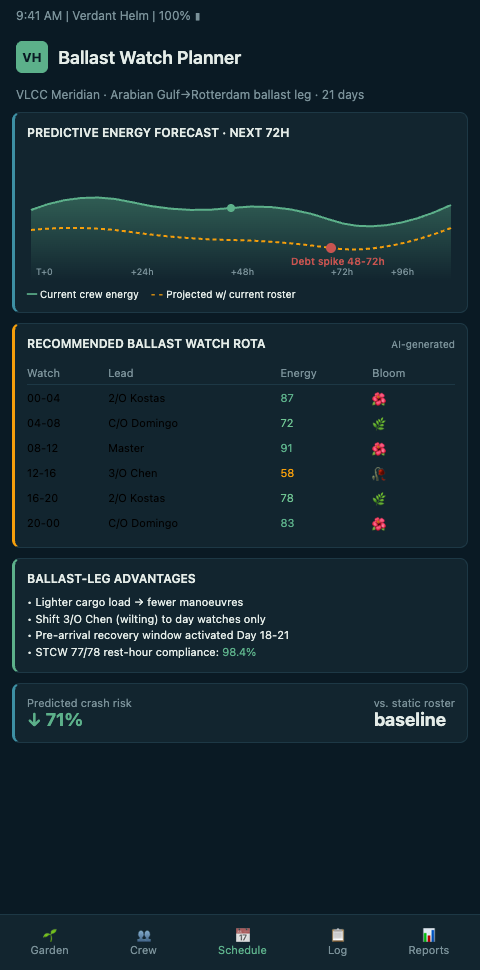
Advanced: the ballast leg as a predictive design surface
The deeper capability is using the ballast leg as a design surface for the next loaded leg. Once the Master can forecast perennial depth at the loaded-leg start, the loaded-leg plan can be calibrated to that forecast. A Chief Mate projected to start the loaded leg at 70% perennial depth triggers a different watch plan than one projected to start at 90%. The Master shares the forecast with the fleet superintendent a week before the loaded-leg start, which lets the crewing office consider a relief crew or a staggered crew change if the forecast is too shallow to absorb the next cargo cycle. The superintendent can arrange a standby Chief Mate from the pool to join at the loading port for a shadow period, rather than trying to negotiate an emergency crew change mid-loaded-leg when the Chief Mate's perennial has already crossed the crash threshold.
This is the operational form of predictive circadian planning the Naval Postgraduate School Crew Endurance Handbook argues for — rotation design anchored to predicted phase, not calendar. The ballast leg becomes the period where the Master either grows or squanders the predictive budget. A Master who arrives at the loading terminal with the bridge team rebuilt carries a commercial advantage as well; the loaded-leg schedule is less likely to slip into fatigue-driven delays, and the charterer's performance notes reflect that. The commercial signal eventually appears in charterer vetting and OCIMF SIRE inspection outcomes; a VLCC with consistently high perennial-depth scores at loaded-leg start attracts vetted trades the way a vessel with a clean detention history attracts them now.
Fleet superintendents can use ballast-leg data across the fleet to redesign the service pattern. If perennial depth consistently finishes the ballast leg below the target band, the ballast leg itself is being misused. Rest discipline is too loose, daywork is being stretched into protected blocks, or the watch pattern during ballast is failing to reinforce the circadian anchor. Those are management questions the garden makes answerable.
ISM audit evidence from a ballast-leg rebuild cycle reads as SMS in motion, not paperwork at rest. A DPA presenting the ballast-leg pattern across four vessels to a DNV auditor has evidence the auditor can read directly rather than narrative the auditor has to interpret.
For context on adjacent capabilities, post 18 on how bosuns rotate deck crews using garden readings covers the deck-side equivalent of the circadian investment move, and post 19 on split anchor-watch rotas driven by garden signals extends the pattern into anchorage periods. The offshore wind sector applies similar predictive logic to campaign planning; post 17 on jack-up campaigns and predictive energy shows how wind operators sequence blade-team work against a comparable garden.
For deep-sea cargo fleet leaders running long ballast legs
If your VLCC or ULCC fleet is treating ballast legs as recovery periods and your next loaded leg is starting from a depleted bridge team, Verdant Helm will overlay a predictive circadian plan on one full ballast leg. Schedule the ballast-leg pilot with the Master of your next Atlantic-to-Gulf ballast passage, and invite the relieving crew to join the briefing so the rebuild target is shared across both rotations.
Before the pilot, pull the previous loaded-leg rest-hour records and wearable exports for the Chief Mate, Second Mate, and Third Mate across the four weeks preceding the ballast departure. The overlay almost always shows a Chief Mate finishing the loaded leg with a phase drift between two and three hours and a Second Mate with a perennial trunk 15 to 20 percent below voyage-one baseline.
On a VLCC ballasting Rotterdam-Ras Tanura with a Suez transit mid-passage, the predictive plan typically places three protected sleep windows on the Chief Mate inside the first eight days and schedules a phase-advance programme using light exposure and meal timing through the Gulf of Aden segment. The DPA gets a ballast-leg investment report that tracks the perennial rebuild day by day, so the loaded-leg departure shows a measurable head start rather than a carry-over debt. OCIMF SIRE inspectors and charterer vetting committees reviewing the ballast-leg record see a Master who uses the empty leg as structured investment rather than passive recovery, which shifts the next vetted-trade conversation.