How Bosuns Rotate Deck Crews Using Garden Readings
The bosun's morning call is too fast for the paper rota
At 06:30 on a bulk carrier rolling in Force 7 heading west of Madeira, the bosun meets the Chief Officer and gets the day's priorities. Hatch covers need resecuring on the number three hold. Lashings on the aft deck are showing play. The bilge pump round needs a careful set of soundings because the hold is taking spray. The bosun has six ABs, a cadet, and an Ordinary Seaman. He has maybe four minutes to make the assignments before the 07:00 breakfast and the 08:00 start of work. On a Panamax bulker crossing the North Atlantic with a Neo-Panamax grain cargo locked under hatches, the decisions cannot wait for the Chief Mate's 08:30 brief.
The Marine Insight description of bosun duties captures the role — plan the day's work, assign tasks, check completion under the Chief Officer's oversight. The paper rota carries names and departments. It does not carry the information the bosun actually uses to assign — who was up late last night resecuring a container that broke loose, who took a grab on the shoulder during the morning safety round, who is on day two of a head cold, who has been on a 4-on-8-off pattern that added an anchor watch last night. On a ULCC working tank-cleaning during the ballast leg, the same gap appears in a different form; the bosun knows which AB managed the inert-gas sequence without error and which one was lagging behind on the Butterworth rotation, but nothing on paper captures that knowledge for the next voyage.
The information the bosun uses is in his head. The Skuld fatigue topic page notes that 25% of casualties are fatigue-related and that extended deck work in adverse conditions reduces capability. The MCA MGN 505 guidance on fatigue and fitness for duty expects the master and bosun to rotate deck crew based on fatigue load, but gives no operational surface for doing so. The bosun's mental model of the deck crew is the surface, and it goes home when he does. When the bosun signs off for leave and a new bosun joins, the whole model has to be rebuilt from scratch over two voyages.
The deck garden beside the work list
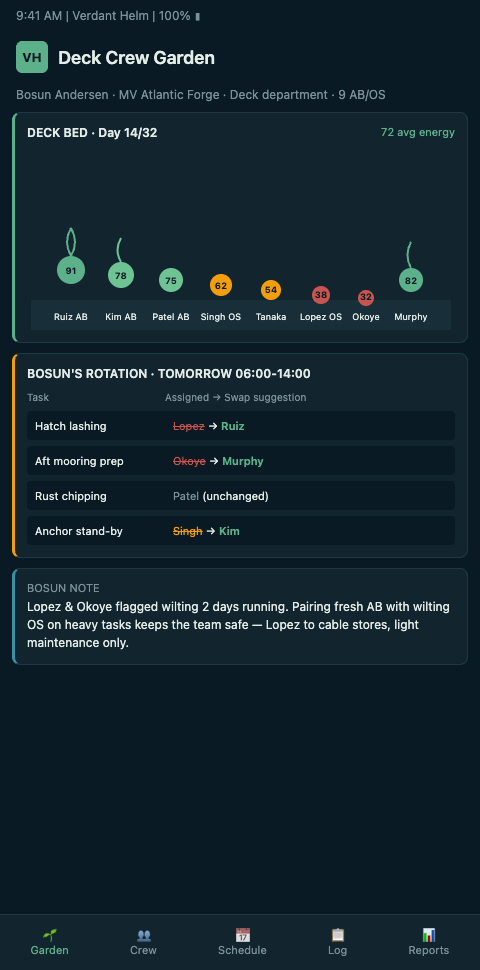
The Verdant Helm approach renders the deck crew as a parallel garden beside the bridge garden. Every AB, OS, and cadet has a bed. The bed shows perennial depth from voyage history, current bloom from the last 12 hours of rest and work, and forecast wilt from the next four hours of planned deck work. The bosun reads the garden in 30 seconds at the morning meeting with the Chief Officer. The deck garden's colour language matches the bridge — fresh green for strong bloom, amber as the bed wilts, russet for compounded debt — so the bosun and the Master are reading the same visual grammar across two different views.
The reading is direct. AB Ramirez spent two hours resecuring a hatch tarp at 02:30 — bloom thin, perennial showing a dip. AB Martins had a protected rest night, perennial strong, bloom in full colour. Cadet Silva is on day three of the voyage with new-joiner energy — bloom good but perennial shallow because the cadet's carry-over is low. OS Traore has been nursing a head cold for two days — perennial visibly wilted, bloom struggling to develop. The bosun holds the same view the Chief Officer holds, and a quick morning word on "Martins on the forward tarp, Ramirez on lashings, Traore on the round" takes twenty seconds instead of the usual three-minute negotiation. The cadet picks up the vocabulary on the first voyage and learns the rotation grammar a bosun usually takes two contracts to absorb.
The bosun now has a match between task and bed. Hatch cover resecuring in a swell wants the strongest bloom — Martins on the number three hatch. Lashing check is a lower-load task requiring experienced hands but less raw energy — Ramirez with Silva as the second pair to train and carry the lighter load. Bilge pump round is a careful, quiet task that Traore can do at his own pace without carrying other men's safety on his back. The rotation the bosun makes in his head is now visible, checkable, and recordable.
A Chief Mate reviewing the assignments thirty minutes later sees a rationale, not just a name list. On a VLCC running tank inspection during the ballast leg, the same task-to-bed matching applies — the AB with the strongest bloom takes the Butterworth tank while the quieter round-check falls to the OS whose perennial is still recovering from a night of cargo-heat monitoring.
The Steamship Mutual guidance on work safety in adverse weather stresses deck-work planning at the intersection of fatigue and weather. Verdant Helm renders both as the same view. When the weather forecast shows the swell easing at 14:00, the garden shifts the recommended deck-work window. The bosun can hold the heavier task back by three hours and use the morning for the lighter round. Over a voyage, the garden accumulates a record of which rotations held up — which ABs carried unexpected fatigue from a Wednesday task into a Friday task, which cadets adapted faster than their first-voyage peers, which OS crews recovered from a Force 8 overnight in one rest cycle versus two. The record is the raw material a Chief Mate takes into the next voyage's planning meeting with the Master, and the Master takes into the next fleet superintendent's crewing review.
Advanced: aggregating deck-garden data across the fleet
The deeper capability is that the bosun's per-voyage garden aggregates into a deck-crew management surface the Chief Officer and fleet crewing team can use. A specific AB whose perennial repeatedly finishes voyages thin — even after rotation discipline — may need a longer leave cycle. A cadet whose bloom tracks ahead of his peers may be ready for a heavier task load and an earlier responsibility step. The crewing office ashore, which usually sees deck-crew appraisals three months late on paper, reads the perennial traces in near-real-time and can plan relief crews with a grounded view of how the outgoing bosun's team is actually leaving the ship. On a VLCC fleet running STCW-complaint rotations alongside a cadet training programme, the crewing office also sees which cadets are developing fastest and can route them to the vessels where the Chief Mate's training discipline has produced the strongest previous cadet perennials.
The LMITAC analysis of the human element in shipping argues that chronic fatigue reduces crew performance and that rest policies are central to safe deck management. The deck garden is the instrument that makes the policy operational — not a policy read once at induction, but a daily decision surface the bosun uses. The MITAGS training guide on good housekeeping and safe working practices supports the same point from the training side; bosun-led deck rotation is teachable when the teaching is anchored to a visible artefact.
A bosun training a new cadet on rotation discipline uses the garden as the shared reference, not just a story about a past voyage. A Chief Mate reviewing the bosun's appraisal at the end of a voyage can point to specific rotation calls — the morning Martins was rotated off the forward tarp, the afternoon Silva was paired with Ramirez for a training round — and discuss rotation quality with an evidence base both men can read.
Class societies are following the same line of thought. The IACS recommendation 192 on embedding human element considerations argues that human element signals need to live inside work-planning tools. The bosun's garden is the work-planning tool for the deck — and it feeds upward into the ship's wider ISM posture. When the PSC officer boards for a fatigue-focused inspection under MLC, the deck garden carries evidence of rotation discipline that paper toolbox talks cannot. Post 19 on split anchor-watch rotas driven by garden signals covers the bridge-side equivalent of the deck-rotation move, and post 9 on chief mate rounds as garden-state entries shows how the Chief Officer's daily round feeds into the same surface. The emotional-labour rotation logic also appears outside cargo — post 18 on casino hosts and emotional labour debt gardens extends the idea to hospitality teams whose fatigue is less physical but no less operationally consequential.
For deep-sea cargo fleet leaders rotating deck gangs
If your bosuns are rotating from instinct alone and your last safety incident on deck named fatigue as a contributor, Verdant Helm will stand up the deck garden on one vessel for one 21-day voyage and let the bosun and Chief Officer compare their rotation calls against it. Book the deck-garden trial with a Chief Officer on a bulk or container voyage this quarter, and involve your shore-side crewing coordinator so the post-voyage rotation trace informs the next relief assignment directly.
Before the trial, pull the last voyage's morning work lists, the ship's weather records for the passage, and the deck-safety incident reports. The trial almost always exposes two or three mornings where the bosun's instinctive call had an AB on a high-load task whose perennial reading the paper rota could not surface. On a Panamax bulker running Richards Bay-Qingdao with a Force 7 segment around Madeira and a Cape of Good Hope passage, the deck garden typically flips the lashing assignment from an AB carrying a short sleep block to a fresher AB whose perennial was strong, with the bosun's original call preserved as a rotation-quality comparison.
The DPA and crewing coordinator get a deck-crew portfolio that travels with each AB across vessel types, so a rating rotating from a container ship onto a tanker carries a readable perennial history rather than a blank slate. Manning-agency principals and charterers' safety committees reviewing the record see a deck-rotation discipline the MLC rest-hour form could not evidence and the ISM audit binder could not carry.