Turning Chief Mate Rounds Into Garden-State Entries
38 minutes of telemetry nobody reads
A British Chief Officer on a 58,000 DWT product tanker running the Middle East Gulf-Singapore clean-product trade runs the morning safety round at 08:30 every day of the voyage. The PopProbe vessel safety rounds checklist that the shipping company adapted for internal use covers 43 items across seven sections — bridge, cargo, LSA, machinery, accommodation, deck, and lookout. The round takes 38 minutes. It produces a paper checklist with 43 tick boxes and a signature.
The checklist goes into a binder in the Chief Officer's cabin. It comes out for the ISM audit or for a post-incident investigation. Between audits, nobody reads it, and the 38 minutes of pattern recognition the Chief Officer built during the walk evaporate into a file. On product tankers running the MEG-Singapore-Yokohama triangle, the same round runs three times a week across a 22-day round voyage, producing roughly 1,800 checked items per voyage that collectively inform zero real-time decisions.
The SafetyCulture vessel inspection checklist template and the Marine Inspection App USCG-aligned digital checklist both map the same 43-ish item scope onto digital forms, improving the audit-trail property while preserving the evaporation property. ShipsBusiness's maritime reference on shipboard safety checklists described the daily chief mate round as an ISM Code touchpoint — compliance, not telemetry. Britannia P&I's loss-prevention library linked rounds quality to fatigue and accident-prevention evidence, and UK P&I's case-study series correlated rounds quality with navigation/error claim frequency. The rounds are a rich data source. The digital-form generation captures the checkbox layer. Neither captures the pattern-recognition layer. The P&I data drew on claims files spanning bulk, container, and tanker segments across the Paris MoU and Tokyo MoU regions, which is why the correlation generalises.
Rounds as garden-state observations
Verdant Helm treats each item on the Chief Officer's round as a garden-state observation, not a compliance tick. A bridge inspection item that reads "ECDIS alarms acknowledged and logged" becomes a bloom-state reading on the ECDIS subsystem of the bridge perennial. A cargo inspection item on a deck PV valve becomes a reading on the cargo-watch perennial. A lookout inspection item on the accommodation fire-door state becomes a reading on the accommodation sink factor. The 43 items are not a checklist. They are a 43-dimensional vector that updates the garden's state every morning.
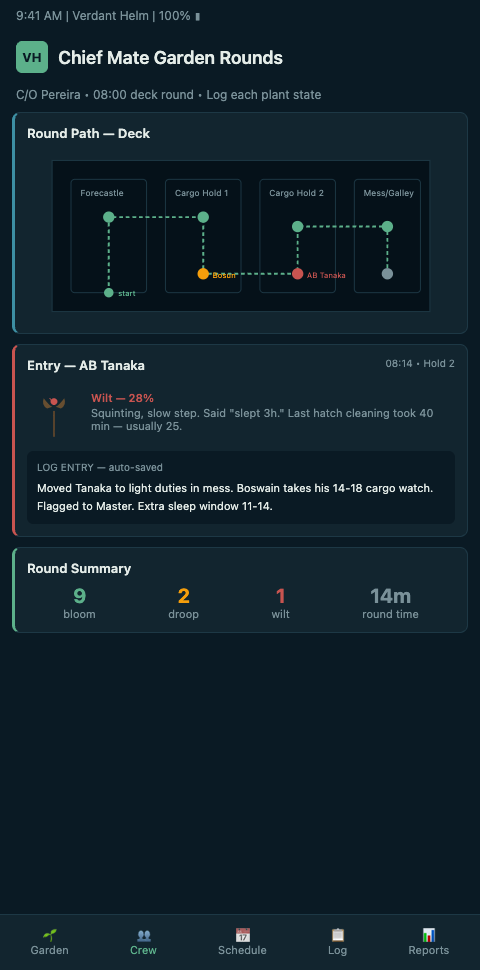
The Chief Officer's walk becomes instrumented. A tablet replaces the paper checklist. Each item captures a tick, an optional photo, a state reading (green/amber/red), and a free-text annotation. The tablet's GPS logs the walk route and timing — auditors can confirm the round was physical, not clerical. The annotations feed the garden as tending notes: a hydraulic oil seepage noted on a cargo PV valve is tagged to the cargo perennial and surfaces on the bed until a follow-up item clears it. The 43 items become a live feed into the bed, not a binder entry. On a VLCC with a larger deck area and more cargo-system items (roughly 55-60 checks), the same telemetry flow scales without adding Chief Officer walk time, because the tablet's capture overhead is less than the paper version's scribble overhead.
The tending loop is what the paper checklist never had. An item marked amber on Monday's round that stays amber on Tuesday's round triggers a follow-up prompt on Wednesday's round. An item that turns red on Wednesday surfaces to the Master in real time, not in the next weekly meeting. The Chief Officer's 38 minutes a day of pattern recognition becomes a continuous bed reading that the Master, the bosun, and the DPA can all see.
A recurring amber on a cargo-room ventilation item across three consecutive voyages surfaces as a maintenance priority that the paper log would have hidden across three separate binders in three separate cabins. On a six-vessel product-tanker fleet rotating officers across vessels, the same cargo-room item amber on three different ships with three different Chief Officers reveals a class-wide maintenance pattern that a single-vessel log cannot produce — the DPA gets a fleet-level signal that the Chief Officers themselves could not see.
The Sitemate vessel inspection checklist platform is representative of the rounds-digitisation trend — the market is moving in this direction. What the market has not yet landed on is the pattern-state representation. A checklist with 43 ticks is a compliance artifact. A bed with 43-dimensional state is an operational instrument. The difference is where the value lives: in the artifact for compliance, in the rendering for operations. Greek and Norwegian owners running mixed fleets have adopted digital rounds on the compliance-first mental model, then migrated selected vessels to the pattern-first model after seeing the second vessel's near-miss curve diverge downward from the first.
UK P&I's correlation between rounds quality and claim frequency is the underlying empirical case. Rounds quality is not "did the round happen." It is "did the round surface the pattern." A Chief Officer who walks the deck every morning and whose rounds surface three anomalies a week is doing higher-quality rounds than one whose rounds surface zero. The garden measures the surfacing rate. Over voyages and across ships, the DPA builds a rounds-quality distribution that feeds into crew welfare, training, and fleet-wide maintenance policy. A DPA managing a twelve-vessel product-tanker fleet running the MEG and Mediterranean trades can see which Chief Officers run high-surfacing rounds and which do not, and — critically — can see when a previously high-surfacing Chief Officer's rate drops, which is a bloom-state signal on the Chief Officer himself.
Advanced tactics for rounds as telemetry
Three tactics make the rounds-to-garden conversion compound. First, tag each item with the perennial or sink it affects, not the ISM section alone. ISM sections group by operational domain. The garden groups by cognitive-load factor. An item on the accommodation fire-door state affects the accommodation sink, which affects every officer's recovery window, which affects every perennial's bloom. The ISM tag stays for audit; the garden tag drives the tending. Both co-exist, and the garden tag is what the Master reads. On a container vessel with a larger accommodation block and more officers than a tanker, the accommodation-sink tagging surfaces more cabin-specific patterns per voyage than the same tagging on a smaller tanker complement.
Second, route anomalies to a follow-up owner, not a log. A paper checklist closes the anomaly with a signature. The garden opens a tending task with an owner, a due watch, and a bloom-state link. The Chief Officer's round on Monday tags a cargo anomaly to the cargo watch officer for the 20:00 watch; the follow-up closes on Tuesday's round or escalates on Wednesday's. The anomaly is a perennial's branch that is being tended, not a file. Every anomaly's life cycle is visible on the bed. On an LNG carrier with specialised cargo-watch duties, the follow-up owner may be a specific cargo engineer rather than the OOW, and the garden's ownership routing respects the vessel-type-specific role structure.
Third, pair the Chief Officer's rounds with the bosun's deck walks. The bosun's view of the deck surfaces patterns the Chief Officer's does not. Running both as parallel garden inputs gives the bed two independent observers on the same perennials. Where the bosun sees an amber state that the Chief Officer has not flagged, the discrepancy is itself a reading — often on the Chief Officer's bloom state, not on the deck. A fatigued Chief Officer walks past items a fresh bosun catches. The garden surfaces the delta.
On a Panamax bulker with a Filipino bosun and a British Chief Officer, the paired-observer pattern also produces a cross-cultural calibration — each observer's pattern-recognition defaults get mutually audited through the shared garden record. The delta is also a voyage-length signal: a Chief Officer whose discrepancies with the bosun's readings widen across the second half of a 28-day round voyage is showing a bloom-state pattern the Master can surface to the DPA before the next rotation is assigned.
The pattern pairs directly with how bosuns rotate deck crews using garden readings, which extends the second-observer principle into the deck rotation itself. The cadet-facing analogue is a cadet's logbook for tracking watch-based fatigue, where a trainee builds observation habits that scale into the Chief Mate's round a decade later. On offshore rigs, the rig medic rounds garden signals piece shows the same rounds-as-telemetry conversion applied to medical rounds rather than deck safety rounds.
What deep-sea cargo fleet leaders should do next
Chief Mates, Masters, and DPAs on product tanker, bulk, and container fleets can convert the existing 43-item safety rounds into garden-state telemetry without adding to the Chief Mate's 38-minute walk. Verdant Helm ingests the rounds on a tablet, surfaces anomalies to the Master in real time, and builds a continuous ISM audit trail alongside the operational bed. Fleet superintendents managing multi-ship fleets get a fleet-wide rounds-quality distribution that feeds crew welfare and training decisions. Book a walkthrough with our deep-sea team: send us your standard rounds template and we will show how it maps to the garden bed on your next voyage.
Before the walkthrough, pull the last three voyages of paper rounds binders alongside the same period's near-miss reports. The rounds-to-perennial mapping typically reveals three or four recurring amber states that the binder absorbed and the garden would have surfaced within a week. On a product tanker running the MEG-Singapore-Yokohama triangle, the persistent amber almost always clusters around PV valve seepage, ballast-pump cavitation, or cargo-room ventilation — items the Chief Officer has noted but the bosun and Second Mate were never looped into.
The DPA gets a fleet-wide rounds-quality board ranking each Chief Officer's surfacing rate, with the bosun's paired deck-walk readings providing the second-observer delta. Port state control inspectors running an ISM focused inspection read the garden's rounds trace as continuous evidence alongside the paper binder, which satisfies the ISM Code clause 10.2 maintenance obligations without a separate binder pull. OCIMF vetting inspectors boarding a product tanker see the same trace and the pre-vetting paperwork shrinks to a data walk-through.