A Cadet's Logbook for Tracking Watch-Based Fatigue
The two logbooks on the bunk shelf
A third-year British deck cadet on a Felixstowe-to-Singapore 14,000 TEU container vessel keeps two logbooks on his bunk shelf. The first is the STCW-mandated Training Record Book, tracking competencies against the BRM 1.22 framework and the cadet competence schedule summarised in the edumaritime STCW reference. The second is a private notebook where he writes what the TRB cannot capture — that he slept 3 hours 40 minutes on voyage day six during the Suez southbound transit, that his 00:00-04:00 watch on day eight felt thick and slow across the Gulf of Aden, that he checked the ECDIS twice in ten minutes on day nine because he could not remember whether he had checked it at all during the approach to the Strait of Hormuz.
The TRB has no column for that. The Just Be Maritime overview of UK MCA deck cadet programmes describes the TRB as a training record, focused on demonstrated competencies. It is a credential instrument, not a fatigue instrument. Nautilus International's findings on seafarer fatigue documented that one-third of seafarers report pressure to falsify rest-hour records. Cadets sit lowest in the pressure gradient. Shipowners' Club's brief on sleepiness and fatigue noted that junior officers are especially vulnerable to compounding fatigue across their first voyages, when they have neither the experience to recognise the state nor the standing to protest it. A cadet on a 42-day Felixstowe-Yantian round voyage experiences three canal and strait transits — Suez, Bab el-Mandeb, Malacca — any of which can compress the cadet's sleep windows to three hours or less while the nominal rest-hour form reads compliant.
Merging the two logbooks into a garden entry
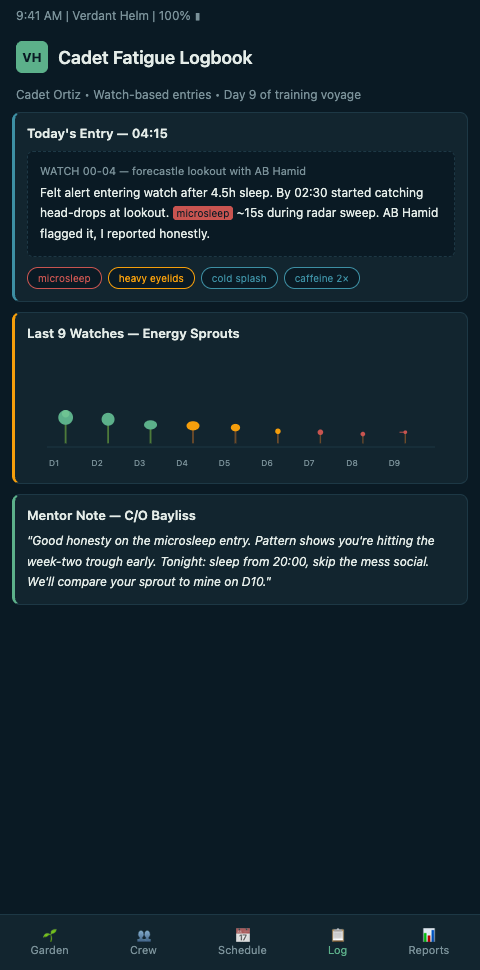
Verdant Helm treats the cadet's second notebook as the missing telemetry the TRB was never designed to collect. Each private entry becomes a garden reading on the cadet's own perennial — a seedling in the broader bridge bed. Seedlings need tending differently than established perennials. Their root systems are shallow, their cognitive reserves smaller, their wilt points closer to the surface. The garden renders this. A cadet perennial shows its bloom state, its trailing sleep window, its per-watch alertness signal, and its phase alignment with the Master and OOWs it is understudying.
The cadet fatigue log that merges these streams has five fields. Watch window (00-04, 04-08, etc), sleep window and length in the preceding twenty-four, self-rated alertness at three points in the watch (start, middle, handover), any lapses noted (missed check, slow recognition, drift), and any tending action the cadet was advised of. Those five fields are the entry. They take ninety seconds to fill. Over a 90-day cadet training period they produce roughly 360 entries, which is a dataset a Chief Mate, a training officer, and a DPA can actually read. On a Panamax bulk carrier running the Richards Bay to Qingdao coal trade, the same 360-entry window captures three full round voyages and the three distinct trough curves they produce.
The USCG National Maritime Center's deck-rating checklists prescribe the structural form of sea-service documentation. The cadet fatigue log fits inside this form without replacing it. The TRB still records competencies. The fatigue log records states. The University of Tasmania's content analysis of incident reports — a thesis on fatigue, watchkeeping, and accidents — showed that logbook tracking is one of the few reliable ways to surface fatigue patterns in retrospective review. Cadets who start the habit early carry it through to OOW and beyond. The Tasmania study cross-referenced cadet-period logbooks against OOW-period casualty data and found cadets with fatigue-logging habits showed lower OOW near-miss rates in their first three years as watchkeeping officers.
The garden metaphor helps cadets read their own state. A seedling does not know it is wilting until an experienced gardener points out the cupped leaves and the dull surface. A cadet at the start of a career has not built the internal calibration yet. The garden's visual rendering — a simple perennial icon that changes state — teaches the recognition faster than a paragraph of text.
A cadet who sees their own perennial turn from full bloom to early wilt across voyage days six through nine develops the pattern recognition that will let them read an OOW's state in five years. This is the pedagogical case for the log. It is not a pure fatigue tracking device. It is alertness literacy. A Filipino cadet on a Greek-flag bulker and a British cadet on a UK-flag container vessel arrive at the same pattern recognition by different paths, and the shared garden vocabulary lets their training officers compare notes across flags.
The ITF Seafarers fatigue resources, designed for unions and new entrants, emphasise the same self-monitoring habit. The garden is the digital skin over that habit. ISWAN's work on seafarer mental health found mood and wellbeing are lowest at the start of a voyage for new entrants, which is precisely when the cadet is most exposed and most in need of a legible tracking instrument. AVTEC and similar AB and cadet training curricula include bridge watchkeeping and alert duties as structural requirements. The fatigue log complements those competencies by turning them into observable states. The cadet's progression from ordinary seaman through AB through Third Mate CoC examination becomes a continuous bloom-state record rather than a series of disconnected sea-service stamps.
Advanced tactics for the cadet garden
Three tactics deepen a cadet fatigue log from a diary into a training instrument. First, pair each cadet entry with the relieved OOW's entry for the same watch. The cadet stands watch alongside an experienced officer. The two garden entries for the same watch window produce a training delta — where the cadet read their own state as alert and the OOW read the same watch as wilting, there is a calibration gap. Closing that gap is a measurable cadet-training outcome. On a Rotterdam-Jebel Ali container run, a British Chief Officer mentoring a first-voyage cadet can use the paired-entry delta to show the cadet where their self-reading diverged from an experienced OOW's, watch by watch, across twenty consecutive days.
Second, project the cadet's bloom curve against the Chief Mate's across the voyage. A cadet who wilts at voyage day ten alongside a Chief Mate who wilts at day twelve is showing a steeper debt accumulation. That is expected — shallower roots — but it is also the data the training officer needs to prescribe the right interventions: longer consolidated sleep windows in port, a reduced-duties day after a TSS transit, an extended handover with the Chief Mate on day nine.
Across three voyages with the same Chief Mate, a cadet's curve converges on the Chief Mate's profile, and the rate of convergence is the observable signal that the cadet is internalising the watch pattern. On a Felixstowe-Singapore-Yantian triangle with Suez and Malacca transits at predictable voyage-day anchors, the curves from voyage one, voyage two, and voyage three can be overlaid and the cadet's root-depth maturation is readable in the alignment of their trough timing with the Chief Mate's.
Third, carry the log forward across ships. A cadet on their second voyage arrives with 90 days of bloom-state history. The garden renders the carry-forward so that the new Chief Mate inherits the cadet's baseline rather than building it from scratch. This is where the individual log compounds into fleet-level value. A DPA with ten cadets across a fleet gets a consolidated view of how new entrants respond to the first, second, and third voyages — where each cadet's wilt point is trending, whether the training programme is closing or widening it.
On a UK-flag fleet with cadets rotating across container, tanker, and bulk segments, the carry-forward lets the DPA compare how the same cadet handles different vessel types' watch rhythms and cargo-operation cadences. A cadet who showed a week-three trough on a 30-day bulk voyage and a week-two trough on a 14-day container run reveals trade-specific debt kinetics that will shape their Third Mate CoC readiness two years forward, giving the training officer a calibration point no paper TRB could surface.
The method sits naturally alongside turning Chief Mate rounds into garden-state entries, since the Chief Mate is usually the officer mentoring the cadet and their rounds-based bloom readings feed the cadet's calibration. The able seaman's first voyage with Verdant Helm shows how the same onboarding pattern works at the rating level, with different bloom kinetics but the same training-by-rendering logic. Cruise operators working a parallel problem in hospitality departments can see the same pattern in the bar manager's cheat sheet for crew fatigue, where new entrants face compounding fatigue under a different workload shape.
What deep-sea cargo fleet leaders should do next
Training officers, DPAs, and fleet superintendents running cadet programmes on cargo vessels can start a cadet fatigue log on the next sailing voyage without modifying the TRB or the STCW-referenced training schedule. Verdant Helm ships with a cadet-mode entry flow that takes ninety seconds per watch and feeds directly into the bridge garden the Master is already reading. Masters sponsoring cadets get a calibration instrument they can actually teach from. Book a cadet-programme walk-through with our deep-sea team and we will show how the log compounds across a cadet's first year.
Before the walk-through, the training officer should pull the last two cadets' TRBs and match them against the five-field log structure. On a Felixstowe-Singapore-Yantian triangle with a first-year cadet and a second-year cadet onboard, the paired entry pattern surfaces the calibration delta between cadet self-reads and Chief Mate handover notes within the first Suez transit. The DPA gets a fleet-wide cadet-progression board that ranks each seedling perennial by root-depth maturation across voyages, with the Master's mentoring notes attached to each cadet's carry-forward baseline. Port state control inspectors reviewing the TRB during a focused inspection on crew training see a cadet log that reads as a continuous alertness record alongside the competency ticks, which answers the MLC 2006 young-seafarer welfare clauses without a separate binder. Sponsoring owners renewing their UK MCA cadet-sponsor status have the same log as evidence the training programme is operating, not simply documented.