Jack-Up Campaign Calendars Driven by Predictive Energy
The Problem: WTIV Campaigns Budget Steel, Not People
Jack-up installation campaigns are the flagship logistics operations in offshore wind. A WTIV — the Wind Turbine Installation Vessel, or HLJV, the heavy-lift jack-up — arrives on site, jacks its legs onto the seabed, and installs or services a cluster of turbines before transiting to the next position. DNV's offshore wind JIP that produced the jack-up installation standard and DNV-ST-N001 for marine operations both focus the design envelope on leg bottom-impact, seabed interaction, and weather windows. The campaign calendar flows from that envelope.
The CRS congressional research brief on Jones Act WTIV supply and the Offshore Magazine coverage of heavy-lift vessel demand together show a fleet under structural shortage. Rystad forecasts a WTIV and jack-up bottleneck compressing 2025-2026 campaigns; Maritime Executive's coverage of the same projection flags schedules being stretched beyond crew capacity as a named risk. The industry is good at tracking the steel. The humans riding the steel run on a schedule built by the vessel ops team and the crewing department, and those two systems touch each other only at the rotation-change date.
The WTIV manager planning the 48-turbine installation had budgeted vessel-hours, crane-cycles, grout-cure windows, and seasonal tonnage movements. The vessel was a 3,000t main-crane class WTIV running GE Haliade-X 13MW nacelle sets onto monopiles in 40m water depth. The calendar was clean at the steel layer. What it did not show was that by turbine 31, the lift-directors, hookup specialists, and commissioning techs who had been on the vessel for 18 days were running a bloom curve that would not clear the final 17 turbines. The IADC jack-up selection and operation guideline and the ScienceDirect review of offshore wind turbine installation are explicit about weather-window constraints on campaigns; they say less about crew-window constraints, which tend to be the binding constraint on the ninth day of continuous good weather.
The three rested specialists sitting in shore rotation six days away were not a scheduling accident. The rotation plan assumed the campaign would pace to the calendar. The campaign instead paced to the weather, and the weather in that six-day gap was the reason the vessel was still on station with no fresh specialists.
The Solution: A Garden Calendar for the Jack-Up
Verdant Helm runs the jack-up campaign calendar off the garden. Each specialist role on the vessel — lift director, hookup lead, commissioning tech, crane operator, scaffolder — is a perennial with a bloom curve specific to their task, their prior week's rotation, and the vessel's transit and jack-cycle rhythm. The beds are grouped by phase (pile, tower, nacelle, rotor, commissioning), and the bloom state of each bed drives the sequence of turbines the campaign can consume.
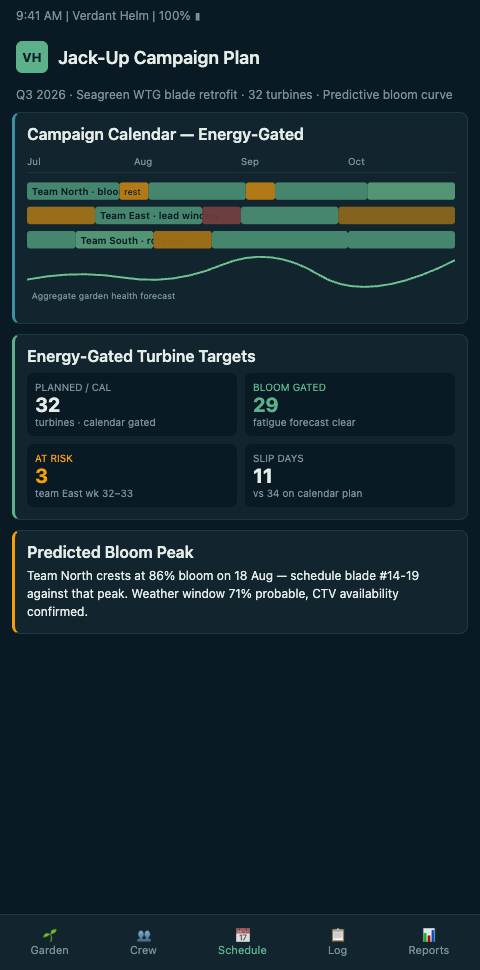
The predictive side of the model is what changes WTIV planning. Verdant Helm ingests the ECMWF extended-range forecasts, the probabilistic operation-failure methodology from the MDPI weather-window research, and the vessel's own jack-cycle telemetry, and it produces a campaign calendar that is scored on both steel and humans. The calendar shows the 48-turbine plan with two overlays: the steel-workability ribbon (legs, cranes, grout) and the crew-workability ribbon (bloom curves by role, rotation-day markers, recovery windows).
The garden framing reveals the binding constraint earlier. On day 9, the steel ribbon is still green, the vessel is still on station, and the garden ribbon is showing amber for the lift-director bed and red for the hookup bed. The calendar flags turbine 31 as the crossover point — the first turbine where the crew ribbon goes from amber to red — and the planner gets a 72-hour warning that the rotation needs a bench pull or a pace reduction. The WTIV manager on the failed campaign had no such warning; the day-18 bench gap was invisible until the morning of day 18.
The DNV jack-up weather-window widening work is important here. The JIP numerical model for leg bottom-impact lets operators widen weather windows safely at the steel layer — pushing workability from 1.5m Hs to 2.0m on suitable seabeds — but widening the weather window only extends the vessel's capacity to consume hours; it does not extend the crew's capacity to consume the widened window. Verdant Helm makes that asymmetry visible, so the weather-window widening decision is made with both ribbons in view.
The garden also reshapes the rotation-change logic. Instead of seating every role on the same 21-day rotation, the dashboard seats each role's rotation against its bloom curve. Commissioning techs burn hot in the last week of a campaign and rotate on a shorter cycle; scaffolders carry a flatter curve and handle a longer stretch. Crane operators on the Huisman 3,000t main crane pace differently from the auxiliary-crane operators; the lift cycle on a 13MW nacelle set is a 90-minute sequence with five decision points, and the garden flags when the operator's bloom no longer clears the fifth decision point reliably. The campaign's crewing plan becomes a function of the garden, not a flat calendar.
SOV transit cycles from garden curves covers the adjacent SOV-served site logic, and fusing weather forecasts with live crew energy views is the upstream dispatch pattern the jack-up calendar inherits. For deep-sea cargo teams running a compatible predictive pattern, ballast watch with predictive circadian overlays covers the same kind of forward-looking fatigue math.
Advanced Tactics
Four extensions move the jack-up calendar from reactive to predictive. The first is the role-specific horizon forecast. The ECMWF extended-range charts reach 42 days; the vessel's own jack-cycle telemetry and the prior campaign's residual bloom data reach further. Verdant Helm builds a 30-day-ahead forecast of each role's bloom state against the planned turbine sequence and the forecast weather, so the planner can see which roles will clear the campaign and which will need bench depth booked in advance. Rystad's vessel-shortage forecast makes this planning horizon necessary — the bench is too scarce to find in the spot market, especially for WTIVs sized to the Haliade-X or the Siemens Gamesa SG 14-222 DD class.
The second is the campaign-split decision. Long campaigns — 50+ turbines — are often better split into two sub-campaigns with a mid-campaign rotation than run as one monolithic push. The garden calendar scores both options on total duration and total bloom debt, and the planner picks the split that keeps the back-half bloom curve above the amber line. The IADC jack-up operations guidance and the ScienceDirect installation review both note that mobilisation cost pressures campaigns toward monolithic runs; the tool quantifies the crew cost of that decision. On a floating-wind substructure tow-and-install campaign, where the jack-up is replaced by a semi-submersible crane barge, the same split logic holds — the commissioning phase always burns hotter than the tow phase, and the split should land before the commissioning bed turns amber.
The third is the bench-pull trigger. When the bloom ribbon crosses from green to amber, the tool generates a bench-pull ticket — specific role, specific rotation window, specific bench candidate. The shore crewing manager receives the ticket with a 72-hour decision horizon, not a 12-hour scramble. The three rested specialists sitting six days out in the opening example were in the system; the ticket would have named them on day 6, not day 18.
The fourth is the campaign-to-campaign residue carry. A WTIV finishing one campaign and transiting to the next carries bloom debt in the crew it retains. The dashboard explicitly carries that debt into the next campaign's pre-seed, so the second campaign does not start from a clean-slate assumption. This is the pattern the DOE O&M roadmap hints at when it talks about continuous O&M modeling; the garden makes it operational for the jack-up layer.
The fifth extension, which campaign managers layer in after the first pilot, is the phase-boundary re-seat. A jack-up campaign transitions through distinct phases — monopile installation, transition-piece grouting, tower sections, nacelle-plus-hub lifts, blade fits, commissioning — and each phase burns different beds. The phase boundary is the natural re-seat point: a hookup pair that carried the nacelle phase rotates out for the blade phase; the commissioning crew rotates in from shore as the rotor fits complete. The garden calendar surfaces each phase boundary as a seating decision, so the back-half commissioning push on turbines 38-48 does not inherit the front-half exhaustion from the nacelle lifts on turbines 1-10.
Build the Campaign Against Both Ribbons
If your WTIV or HLJV campaign planning still flows off a steel-only calendar, the 2025-2026 campaign compression is going to land the crew-window gap in your critical path. The Verdant Helm team will run a campaign pre-read — take your next campaign's turbine sequence and rotation plan, overlay the bloom curves we reconstruct from your last two campaigns, and generate the dual-ribbon calendar with crossover points and bench-pull windows. Offshore Wind O&M installation planners, WTIV masters, and HLJV crewing managers running North Sea, US East Coast, and Taiwan Strait campaigns use this format. Most planners walk out with two bench-pull dates and one campaign-split evaluation to pilot before dispatch.
Citations:
- DNV: Offshore Wind JIP Lays Ground for Jack-Up Installation Standards
- DNV-ST-N001 Marine Operations and Marine Warranty
- Offshore-Mag: Offshore Wind Market Propels Demand for Heavy-Lift Vessels
- CRS Congressional Research Service: Vessel Construction for Offshore Wind Power Generation
- IADC: Guidelines for Selection and Operation of Jack-Ups in Marine Renewable Energy
- ScienceDirect: Installation of Offshore Wind Turbines — A Technical Review
- Maritime Executive — Rystad Predicts Shortage of Wind Farm Installation Vessels
Book the campaign pre-read with the Verdant Helm team before your next dispatch.