Fusing Weather Forecasts With Live Crew Energy Views
The Problem: Two Screens, One Decision
Offshore wind dispatch lives on two screens. One is the metocean display — ECMWF, Met Office, the vessel motion overlay from HR Wallingford, a probability ribbon across the next 72 hours. The other is the crew wall — whiteboard, spreadsheet, or a fatigue tracker that updates once a shift. The O&M manager toggles between them, and the weather wins every argument because it is the one with numbers.
That Dogger Bank manager had a 48-hour window opening on Tuesday morning. Her ECMWF feed showed 1.2-meter significant wave height, 12-knot winds, and a probability-of-operation-failure curve that sat below 15% through Thursday. The workable window was clean. What was not clean was the energy ledger behind the crew she dispatched. The blade pair she sent to turbine B-14 — a Siemens Gamesa SG 8.0-167 DD running on a monopile at 35m water depth — had done three climbs on the preceding Friday, taken Saturday off, and worked a half-day Monday on a gearbox inspection. The metocean said go. The garden, if anyone had been reading it, was showing two perennials at the end of their bloom cycle.
She ran the dispatch. The transfer happened off a 24m CTV onto the boat-landing in 1.0m Hs with a 4-second peak period — inside the Fugro workability envelope but at the edge of the tech's personal tolerance. Thirty minutes into the climb, one tech called a halt — not an incident, a judgment — and the pair descended. The window stayed open but the crew did not. The 48 hours became 12 productive hours, and the metocean forecast gets the blame because nobody logged the crew-state number that would have caught it on Monday evening.
The gap is not forecast accuracy. BOEM's metocean recommended practices and NREL's conditional-probability database give offshore wind managers wind and wave readouts that are already precise enough for most dispatch calls. What is missing is the second stream — a live readout of which techs can actually consume the workable hours the forecast predicts.
The Solution: A Garden Overlay on the Metocean Ribbon
Verdant Helm treats crew energy as a botanical garden. Every technician is a perennial with a bloom curve — some flower fast and rest hard, some build slowly through a week, some only carry full color through the first eight hours of a day. The field has beds, the beds have soil conditions, and the dispatcher reads the garden the way a head gardener reads their plot in May.
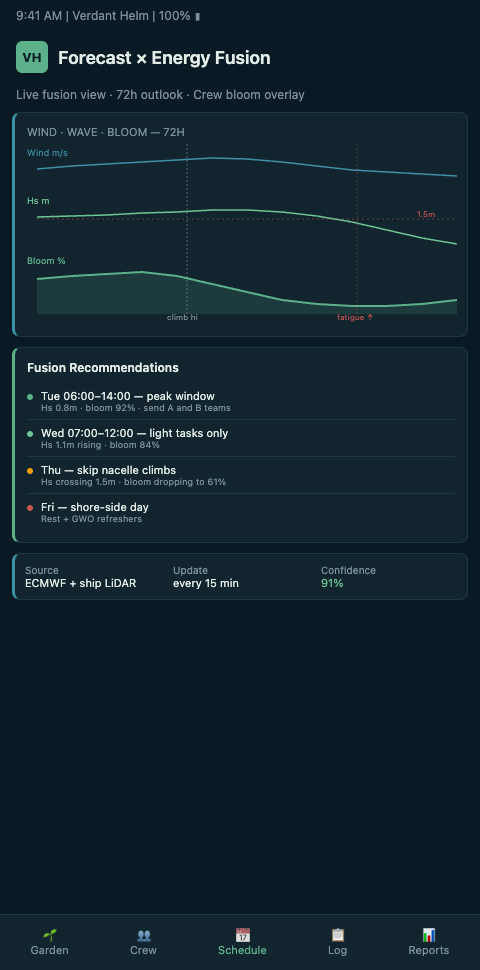
The metocean fusion view lays the garden over the weather ribbon. On the top half of the screen, the 72-hour probability-of-operation-failure curve runs across the fleet — green where transfers are clean, amber where bow motion exceeds workability thresholds (typically 2.5m/s vertical velocity at the bow fender), red where the sea state closes the field. On the bottom half, each tech's bloom state runs on the same time axis. The eye picks out the mismatches without training: a green weather band over a bed of amber perennials is a forecast you cannot consume, and a red weather band over a bed of full-bloom perennials is energy you are wasting.
The garden metaphor is not decorative. It gives the dispatcher a vocabulary for the decisions that spreadsheets hide. A perennial that just bloomed needs a dormancy window. A bed over-watered with a ten-hour shift needs drying out. A sink — the shadowed corner of the garden where water pools — is the crew bunk where two techs rotate through the same 14-day cycle without a real break. The dashboard names these states so the dispatcher can talk about them on the radio.
When Verdant Helm fuses the two streams, the workability calculation changes. Instead of asking "is this window workable," the tool asks "which perennials in this garden can bloom in this window." A 48-hour opening for a blade campaign is not 48 hours of production — it is the subset of hours that intersect with rope-access pairs in full bloom. The output is a dispatch shortlist with confidence bands. The blade pair with three climbs behind them shows up at the bottom, not the top, even if the weather says they are the nearest pair to turbine B-14.
The fusion also rewrites the morning brief. The O&M manager walks in with one screen, not two. The probabilistic weather-window methodology from MDPI research feeds the top half, and the garden feeds the bottom, and the question on the whiteboard is no longer "is Tuesday workable" but "which gardens are in bloom for the workable hours of Tuesday." That reframing is what turns the forecast into a dispatch tool rather than a background readout.
Teams that already stitch live energy signals into their dispatch wall see the same pattern in neighboring contexts — how O&M managers sequence turbine climbs using gardens shows the inside of that workflow on a single turbine, and the jack-up campaign calendar work extends it across a multi-week installation rotation.
Advanced Tactics
The fusion view unlocks four decisions that were previously invisible. First is the pre-climb confidence filter. Before the dispatcher clears a transfer, Verdant Helm runs the tech pair against the probability curve for their specific workability envelope — a blade pair on rope access has a different tolerance than a gearbox specialist doing a scheduled swap, and the bow-motion thresholds in the Frontiers offshore-decision-tool research differ by task. A Vestas V174 gearbox bearing swap tolerates 1.5m Hs; a blade leading-edge overlam on the same Vestas rotor tolerates 1.2m. The dashboard scores each tech's current garden state against the task's motion envelope and flags mismatches before the CTV leaves the pontoon.
Second is the partial-window split. Forecasts rarely give 48 flat hours; they give a bumpy envelope with one or two amber dips. Instead of calling the whole window green, the tool slices it into segments and matches each segment to the garden. A five-hour morning window with 1.0m Hs and a 5-second peak goes to a full-bloom pair; the afternoon recovery period — when the tide turns and the residual swell builds to 1.4m — pre-seats the secondary team on the lighter tasks. Planners stop burning their best perennials on the easiest hours.
Third is the retroactive audit. Every dispatch the manager clears generates a pair of after-action traces — what the metocean delivered versus what the garden delivered. If the window closed early, Verdant Helm shows whether the miss was forecast drift or garden drift. Over a season, that audit tells the operator where the model is wrong and where the rotation is wrong, which are different problems with different fixes.
Fourth is the cross-site pull. A manager running two fields 90 km apart can see both gardens on one screen and move a pair from the slower field into the hot window on the faster field without waiting for a crew-change week. Operators running portfolios the size of SSE Renewables at Dogger Bank or Ørsted at Hornsea use this pull to smooth energy spikes across the fleet rather than stacking them on one CTV. The same pull works on floating wind sites where SOV-served rotations overlap — the Hywind Tampen and Kincardine operations teams face a version of this every time a North Sea low pressure parks over one field and skips the other. DNV's metocean guidance on combining modeled, satellite, and vessel-mounted data gives the upstream side of that pull enough fidelity to justify the cross-site move.
The same fusion mindset anchors adjacent Verdant Helm work — the Princess Cruises medallion analytics case shows how a related data fusion plays out on a hospitality fleet, which is useful reading for offshore wind operators thinking about where the next integration belongs.
Bring the Two Screens Together This Season
If your dispatch wall still runs weather and crew as separate conversations, the next hot window is going to make that split visible in your LTI column. Book a 30-minute walkthrough with the Verdant Helm team — we will pull a recent weather window from your own Met Office or ECMWF feed, run the fusion against your last six weeks of crew data, and show you exactly which dispatches would have flipped. Offshore wind O&M managers at SOV-served fields and CTV day-shuttle operations both run the same demo; we tailor the output to your rotation cadence, whether you are on a 14/14 North Sea cycle or a 21-on/21-off Taiwan Strait pattern. Most teams walk out with two or three dispatch decisions they can change inside a week, before the summer campaign catches them unprepared.
Citations:
- BOEM Metocean Characterization Recommended Practices
- DNV Meteorological and Oceanographic Studies
- Frontiers: Decision-Making Tool for Planning O&M Activities of Offshore Wind Farms
- HR Wallingford: Supporting Safe Operations With Accurate Marine Weather Forecasts
- NREL: Meteorological Ocean Data for Offshore Wind Energy Research
- MDPI: Improved Methodology of Weather Window Prediction Based on Probabilities of Operation Failure
Book a walkthrough with the Verdant Helm team to see the weather-crew fusion on your field.