How O&M Managers Sequence Turbine Climbs Using Gardens
Tuesday at 06:45, 18 Climbs, 14 Techs
An O&M manager for a UK North Sea wind farm on Siemens Gamesa 154-DD turbines opens the Tuesday dispatch sheet at 06:45. Eighteen turbine climbs are planned across the field — twelve routine gearbox inspections, four blade ply checks, one oil top-up on a pitch system, one high-vibration follow-up on a six-week-old alarm. Fourteen techs are in rotation on the SOV. The sheet as inherited from Monday's plan shows names in alphabetical order with climb locations beside them. The 09:00 gangway opens in two hours. Nothing on the sheet tells the manager which tech has climbed three times already this week, which pair is newest to working together, which senior tech flagged a sore shoulder in yesterday's debrief. The manager sequences by the only signal the sheet offers: the alphabet.
This is the default state for most offshore wind O&M operations. An NREL 2024 Cost of Wind Energy Review puts offshore O&M at roughly 30% of total LCOE, which means climb sequencing decisions — who climbs where on which day — directly drive OpEx unit cost at a scale that dwarfs the software budget. A ScienceDirect paper on optimising O&M scheduling under weather forecast uncertainty formalises the sequencing problem by weather and wake loss, while an arXiv/IEEE paper on maintenance optimisation with accessibility and crew dispatch adds opportunistic scheduling triggered by crew availability. Both models treat crew as a quantity. A garden view treats crew as state. The difference shows up most sharply on marginal days — a Tuesday that could carry 14 climbs or 18 depending on which techs take which turbines, and where an alphabetical sort leaves four turbines behind the capacity the crew could actually deliver.
The physiological case for sequencing by state is established. A peer-reviewed UTM Consultants study by Barron on vertical ladder ergometer climbing quantifies VO2 and HR load for vertical turbine climbs, and the RenewableUK Medical Fitness to Work guidance via Templar Medical documents the physical demand profile that should govern daily assignment. The literature says the climb load matters. The dispatch sheet still says alphabet. The garden closes that gap. The climb profile on a Vestas V164-9.5MW at 105m hub height differs meaningfully from a Siemens Gamesa 14-222 DD at 150m — taller climbs compound VO2 cost nonlinearly past 100m, and the garden reading should reflect the turbine model as well as the tech bed.
The Sequence the Bloom Order Reveals
A head gardener planning the week's pruning does not begin with an alphabetic list of beds. She begins with bloom state, pest pressure, soil readiness, and the forecast for the week. Verdant Helm brings the same logic to the Tuesday morning climb sequence.
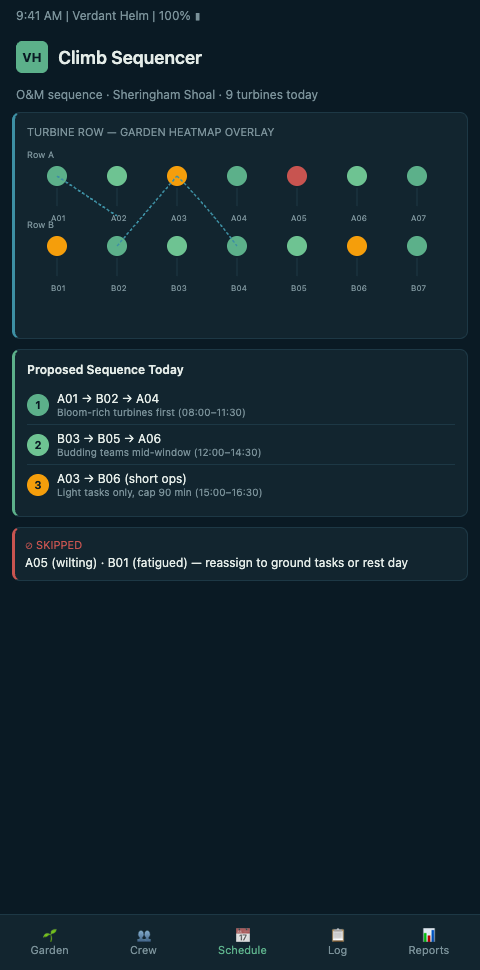
The dashboard shows 14 beds. Six are bright green — techs who slept well, finished Monday at strong scores, have climbed once or twice this week, are well within their WINDA validity. Four are amber — one came off a 2.5-hour blade job on Monday afternoon, one has a logged sore shoulder, one is new to working with Tuesday's assigned buddy, one has climbed four times already this week. Three are pruned state — not red-flagged dangerous, but visibly drained and overdue a rest day the schedule never gave them. One is red — the senior tech who rolled Monday with a logged grip-strength drop of 12% and a self-reported "tired" score; she should not be climbing today.
The bloom order sorts the 14 into bright green, fresh amber, recoverable amber, pruned, red. The climb list sorts by vertical load — the 85m nacelle oil top-up is the heaviest, the 60m ply check is the lightest.
The match-up writes itself. The heavy nacelle jobs go to the six green beds, with the senior tech assigning a well-rested pair to the high-vibration follow-up because that climb needs clean attention. Three of the four amber beds take lighter ply checks at 60-70m or gearbox visuals that do not require full platform work. The three pruned beds stay on the SOV for equipment prep, WINDA module refresh, and stand-down recovery. The red bed takes a mandatory day off the climb list, with the occupational health lead running through her next 36 hours.
The 18 planned climbs drop to 16 — two deferred to Wednesday's window — and the remaining 16 are paired against techs in the right bloom state to carry them. The deferred two are the ones that matter least to Thursday's inspection cycle deadline, which the sequencing engine already knows because the work-pack planner feeds into the same dashboard.
A peer-reviewed MDPI Energies paper on crew scheduling for offshore wind workforce assignments builds incremental crew-assignment models that consider workforce capacity rather than just logistics, which is exactly what the garden view operationalises for a daily cadence. A Tractel industry reference on wind turbine climber safety notes that climb-assist reduces fatigue and falls, and the garden view directs climb-assist equipped assignments toward beds that need the support while freeing the ergometrically heavier climbs for the beds fresh enough to carry them without the assist. The sequencing decision has finally got the information it needed.
Advanced Tactics
Three sequencing habits separate managers who use the garden from those who park it next to the alphabet.
First, run the Monday-evening re-plot. Many teams generate a static week plan on Sunday and stick with it through Friday. The garden state changes daily, sometimes dramatically — a single failed transfer on Tuesday afternoon can flip an amber bed to red by Wednesday morning. Verdant Helm's re-plot view runs each evening at 17:30 on the vessel, showing the bloom state after the day's climbs and the next morning's forecast in one frame. The re-plot takes the O&M manager 12 minutes and usually changes 3-4 of the next day's assignments. Teams that skip it find themselves sequencing Wednesday on Monday's intel.
Second, protect the pruned state from schedule pressure. The single most common failure mode of garden sequencing is the manager who notices a pruned bed and reassigns them anyway because Wednesday's roster looks thin. Verdant Helm's schedule lock flags a prune override for second review by the senior tech or occupational health lead — not to block the override, but to ensure it is a deliberate decision with a logged reason. Teams that enforce the review gate protect the trust the tech put in the honest self-report. Teams that skip it train their techs to stop reporting wilt, and the garden goes dark.
Pilots at a German Bight operator showed the failure mode at scale: three prune overrides in a single 14-day rotation dropped voluntary reporting to 45% by the next campaign, and the dashboard stayed dim for six weeks until the senior team ran a structured trust-repair conversation with the affected crew.
Third, tier the climb list by physiological load and pair it to the bloom state explicitly. A rope-access blade job at 75m is not equivalent to a gearbox inspection at 80m; the Barron ladder-ergometer study captures the difference in HR response across climb profiles. Verdant Helm's climb library carries the tiered load rating for each task type, and the assignment engine suggests pairings where the climb load matches the bloom reserve. Managers always have final authority, but the suggestion changes what the default looks like, which changes where the effort goes when time is short.
The library differentiates seven climb profiles across the sector — gearbox routine, gearbox unscheduled, blade ply check, blade rope-access repair, HV switching, pitch system, generator inspection — and assigns each a composite load score derived from vertical ladder height, time at height, harness duration, and handling weight. The pairing engine reads both the climb profile and the tech profile, so a blade rope-access repair at 110m on a Siemens Gamesa 193-DD does not land on a tech who climbed four days in a row and is sitting at amber on the dashboard.
The sequencing view strengthens when wired to adjacent layers. Dashboard-led energy briefs replace toolbox talks at the 07:00 rhythm so the bloom order is named aloud every morning, and fusing weather forecasts with live crew energy views ties the climb sequence back to the forecast stacking that drives the whole week. The hospitality analogue is useful too — hotel directors preempt complaints with garden-state briefings uses the same bloom-order daily sequencing on a cruise ship restaurant and bar roster, and the cross-read sharpens the offshore wind manager's eye for what a well-run daily sequence looks like.
Sequence Tomorrow's Climbs by Bloom, Not Alphabet
Offshore Wind Ops teams can test the garden sequencing on a single Tuesday. Verdant Helm imports WINDA records, yesterday's log, and the weather forecast in one session, and the bloom-order plot is readable before the 06:45 brief. O&M managers running rotations of 12-16 techs report that the 07:00 meeting shortens while the dispatch decisions get more defensible. Try it once. The pairing between the senior tech and the high-vibration follow-up will change, and that one decision usually pays for the week.
Choose the Tuesday where the dispatch sheet feels marginal — 16-18 climbs planned, a window that could go either way by Wednesday afternoon, a couple of techs the senior lead has been watching. Those are the days the bloom-order sort earns its keep. On an easy day, the alphabet and the bloom converge because everyone is green; on a hard day, they diverge, and the diverge is where the garden pays. Run the view with the O&M manager, the senior tech, and the occupational health lead in the same room for the 06:45 meeting. Three voices reading the same dashboard keeps the decision honest.
After the first Tuesday, keep the bloom sort as the default sequencing artifact for one full rotation. Three things start to happen. The senior tech begins referring to beds by colour rather than by name at the morning brief, which speeds the decision rhythm. The occupational health lead begins pre-empting the Friday meeting with Wednesday notes on amber beds. And the manager stops defending assignments to the charterer with alphabet logic and starts defending them with bloom logic, which is the argument the charterer's own safety officer has been waiting to hear. By the end of the rotation, the alphabetical sheet looks like what it always was — a roster printed in the order the names were entered, not a sequencing decision.