Replacing Toolbox Talks With Dashboard-Led Energy Briefs
The Problem: Toolbox Talks Are a Habit, Not a Brief
Toolbox talks (TBTs) are the most widely adopted pre-job safety ritual in offshore wind. The MDPI scoping review of TBT effectiveness found them near-universal and under-evaluated — delivery and relevance drive whether they move behavior, but most programs measure delivery alone. The ASSP Professional Safety Journal article on structured active safety briefings and the SPE OnePetro paper on enhanced TBTs both report the same pattern: unstructured TBTs land as noise, structured TBTs that engage with the day's actual conditions cut inadequate-brief incidents by 25% in oil and gas.
The Taiwanese lead had 18 months of daily talks on her vessel — a 27m CTV serving a cluster of SG 8.0-167 DD turbines in the Taiwan Strait. She ran them off a cycle of 30 topics — ladder safety, hatch discipline, tool tethering, MOB drill, and so on — and she delivered each one cleanly. Her techs could recite the first two sentences of most of them. The memorisation was the tell. The talks had become a ritual that satisfied the log entry and left no residue on the day's actual work. The Energy Institute news release on offshore wind's unprecedented growth accompanied by rising injury rates names this pattern directly — traditional pre-job controls are lagging the risk profile.
The BSEE Technical Assessment Program report on worker health and safety on offshore wind farms flags verbal briefings and huddles as the primary interactive safety channel, which is also the channel that is easiest to let rot. The Human Factors in Wind industry initiative frames this as a pillar problem — individual, team, and organisational factors all have to engage, and a scripted TBT only touches the organisational pillar in the thinnest way.
The gap the Taiwanese lead noticed is the gap across the industry: the TBT is a broadcast. It goes in one direction. It does not read back what the crew actually brought onto the vessel that morning — who slept, who is in amber bloom, who cracked a rib three weeks ago and still favors the left side on a ladder. The brief should be a conversation shaped by that data. Instead, it is a monologue about a topic that was scheduled before the data was collected.
The Solution: The Garden on the Bridge Monitor
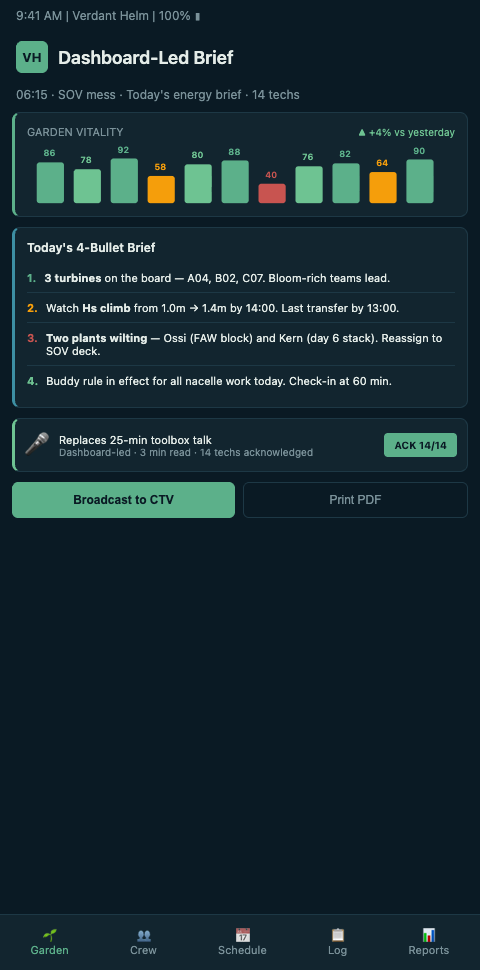
Verdant Helm replaces the morning TBT with a dashboard-led energy brief. The vessel's bridge monitor or the shore base's morning-huddle screen shows the day's garden — every tech on rotation as a perennial with a live bloom state, each bed tagged with its watering (rest, hydration, climb load) from the prior 48 hours, and each sink called out where energy has pooled low. The brief runs for eight to ten minutes and closes on a sequence decision, not a topic recap.
The structure is simple. First minute: the garden view. The whole crew sees the bed layout and the bloom map before anyone speaks. Second minute: the pair assignments with their combined bloom score. Third and fourth minutes: the G+ Learning From Incidents workstream pulls the most relevant pooled precursor for the day's task profile — a slip pattern from the same sea state two weeks back, a hatch incident from a similar climb cadence — and the dashboard anchors the precursor in the garden context. Fifth through seventh minutes: open Q&A against the garden, where a tech can flag their own bloom state and the crew adjusts the ticket order in real time. Eighth minute: close with a single sequence decision — who climbs first, who rests the afternoon, who runs the watch pair.
The garden vocabulary is the change the script-based TBT could not produce. A tech who would never raise their hand to say "I'm tired" will say "I'm at amber today" when the dashboard is already showing them as amber. The brief becomes a two-way read. The ASSP PSJ structured-briefing guidance is what the tool operationalizes; the garden is what makes the structure stick in the crew's memory past the end of the call.
The Human Factors in Wind three-pillar frame fits the brief cleanly. The individual pillar is each perennial's bloom. The team pillar is the pair score. The organisational pillar is the sequence decision the lead signs off on. All three read off the same screen. The tech learns to read the garden; the lead learns to shape the garden; the operator learns to benchmark the garden against the G+ pooled dataset across the fleet.
Operators running the brief for a season find that the dashboard reshapes other rituals upstream and downstream. The live energy dashboard work on cruise fleets runs on a compatible pattern. Within wind operations, how O&M managers sequence turbine climbs using gardens is the tactical layer the brief feeds into, and reading tech energy like a turbine vibration trace is the upstream calibration that keeps the bloom signal clean.
Advanced Tactics
Four patterns sharpen the brief over a season. The first is the pair-score veto. The pair combined bloom score is the gatekeeper for the day's assignments. If the score sits below the site threshold — most operators set it at 1.4 on a 2-point scale — the lead cannot clear the pair for nacelle entry without a supervisor override. The override itself logs into the bloom dataset, which feeds the retrospective at the end of the rotation. The veto is unpopular in week one and produces the cleanest handover-error reduction by week six.
The second is the precursor rotation. Instead of cycling 30 TBT topics on a monthly script, the dashboard pulls the day's relevant precursor from the G+ Learning From Incidents pool plus the operator's own incident ledger. If the garden shows a cluster of amber rope-access perennials on a day with a 1.5-meter sea state, the precursor shown is the matched slip pattern from the operator's own field or from the pooled dataset — not the scheduled "tool tethering" topic that happened to fall on this Tuesday. Relevance drives attention; the SPE OnePetro 25%-reduction data is what operators get back in the first quarter. For jack-up campaigns mid-installation, the precursor pulls from WTIV-specific cases — leg-punch-through events, crane-cycle fatigue patterns — rather than the generic CTV cycle.
The third is the tech-driven re-sequence. Verdant Helm builds in a five-minute re-sequence window during the brief where any tech can flag a bloom read that contradicts the dashboard reading — an HRV anomaly, a sleep disruption the wearable missed, a personal event the tech did not log. The flag triggers a re-read of the pair score, and the sequence shifts if the pair score drops below the threshold. This is the human-factors pillar the Tandfonline scoping review insists on; the garden gives the tech the vocabulary to use it without feeling watched.
The fourth is the post-brief residue check. Twenty minutes after the brief, the tool runs a one-question ping to each tech — one micro-survey item tied to the brief's sequence decision. The ping rate and the answer pattern are the residue check. If residue drops across the rotation, the brief format needs recalibration. If residue stays high, the brief is landing. The BSEE TAP report explicitly flags verbal-briefing attenuation over time; residue checking is the counter-pattern.
The fifth pattern, which operators add after a season of briefings, is the vessel-specific calibration. A 27m CTV running a 90-minute transit to a near-shore Siemens Gamesa field has a different brief rhythm than a walk-to-work SOV running 21-day rotations to a Hornsea 3 Vestas V236 cluster. On the CTV, the brief lands at the shore base before boarding; on the SOV, it lands on the vessel itself, with the overnight shift still in residue. Verdant Helm ships two brief templates — a pre-boarding variant and a vessel-resident variant — and each template carries a different bloom-read cadence tuned to the preceding rest window.
Run the Brief on Your Next CTV Sailing
If your morning TBT has been the same 30-topic cycle for more than six months, your techs are memorising and tuning out. The Verdant Helm team will ship a two-week pilot — reconstruct your last 30 days of bloom curves from shift and transfer logs, install the brief dashboard on one vessel's bridge monitor, and train your lead on the eight-minute sequence. Offshore Wind O&M leads running CTV operations from UK, German, Taiwan, and US East Coast bases have used this pilot format, as have SOV masters on walk-to-work fields like Dogger Bank A and Hornsea 3. Most leads report the re-sequence veto catches two to three misaligned pair assignments in the first week and the tech-driven flags surface within the first five briefs.
Citations:
- MDPI: Effectiveness of Toolbox Talks as a Workplace Safety Intervention — Scoping Review
- ASSP: Safety Moments and Toolbox Talks (PSJ)
- OnePetro/SPE: Structuring the Active Safety Briefing Through Enhanced Toolbox Talks
- G+ Learning From Incidents Workstream
- Human Factors in Wind: About Human Factors
- Energy Institute: Unprecedented Growth in Offshore Wind Accompanied by Rise in Injury Rates
- BSEE: Worker Health and Safety on Offshore Wind Farms
Book the two-week pilot with the Verdant Helm team to reboot your morning brief.