Reading Tech Energy Like a Turbine Vibration Trace
Two Traces, One Eye
At 08:00 in the O&M control room of a Dogger Bank A control centre, the condition-monitoring engineer expands a seven-week window on the Siemens Gamesa 14-222 DD turbine's gearbox vibration trace. A 0.3 mm/s drift climbs across the window, subtle enough to miss on a single day, impossible to miss across seven weeks. She flags the bearing, schedules the inspection, and the callout enters the work pack. At 09:00 the same team leader reading the nacelle tech's post-climb energy scores sees a comparable drift — baseline 85, last five climbs 82, 79, 76, 73, 71 — and green-lights the Tuesday transfer anyway. The difference is not the data.
The difference is that the gearbox trace has been read as a signal for decades, and the tech trace has not. A condition-monitoring specialist has three trade associations, two peer-reviewed journals, and a career ladder organised around reading bearings; the crewing manager reading the tech trace has, at most, a tab in the same dashboard and a five-minute slot at the Friday forecast meeting.
The cost of that asymmetry shows up in the failure numbers. A Strathclyde analysis of failure rate, repair time, and unscheduled O&M cost by Carroll et al. puts gearbox failure at 0.154 events per turbine per year, with the most expensive cases being the ones that reach catastrophic failure without warning. Trace readers catch 70-80% of those before the unscheduled callout. The same discipline applied to crew telemetry would catch a comparable fraction of near-misses before they reach the incident log — but only if the human signal is read with the same patience and cadence as the machine signal. On a typical 80-turbine asset running Vestas V174 or Siemens Gamesa 193-DD platforms, that capture rate translates into roughly 8-12 prevented near-misses per season and, more importantly, a steadier bloom state across the crew through the back half of a stacked weather window.
A foundational IET Renewable Power Generation review by Tavner et al. codifies how SCADA and vibration data get trended, clustered, and modelled into normal-behaviour baselines so that drift becomes visible rather than noise. That discipline is the template. The O&M control room already has it. What is missing is the equivalent for the tech bed next to the turbine bed. The language the two read in common — slope, envelope, covariance, residual — makes the crossover easier than it sounds; a condition-monitoring engineer who has been reading vibration traces for a decade can learn to read tech traces in a week.
The Garden's Condition-Monitoring View
A gardener who knows one perennial bed reads its current bloom against its own seven-year history, not against the other 40 beds in the garden. Verdant Helm applies the same principle to each tech. Grip strength on the climb-assist, HRV on an optional chest strap, sleep self-report, logged meals, near-miss proximity, transfer attempt count, time-in-nacelle all get traced against that tech's personal normal-behaviour envelope. The drift pattern that matters is deviation from self, not ranking against the roster. A gearbox specialist who runs 78-84 on her envelope is not the same kind of bed as a blade tech who runs 86-92; comparing them flat against each other misreads both.
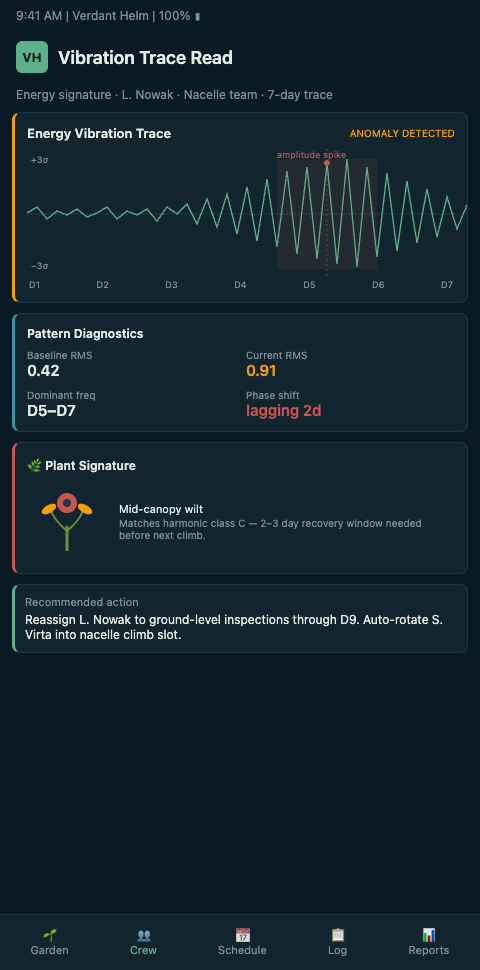
The result is a bloom trace that looks eerily like the gearbox plot. A senior blade tech who normally registers 82-88 on the composite score over a six-month baseline begins trending 79, 76, 74, 73 across a stacked weather week. No single reading is alarming. The drift is. The vibration analogy holds: a 0.3 mm/s rise on a gearbox is not immediately a failure, but the slope through four readings is the signature the condition-monitoring engineer looks for. A Wiley Wind Energy paper on combining SCADA and vibration formalises this as an integrated anomaly model — multiple subtle shifts across correlated channels becoming a single confident prediction. The crew trace applies the same logic: a grip drop plus an HRV narrowing plus a third consecutive sub-baseline sleep becomes a confident signal that the bed needs pruning on Tuesday, not a data point the manager discounts as a one-off.
The crew version works the same way. Verdant Helm correlates the bloom drift with the shift envelope the tech has been working — CTV transfer frequency, climb count, nacelle temperature exposure, overnight SOV sleep — so the trace is read in context. A peer-reviewed PMC guideline for HR and HRV in occupational medicine confirms that HR and HRV telemetry reliably assess workload, recovery, and fatigue when read as continuous signals with a personal baseline, precisely the role vibration traces play for a bearing. A systematic MDPI Machines PRISMA review of vibration-based predictive maintenance documents the methodology at depth: trend detection, remaining-useful-life inference, and thresholding against personalised envelopes — all directly portable to crew telemetry when the framework decides to port it.
The garden language holds the analogy without flattening it. Each tech is a perennial bed. Each bloom reading is a sample. The trace is the season's history across that bed. The condition-monitoring engineer reads bearings the same way a head gardener reads the plot that has been there since the garden was planted: carefully, with context, and with the patience to let drift accumulate into a clear enough signal that pruning becomes a defensible decision rather than a reaction.
Advanced Tactics
Four pattern-reading habits separate teams that use the trace from teams that merely collect it.
First, read the slope, not the level. A tech whose absolute score is 75 but who has been trending stable there for six months is a healthy bed. A tech whose score is 85 but trending down 2 points a week is a bed already pruning itself. An MDPI Energies paper on machine-learning vibration monitoring demonstrates how slope-based anomaly detection catches bearing faults 4-6 weeks earlier than level-based alarms. Verdant Helm's default dashboard foregrounds slope and tucks level behind an expansion click, because the slope decision is the one that changes what happens Tuesday morning.
Second, weigh correlated channels as a bundle. A 3% drop in grip strength in isolation is noise. A 3% grip drop plus a 5 bpm resting HR rise plus a skipped mess hall breakfast is a signature. The vibration literature calls this covariance of informants; the gardening eye calls it reading the whole bed at once. An NSC Work to Zero brief on fatigue monitoring and wearables makes the case that multi-channel fatigue signals have substantially higher predictive value than any single sensor, and the same logic applies to the crew trace. Verdant Helm fires its amber flag only when two of three correlated channels agree, reducing false positives that would burn trust.
Third, let seasonality inform the envelope. A tech whose scores drop 3-5 points across mid-season every year is showing habituated seasonal strain, not new deterioration. The condition-monitoring literature treats ambient temperature and turbine load as normalising covariates for the vibration model; the crew trace needs the same treatment for weather-window stacking and rotation phase. Year-two baselines look different from year-one baselines, and the dashboard should reflect that so the team leader does not prune a bed that was going to bloom again on schedule.
Fourth, keep the review cadence honest. A gearbox is reviewed weekly at minimum by a dedicated specialist. A tech's trace should be reviewed weekly by someone whose job description explicitly includes it — not parked in a dashboard that only opens when someone is already worried. Teams that build the trace into Friday forecast meetings alongside the gearbox review get the full benefit of the framework. Early pilots that failed at this step taught the lesson: one UK operator loaded the crew trace alongside the vibration trace in a shared dashboard but did not assign review ownership, and within six weeks the crew-side plot was unmaintained while the gearbox plot stayed pristine. The discipline is organisational, not technical. Naming a single occupational health lead or senior shift leader as the weekly trace reader is the difference between a framework that compounds and a dashboard that decorates.
The analogy strengthens when paired with concrete rollout. A turbine technician's first month with Verdant Helm walks through how the baseline gets established in the first 30 days so the trace becomes readable by month two. Dashboard-led energy briefs replace toolbox talks on many teams, which creates the daily review habit the trace needs. The underlying pattern echoes shore-side oil rig practice too — the rig crew energy drilling-fluid report uses a near-identical trace discipline applied to drilling operations, and the cross-industry read sharpens the offshore wind eye.
Start the Trace This Week
Offshore Wind O&M teams who already trend gearbox vibration know what a trace worth reading looks like. Verdant Helm supplies the crew-side equivalent in a form that is readable by the same engineers who already review the machine traces. Crewing managers and CTV masters can pilot the trace on a single vessel over one rotation, and by the second rotation the bloom slope will already be informing the Tuesday dispatch. The gap between the gearbox trace and the tech trace does not need to exist any longer than the next campaign.
Begin with the same four channels the condition-monitoring engineer already trusts: a composite score built from grip-assist log data, a self-reported sleep number, logged near-miss proximity, and cumulative transfer count across the past fourteen days. Four channels is enough to build a readable envelope within two weeks of trace data. Add the chest-strap HRV layer in the third rotation only if the techs opt in and the operational health lead holds the data boundary honestly — rushing the wearable layer ahead of trust is how these programmes die.
Budget ten minutes at each Friday forecast meeting for a trace review alongside the gearbox review. The condition-monitoring engineer who reads bearings reads the crew slope too, side by side, using the same language — slope, envelope, covariance, residual. That shared review ritual is where the framework earns its place in the operational cadence. Once the Friday meeting routinely pauses on an amber bloom slope the way it pauses on a drifting bearing, the trace has graduated from a dashboard to a working instrument, and the next stacked weather window will find the crew genuinely ready for it rather than nominally cleared.