A Turbine Technician's First Month With Verdant Helm
Sunday Evening, Esbjerg Quayside
A graduate wind technician finishes her GWO Basic Safety Training in Denmark on Friday afternoon and reports to the Esbjerg quayside at 17:00 Sunday. Her WINDA record shows five fresh BST modules — First Aid, Working at Heights, Manual Handling, Fire Awareness, Sea Survival — all valid through the next 24 months. She has never boarded an SOV before. The crewing manager hands her a tablet at the mess hall door during dinner and walks her through the Sunday baseline card on Verdant Helm: sleep last night, current energy self-score, any physical flags, BST refresher status. Five inputs. Three minutes. By 20:00 her plot shows as a green sprout on the SOV's garden dashboard — a single fresh bed among the 12 that make up Monday morning's rotation.
The deployment is on an Orsted-operated North Sea field of Siemens Gamesa 8MW turbines, a 28-day rotation with two weather windows already modelled in the Monday forecast.
The research on new-worker risk is unambiguous. Safety + Health Magazine reports first-month workers carry 3x the lost-time injury risk compared with workers with a year or more of tenure; the early-tracking gap is where most of that risk compounds. US BLS Occupational Outlook data on wind turbine technicians captures the field's entry paths and growth trajectory — the role is expanding faster than the scaffolding that supports new hires into safe, sustainable rotations. An NREL workforce assessment on the US wind energy workforce documents the onboarding gap in structural terms: the pipeline is growing, and the first-month experience is the hinge point for whether the new tech stays and compounds into a senior resource or burns out inside the first year. The sector's first-year attrition sits at 20-30% across most European operators, and the exit interviews consistently cite the first-month overload as a primary driver.
The BMC Public Health SEM study on quantitative demands and offshore wind worker stress links high quantitative job demands to stress reactions, and notes that new hires are more exposed to the mismatch between demand and resource because they are still building the buffer. The garden view gives the new tech — and her shift leader — a scaffolding that makes that buffer visible.
Month One, Bed by Bed
A head gardener planting a new bed does not expect full bloom in the first week. The first month is soil conditioning: watering deliberately, checking the seedling daily, pruning back any early stress, learning the bed's particular response to rain and sun. Verdant Helm's first-month onboarding runs the same pattern for a new turbine tech, and the result is a scaffolded arrival rather than a plunge into the rotation.
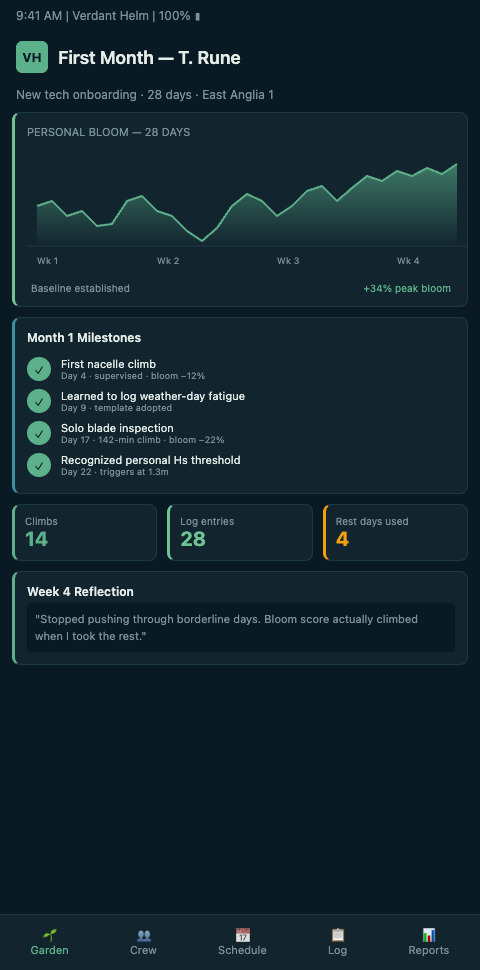
Week one is baseline establishment. Our tech's Sunday sprout gets re-scored every morning at breakfast — two minutes on the mess hall tablet, grip self-report, sleep log, any physical flags. Her first climb on Monday is a 45m gearbox visual with a senior tech partnered to her. The dashboard records the post-climb bloom state and she learns to read her own reading: a climb at 45m drops her score from 86 to 81, recoverable with a lunch break. By Thursday she has four climbs logged, a readable personal baseline emerging, and a pattern visible to the shift leader — she recovers well overnight, she benefits from the climb-assist, her grip holds strong through the morning and drifts in the afternoon.
The US Department of Energy wind technician career map names the first-year skill ladder that frames this progression; the garden reads the underlying energy state that the skill ladder does not.
Week two introduces the first rotation-length ledger. Our tech has now been on the SOV for nine days. The weather delivered two workable windows with a three-day Hs 2.5m gap in the middle. She climbed on six of the nine days, with rest on day 4 during the storm gap. Her bloom trace across the nine days shows the characteristic sawtooth of a well-scaffolded new bed: dips during climb days, recovery during rest days, no sustained drift downward. The American Clean Power guidelines for entry-level wind technician training emphasise progressive competency and supervised task elevation — the garden's role here is not to replace the senior tech's supervision but to add a visible energy layer so the supervision can adjust pacing without requiring a weekly formal review.
On day 7 her senior partner adds a 60m gearbox visual on a turbine with a logged pitch system anomaly, which is her first work on a turbine with an active condition-monitoring flag; the dashboard records a modest bloom dip that recovers overnight, a healthy pattern she will learn to recognise as exposure-to-complexity cost.
Week three graduates her to a partner she has not worked with before. The dashboard shows the pairing as a fresh combination — amber on the social-dynamic channel, not because either tech is tired but because they have not climbed together. Verdant Helm's pairing layer uses social dynamics as a subtle input alongside bloom state, and the shift leader sees the fresh pairing at the 07:00 brief without needing to recall it. The two climbs on Tuesday go well. By Thursday the amber clears and they are logged as a viable pairing for future rotations. The garden has recorded both tending of the new bed and tending of the shared pairing dynamic.
Week four is rotation close-out and first-month review. Our tech's aggregated bloom reading shows a healthy first month: 18 climbs logged, no near-miss entries, sustained bloom state trending slightly upward as she adapts to the rotation rhythm. The shift leader reviews her plot alongside her at the Friday close-out; she sees her own readable trace, recognises the days she felt tired and matches them to the dashboard's amber flags, and signs off on a refresher request for Advanced Rescue Training she did not know she would want until Week three. She disembarks on Sunday having spent a first month that built her baseline rather than a first month that consumed it.
Advanced Tactics
Four habits make first-month onboarding on Verdant Helm produce compounding value rather than a checkbox.
First, protect the first-climb pairing. The strongest predictor of a good first month is the senior tech assigned as the first-week climbing partner. Verdant Helm's pairing engine deliberately matches new techs with partners whose bloom trace shows high stability — senior techs with consistent green baselines, low near-miss counts, good sleep patterns. The BZEE Network Wind Turbine Service Technician training program frames competency development as scaffolded mentorship, and the garden's pairing logic operationalises that scaffolding for the daily dispatch.
Second, hold the Friday close-out weekly for month one, not monthly. The trace reading discipline develops with practice; a new tech who sees her own bloom plot every Friday for four weeks learns to interpret it in a way a once-monthly review cannot replicate. The close-out is 15 minutes, involves the shift leader and the tech, and pairs the bloom reading with the WINDA/training view so the tech sees the full garden from her own bed outward. Teams that run the weekly close-out report new techs are more likely to self-flag wilt honestly in months two and three than teams that bundle reviews quarterly.
Third, set the recovery threshold tighter for first-month techs. A senior tech's amber flag at a 78 score is normal cyclical drift; a first-month tech's amber flag at 78 is an earlier red because the buffer has not yet been built. Verdant Helm's per-tenure calibration adjusts the flag thresholds across the first 90 days, relaxing them as the baseline stabilises. Crewing managers who protect this calibration avoid the most common first-month failure mode: a junior tech pushed through an amber day because the threshold was read against the senior norm.
Fourth, wire the month-one learnings into the month-two rotation plan. The first month's bloom trace has revealed a tech's personal patterns — who she pairs well with, what climb load she tolerates, how she recovers from stacked days, when her grip drifts. Verdant Helm's rotation planner carries these patterns into month two automatically, so the second rotation's dispatch does not start from zero. The tech feels the continuity, the shift leader inherits the scaffolding, and the second-month jump in capability that the BZEE program framework anticipates becomes visible in the garden reading.
The first-month rollout links naturally to the broader framework. Reading tech energy like a turbine vibration trace trains the eye the new tech will need by month three, and planting an energy garden on your walk-to-work SOV covers the vessel-level rollout the new tech joins on Sunday. The cross-sector analogue is a toolpusher's first week with an energy dashboard, which runs the same first-week scaffolding for drilling operations; the parallel reads help crewing managers calibrate what first-month onboarding should look like when done well.
Onboard the Next Graduate into a Planted Garden
Offshore Wind Ops teams taking on graduate intakes this season can have Verdant Helm's first-month framework live on a single SOV in under a week. The Sunday baseline card, the weekly close-out, the pairing engine, and the per-tenure threshold calibration run on the same dashboard the senior crew already use. Crewing managers and training coordinators find the new tech's first rotation produces a readable plot that shortens the month-two planning cycle while protecting the buffer the first month exists to build. Plant the next hire's bed before she boards. The garden will be readable by her second weather window.
Start with the next one or two graduates rather than a cohort rollout. A single new bed in a roster of 11 senior ones is an easier first test than a cohort of four new techs whose baselines have not yet calibrated and whose social-dynamic channel is amber by default. The shift leader gets one first-month trace to read, the senior partner gets one climbing relationship to establish deliberately, and the crewing manager gets one clean dataset to compare against the next rotation. The lessons from that single first month scale into the cohort rollout without the noise that a four-tech first-day launch creates.
Time the rollout to match a shoulder-season rotation rather than a July stacked window. The graduate's first 14 days should not land inside a compressed weather window where the roster is already pushing hard. A September or May rotation with a more typical weather mix — one workable window, one rest gap, moderate Hs — gives the new tech a baseline that will generalise to the harder windows later. A graduate who builds her baseline on a stacked July will have a skewed trace that reads amber for normal rotations through the rest of the year; a graduate who builds her baseline on a typical September rotation will have a reading that stays honest across the season. The crewing manager who protects this calibration window gives the garden a full year of readable data rather than three months of miscalibrated noise before the trace settles.