Planting an Energy Garden on Your Walk-to-Work SOV
The 28-Day Clock Starts at Sunday Supper
A 12-tech offshore wind crew boards an Esvagt-class or Edda Wind SOV in Esbjerg at 18:00 Sunday for a 28-day deployment on a 99-turbine North Sea field running Siemens Gamesa 8MW turbines. The Monday forecast shows 14 workable days over the next 21, compressed into two weather windows with five-day gaps of Hs 2.8m swell between. Dinner is on the vessel at 19:30. The safety briefing runs 21:00-22:00. The first gangway transfer opens at 07:45 Monday morning, weather permitting. The crewing manager in port has signed the rotation. The SOV master has signed the safety plan. Nobody has signed anything resembling a crew-energy plan, because that document does not yet exist on most SOV decks. The rotation will consume 12 techs over 336 accommodation hours each across 28 days, and the workload will bunch into 14 gangway days that each demand 8-10 productive hours on turbine.
The SOV paradigm was designed for this compression problem. The Ampelmann walk-to-work reference explains the W2W/SOV paradigm as a direct response to CTV weather limitations: bring the accommodation to the field, and the transfer window widens from the vessel-dependent 1.5m Hs cap to the gangway-dependent 2.5-3.5m range. An Identec Solutions piece on W2W gangways confirms the widened access envelope, and a peer-reviewed MDPI JMSE paper on vessel-borne motion-compensated gangways shows these systems reject roughly 91% of wave-induced disturbance. The engineering is mature. What lags is the crew-side equivalent: a framework for pacing 12 techs across 28 days when the weather dictates when the beds bloom and when they must go still. Operators like Siemens Gamesa Service, Vestas Service, and Orsted-run in-house O&M teams each have different rotation patterns — 14/14, 21/21, some bespoke 28/28 — and the garden framework has to calibrate per-pattern rather than apply a single template.
A ScienceDirect engineering paper on SOV motion-compensated gangway control captures the hard part: the gangway compensates for vessel motion, but it does not compensate for accumulated crew fatigue. That compensation is the garden's job. The Sunday-evening hours between arrival and lights-out are the planting window, and most SOV deployments leave them empty. The empty window costs more than it shows: a 12-tech crew that boards without a baseline card enters Monday's gangway with no reference against which to read Tuesday's amber flag, and the whole 28-day rotation runs with a one-week lag before the dashboard carries useful signal.
Planting the Beds Before Monday's Gangway Opens
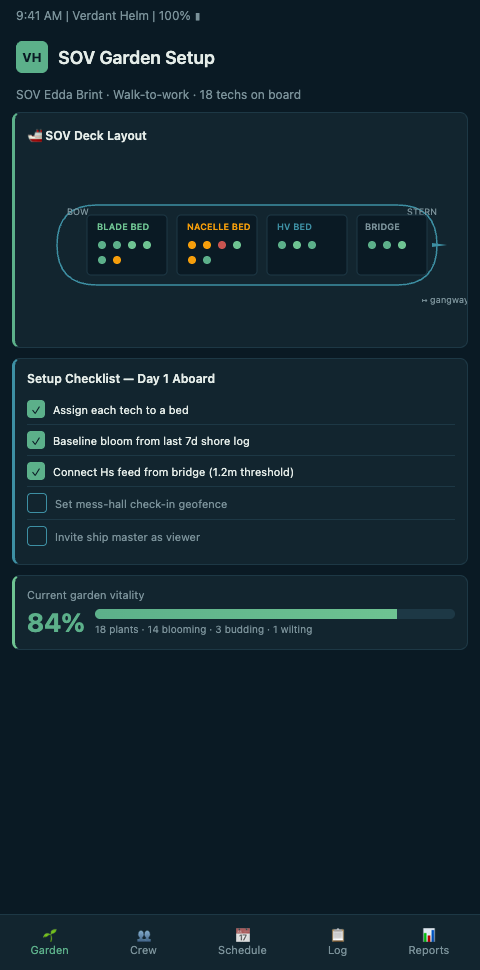
The garden metaphor becomes structural on an SOV. Each tech's cabin is their bed. The mess hall is the shared soil. The gym is a water source. The gangway platform is the exit to the field where the bloom gets asked to produce. Verdant Helm's SOV rollout pulls these elements into a single bloom-state dashboard the SOV master and crewing lead can read at the 07:00 brief.
Sunday evening plants the baseline. Each tech records a five-minute check-in: sleep last night on shore, current energy self-score, any flagged physical issues, WINDA refresher status. The Esvagt and SDU SEEDS framework — stress, exercise, teams, diet, smoking — operates as the operational template on the vessel, and the garden view maps it directly: stress and exercise are wilt-and-bloom signals, teams is the shared-bed dynamic, diet is the mess-hall soil feed, smoking is a pruning input. The Sunday baseline card for each tech shows as a green sprout on the dashboard by Monday morning. The weather forecast overlays as pressure: a 14-day compressed window shows as a visible intensity gradient across the 21-day bed view.
Monday's first gangway opens with the garden already annotated. Five techs are green and carry the first climbs. Three techs registered amber on the Sunday card — mild travel fatigue, one flagged knee, one under-slept — and take lighter tasks. Four techs are fresh but new to this SOV; they shadow the first day. The SOV master's 07:00 brief reads the garden state aloud, not the alphabet. The gangway opens at 07:45 and the first transfer crosses on a plan that has priced the deployment's first cost centre — the transit from home — as deliberately as it prices the sea state.
By 11:00, the five green beds have completed their first gearbox rounds on turbines at the field's weather-exposed edge; by 14:00, the three amber beds have come back from lighter ply inspections on the sheltered inner turbines; and the four new techs have each completed one shadowed climb and filed their first post-climb bloom reading.
The perennial framing holds through the compression windows. An industry analysis at NS Energy on Service Operation Vessels one year on documents 28-day deployments, gangway uptime, and the crew-flow patterns that emerge. The industry handbook for floating offshore wind SOV specs describes the rotation structure and onboard workflow in detail. The garden view sits on top of both — a bloom reading per tech, a wilt flag per bed, a prune decision per marginal climb, and a recovery day sequence built from the forecast stacking. Techs who flower consistently through days 1-10 absorb the first window; techs sitting in energy sinks on day 6 get tended, not stacked. By day 14 the second window opens onto a roster that has been rotated through rest deliberately, not a roster that has simply survived the first window and been asked to produce again.
Advanced Tactics
Three rollout practices separate SOV deployments that inherit a living garden from those that merely install the dashboard.
First, commit the mess hall to the reporting rhythm. The garden only stays readable when the Sunday baseline card gets followed by a two-minute daily re-score at breakfast. Teams that fold the re-score into the mess hall morning flow — a tablet by the coffee urn, a one-question check on grip and sleep, a private self-score — find the signal arrives at the 07:00 brief without anyone chasing it. Teams that leave the re-score to cabin discretion find compliance drops below 60% by day 10 and the garden goes half-dark for the second window. The integration is a rhythm decision, not a technical one. The SOV chef turns out to matter more than most technical choices — a chef who sits the tablet beside the coffee and knows every tech's name by day 3 drives compliance above 90%, while an anonymous mess setup rarely crosses 70%.
Second, use the compression forecast to schedule recovery, not just work. A Tuesday-Wednesday window of Hs 2.8m with no workable transfers is a free gift to the ledger — but only if it gets used as one. The Guide to Floating Offshore Wind SOV handbook describes mandatory rest envelopes that many rotations treat as waiting time. Verdant Helm flips the frame: the two-day gap is programmed as a recovery block with explicit gym slots, mess-hall full meals, and a 09:30 light-duty briefing instead of a 07:00 operational brief. The beds that wilted through the first window come back ready, not merely idle. The crewing manager sees the recovery hours tagged on the bloom trace, and the second window opens to a re-greened garden rather than a continuation of the first.
Third, treat the gangway platform as the garden's checkpoint, not the clock. Every transfer out and back records a bloom-state marker — Hs at transfer, gangway compensation at landing, tech self-report at return. The MDPI JMSE gangway paper confirms the 91% disturbance rejection benchmark, but the tech's subjective energy state still carries the residual motion load, and the platform is where that state gets captured. Verdant Helm's gangway module turns the W2W advantage into accurate accounting: the widened access envelope becomes visible recovery margin rather than silent accumulated load. Esvagt and Edda Wind vessels running on UK, Dutch, and German waters produce different residual motion signatures even at the same gangway class, and the garden view stores the per-vessel calibration so the checkpoint reading stays comparable across SOV substitutions mid-campaign — an operational reality when vessels rotate between fields to track weather.
The SOV rollout compounds when paired with adjacent practice. A turbine technician's first month with Verdant Helm runs through the onboarding scaffolding for the new tech among the 12, and SOV transit cycles planned from garden curves shows the master-side view of the same bloom data. For teams moving between sectors, the first energy garden on a jack-up rig uses a closely related baseline card adapted to jack-up crew schedules, and the cross-read helps calibrate what to expect from a first SOV deployment.
Plant Sunday Evening, Not Monday Morning
Offshore Wind Ops teams who run SOV campaigns can install Verdant Helm's Sunday baseline card on the vessel tablet fleet in a single port call and have a readable garden by the first Monday gangway transfer. SOV masters and crewing leads find the 07:00 brief shortens from 25 minutes to 15 when the bloom state is already plotted. Plant the first deployment's beds this Sunday, and the second window of the campaign opens onto a roster that has been tended rather than merely rotated.
Stage the rollout across two 28-day deployments rather than one. The first deployment calibrates the baseline card to the vessel's real crew — the chef's mess-hall flow, the gangway lead's transfer protocol, the per-tech energy curves. The second deployment operates on the calibrated model with the lessons of the first already in the ranges. Crewing managers who try to launch the full framework in a single rotation tend to get a half-working dashboard and a half-convinced crew; crewing managers who split the rollout get a working one by day 14 of the second deployment.
The port-call moment matters more than the vessel tablet setup. Board the vessel with the Verdant Helm field engineer on Sunday afternoon before the techs arrive. Walk the mess hall, the gym, the gangway platform, the two highest-use cabin blocks, and map each as a garden zone on the dashboard before supper opens. When the techs board at 18:00 and the five-minute baseline card prompts them in the mess hall at 19:30, the zones are already named and the SOV master has already approved the gangway checkpoint as a reading station rather than a compliance gate. The crew's first interaction with the garden is a Sunday supper conversation, not a Monday morning memo — that framing carries the whole deployment.