A Toolpusher's First Week Reading Energy Dashboards
Day One: The Screen Is Already There
A new toolpusher lands on a drillship in the Gulf and walks into the doghouse for his first handover. On the wall next to the mud report and the drilling mechanics screen is a new display — colored tiles representing crew energy state by department. The outgoing toolpusher gestures at it during handover. "The new system. OIM wants us reading it. Honestly, I check it maybe twice a day." The new toolpusher files the comment. For the first three shifts, the dashboard is background.
On shift four, he watches the drill floor tile shift from green to amber over a 12-hour period and asks the OIM about it. The OIM explains the read. By end of week one, the new toolpusher is reading the dashboard the way he reads the mud report — at handover, before JSA reviews, when a permit is being signed. The difference between an ignored screen and a working tool was seven days.
The industry is transitioning at scale. A Drilling Contractor piece on Transocean's digital transformation documents Transocean's performance dashboards, designed with cognitive psychologists, that toolpushers now use daily. Seadrill's data-driven performance platform shows toolpusher-facing dashboards updating in real time with rig and crew data. A DataCalculus industry piece on drilling best practices describes the toolpusher onboarding curve to data and analytics tools and the change-management learning curve that goes with it. The dashboards are arriving on rigs across the fleet. The reading practice is the gap. First-week onboarding is where the gap closes or persists.
Seven Days of Garden Literacy
The Verdant Helm onboarding for a new toolpusher is a seven-day structured engagement that teaches the dashboard the way a drilling supervisor would teach a new well plan — with progression, with repeated practice, with an experienced reader in the room. The garden metaphor is what carries the learning. By the end of week one, the toolpusher is reading the dashboard as the garden: beds, plantings, wilt, bloom, sinks, pruning. Not a data display. An operational map of the living crew system.
Day one is orientation. The toolpusher walks the physical rig with the OIM and the outgoing toolpusher, and on each visit to a department — drill floor, mud pit, roustabout pool, galley, marine — the OIM opens the dashboard and shows how that department appears as a bed in the garden. The OIM reads the current state out loud. The incoming toolpusher asks questions. Forty minutes, spread across the morning walk. No screens after that until the handover.
Day two is reading practice. The new toolpusher shadows the OIM reading the dashboard at 06:00, at the permit review, and before the afternoon handover. Three readings, each with the OIM narrating what they are seeing and why. The toolpusher takes no action. Listening only. A ResearchGate academic paper on an FRMS dashboard for high-risk occupational settings describes the cognitive load of first-time dashboard reading and the value of accompanied reading in the first days — the shadowing pattern reflects that research.
Day three is co-reading. The new toolpusher reads the dashboard first at each checkpoint and states their read. The OIM confirms or corrects. Three checkpoints, five minutes each. The errors are the learning. A toolpusher who misreads a yellowing drill floor bed as weather-driven when the data shows sleep debt gets corrected immediately and will not make the same misread again.
Day four is solo reading. The OIM observes but does not narrate. The toolpusher reads the dashboard at handover, at permit review, and at the end-of-shift walk. The OIM reviews the reads at the end of the day — what was caught, what was missed, what actions were proposed. By this point the dashboard is a tool the toolpusher is working with, not a screen they are looking at.
Days five through seven are integration. The dashboard becomes part of the toolpusher's normal operational flow — consulted before JSA reviews, referenced in permit discussions, cited in handover notes. The SLB DrillOps drilling advisory reference gives the vendor overview of how drilling advisory dashboards integrate into the toolpusher's daily rhythm, and the Verdant Helm onboarding follows the same integration pattern for crew-energy dashboards. By day seven, the dashboard is indistinguishable from the mud report in operational weight.
The PwC Strategy& market report on drilling digitization provides context for why the first-week discipline matters — upstream digitization is moving faster than operational adoption, which means rigs that invest in reading practice outperform rigs that merely install dashboards. The Halliburton Energy Pulse article on AI in drilling reinforces that operator perspective on AI-augmented dashboards — the tool is only as useful as the reader's practiced eye.
The Toolpusher's First-Week Dashboard View
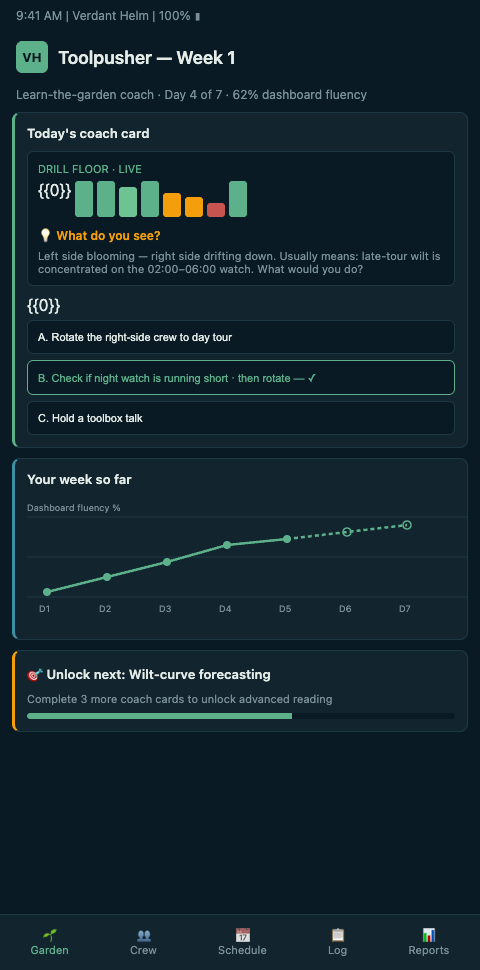
The dashboard a first-week toolpusher reads is the same dashboard a seasoned toolpusher reads — the interface is not simplified for onboarding. What is different is a persistent "teaching layer" that can be toggled on during the first hitch. The teaching layer surfaces interpretive notes — "this bed has yellowed over three days, typical pattern is deck-team mid-hitch wilt" — that an experienced reader would surface mentally. The toolpusher can turn the layer off anytime. Most do by day five. That progression from scaffolded to unscaffolded reading is what the onboarding supports.
The crew-vitals reading discipline provides the mental model the first-week toolpusher maps the dashboard onto. The rig-wide garden display post covers the physical deployment context — where the dashboard lives on the rig, who has access, how the display scales from the doghouse tablet to the mess screen. Both contexts matter for the first-week reader.
Advanced Tactics: Week Two and Beyond
Three tactics extend first-week literacy into ongoing mastery. First, keep a reading journal for the first full hitch. The toolpusher writes one paragraph at end of shift capturing what the dashboard showed, what they did, and what happened. Reviewing the journal at hitch end with the OIM turns experience into explicit knowledge. Most toolpushers stop journaling after hitch one. The ones who continue become the rig's dashboard teachers for subsequent new hires.
Second, rotate dashboard-reading responsibility across the senior crew. A rig where only the toolpusher reads the dashboard is a rig one handover away from losing the practice. A rig where the OIM, both toolpushers, the senior HSE coordinator, and the rig medic all read the dashboard daily has the practice distributed across roles. Distributed reading is what makes the garden resilient to crew changes. Verdant Helm supports multi-role dashboards for exactly this reason.
Third, cross-reference with adjacent-industry onboarding. Offshore wind technicians arriving on SOVs face the same first-week dashboard-literacy problem. The turbine technician first-month onboarding post documents the first-month curriculum wind operators use to onboard new technicians into the dashboard practice. Drilling contractors can adapt the curriculum with minor edits. The learning is the same.
The common mistake is to hand a new toolpusher the dashboard URL and assume they will figure it out. Without the seven-day structured onboarding, dashboard adoption stalls at "the screen I check when something feels off" — which means it only gets checked when the garden is already wilting. The point of the garden is to read the state before it wilts. That reading takes practice. Week one is where the practice is planted. Verdant Helm's onboarding makes sure the planting takes root.
A fourth tactic is to have the incoming toolpusher teach the dashboard to their own shift crew during week two. Teaching is the fastest way to lock in reading practice, and the senior drilling hands benefit from a structured 15-minute walkthrough of the garden state each shift-start for the first week. Toolpushers who teach the dashboard in week two retain the reading habit through hitch end. Toolpushers who keep the reading private often revert to the mud report alone by week three. Teach the garden to keep the garden.
A fifth tactic is to capture the toolpusher's reading of a specific incident within the first hitch. When a near-miss occurs, the incoming toolpusher writes a one-paragraph retrospective explaining what the dashboard was showing in the 24 hours before the incident and what read they had at the time. That retrospective, reviewed with the OIM, converts a generic onboarding into a concrete case. Toolpushers who have one concrete case grounded in their own rig's data read the dashboard differently afterwards. The abstract pattern becomes operational memory. By month three, the toolpusher is reading the garden with their own library of cases, not the generic onboarding examples.
CTA: For Drilling Supervisors Onboarding New Toolpushers
For drilling supervisors or OIMs preparing to welcome a new toolpusher onto a rig running energy dashboards, the first week is where the adoption curve gets set. Verdant Helm provides a seven-day structured onboarding plan with shadowing scripts, reading practice checkpoints, and a journaling template for hitch one. Pair it with a quick scoping call to tune the onboarding to your rig's specific operational rhythm. The week-one practice decides whether the dashboard lives or dies — the conversation is worth having before the new toolpusher lands.
The scoping call takes 25 minutes and covers three practical inputs. First, the incoming toolpusher's prior dashboard experience — a toolpusher who has read crew-energy dashboards on another rig runs a compressed four-day onboarding rather than the full seven. Second, the rig's current garden state at the time of arrival — a toolpusher landing during a mid-hitch wilt has different day-one reading practice than one landing during a fresh crew change.
Third, the OIM's available time across the first week — days two and three require 30 minutes of shadowing each, and an OIM running a high-tempo operation may need the rig medic or senior drilling supervisor to cover some of that shadowing. The call ends with a named day-by-day plan the OIM prints and keeps on the operations-office wall. Drilling supervisors who run the scoping conversation before the toolpusher lands report smoother first hitches and higher dashboard-reading retention across months three and six. The conversation is the cheapest part of the rollout — the expensive part is a toolpusher who arrives without the onboarding and stops reading the dashboard by hitch two.