Ditching Paper Fatigue Logs for a Rig-Wide Garden Display
1,400 Paper Forms Per Hitch
A UKCS jackup running a standard rota generates close to 1,400 paper fatigue self-reports across a 21-day hitch — a form per crew member per shift across the drill floor, derrick, subsea, marine, and catering departments. The toolpusher signs maybe 200 as part of the daily routine; the rest are filed in a cabinet outside the medic's office. When the HSE auditor turns up and asks to see a hitch-over-hitch trend in sleep-debt self-reports from the drill floor, the rig spends four days with a roustabout and a clerk stitching a retrospective picture together from photocopied sheets. The trend that emerges is real, but it arrives eight weeks after the moments where it would have changed a decision. The paper system was adequate when the regulator asked for evidence of a process; it struggles when the regulator asks for evidence of actual risk management in the daily flow of operations.
A ScienceDirect interview study on offshore fatigue management found that the overwhelming majority of offshore sites rely on supervisor observation and paper self-report, and that this approach degrades precisely as the rotation stretches and sleep debt accumulates (Safety culture and worker fatigue management offshore). The UK's Step Change in Safety OIM guidance on rota and rest periods offshore sets out the evidence expectations, and field practice shows most rigs meet the letter with paper while missing the spirit — the kind of continuous picture that actually supports decisions (Step Change in Safety OIM Guidance for Offshore Rota and Rest Periods). The gap is not policy. The gap is the medium. Paper captures the signature; it does not capture the state behind the signature, and by the time the trend can be reconstructed from the archive, the decisions that would have used the trend have already been made.
The Mess-Hall Garden Display
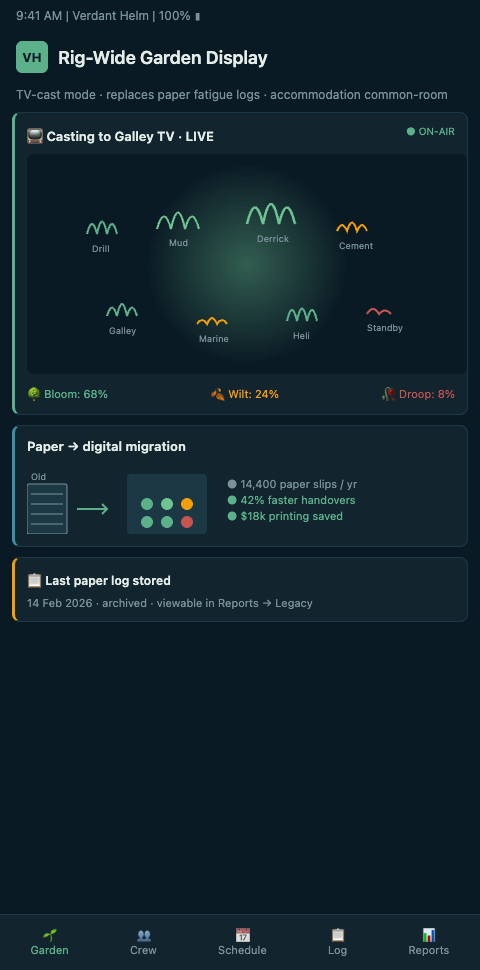
Verdant Helm replaces the filing cabinet with a rig-wide garden display. The concept is simple: every crew member's energy state is a plant in the shared garden, and the garden is visible in the mess hall, the driller's cabin, the subsea engineer's office, and the OIM's office. A perennial in bloom is a rested crew member; a wilting plant is a sleep-debt signal; a pruned bed is a shift that finished with a recovery window. The metaphor is not decoration. It is a shared mental model that travels across roles without needing training in dashboards. The roustabout at the coffee urn sees the same garden as the OIM in her office, and both can talk about it in the same language, which reduces the cultural distance between the crew and the safety program.
The practical shift rests on four design choices. First, the self-report moves from paper to a 30-second tap interaction at shift-change (in the mess hall, at the cabin door, or on a tablet at the driller's shack). The report is fewer questions, captured more often, and signed digitally. The tap interaction also makes it possible to add mid-shift micro-reports when a crew member feels a state change, which is data the paper system cannot capture. Reduced questions mean reduced friction, which is the single biggest predictor of whether self-report data will be honest rather than performative.
Second, the display is public but de-identified by default. A toolpusher sees named data for their department; the mess hall shows department-level bloom and wilt patterns. This is a culture decision as much as a data decision. A Sage paper on FRMS dashboards for high-risk settings walks through the trade-offs of name-level vs aggregate display and the conditions under which each works (A Fatigue Risk Management System Dashboard for High-Risk Settings).
Third, the display ingests adjacent signals: sleep quality proxies, time-since-sleep, workload density from the IADC DDR (where available), and peer observation. Step Change in Safety's guidance on human-factors fatigue reinforces the need for a formal process beyond a clipboard signature (Step Change in Safety Human Factors Fatigue). Fourth, the data is evergreen. An HSE auditor asks for a six-month trend and the rig pulls it in two clicks. The same data base serves the medic, the OIM, the drilling supervisor, and the shore-based safety team without separate reports.
Existing paperless EHS tooling in oil and gas shows the baseline for the market: platforms handle near-miss, incident, and audit workflows in digital form, and the next layer is continuous fatigue (EHS Insight Oil and Gas Safety Management Software; BasinCheck 10 Best Safety Management Software for Oil & Gas). An offshore operator's case study on the Hercules HSE dashboard illustrates what a full digital replacement for fragmented reporting looks like in practice (Oil & Gas Journal Hercules HSE Dashboard). The garden overlay adds the human-energy view on top of that compliance layer. It does not replace the existing HSE platform; it sits alongside it, sharing crew identifiers and event timelines so the HSE and fatigue views converge in the supervisor's decision flow without requiring a separate login or a parallel report.
Advanced Tactics for Rolling Out the Display
Three tactics turn the display from a screen in the mess hall into a decision tool. The first is department weaving. Drill floor crews bloom and wilt differently from marine crews; catering differently again. Show each department on its own bed, then show the composite garden. This stops the "overall looks fine" problem where one department's trough is masked by another's bloom. The first-week toolpusher fatigue dashboard view walks through how a toolpusher uses the same data structure during their first seven days. Each department's color palette and plant type on the display is distinct, so a quick glance from across the mess hall conveys the rig-wide picture without needing to read labels.
The second tactic is the morning garden walk. The OIM, toolpusher, and HSE lead spend five minutes each morning at the display before the tailgate meeting. Three questions: which beds wilted overnight, which are recovering, and which tasks today will ask the most of the current garden. This is faster than the paper review it replaces, and it changes the task assignment that follows. The walk also doubles as an informal one-on-one — a roustabout passing through the mess hall during the walk can catch the OIM's attention about a specific concern, which the clipboard system never encouraged. Over a rotation, the walks accumulate into a shared reading of the rig's state that transfers across OIM handovers more reliably than a written handover document.
The third tactic is the audit-ready export. When an HSE auditor asks for a trend, the display exports a PDF with the narrative, the charts, and the linked events. The audit conversation moves from "where's the paper?" to "why did the drill floor bloom drop on day 13?" — a more productive conversation. The same export format feeds IADC daily drilling reports powered by garden data, so the reporting investments compound.
A fourth tactic is crew-led garden curation. Nominated crew representatives from each department review the display weekly and flag patterns they see. This distributes the sensemaking across the rig rather than concentrating it in the OIM's office, and it catches cultural signals (a new crew member isolating, a roster change producing unexpected friction) that pure data streams miss.
Common mistakes include rolling the display out without crew consultation (the plants do not trust the gardener), showing too much named data in shared spaces (which suppresses honest self-report), and keeping the paper system as a parallel track for six months (which signals that the digital system is optional). A less obvious trap: the display that only updates at shift-change misses mid-shift signals; real-time micro-updates (workload, radio traffic, task sequencing) keep the garden honest between formal reports. Another trap is treating the display as a one-time installation — the display is a living instrument that needs periodic re-calibration as crew composition, rota patterns, and rig operations evolve. The parallel practice on cargo vessels — MLC rest-hour paperwork replaced by a bridge dashboard — shows how the same logic applies to a different regulatory frame.
Retire Your Filing Cabinet
If you run an OIM or HSE lead role, pull the last hitch of paper fatigue self-reports and count how many actually changed a task assignment, rota decision, or supervisor conversation. The number is usually in single digits, and the remaining thousand-plus pages are filing-cabinet evidence that nobody will read until the audit. That is not a filing problem; it is a signal-routing problem, and the paper form is the wrong medium for the signal. Verdant Helm gives toolpushers and OIMs a mess-hall display that replaces the clipboard and turns the self-report into a live decision input. Book a walkthrough: send us the layout of your rig's mess hall and the current rota, and we will model what the garden looks like after one hitch of data, with a specific transition plan that runs the paper and digital systems in parallel for two hitches before the paper retires.