IADC Daily Drilling Reports Powered by Garden Data
The Fields Everyone Leaves Blank
The IADC Daily Drilling Report Plus schema was launched in 2018 to replace the flat-file DDR with a granular XML framework. The Drilling Contractor coverage of the DDR Plus launch described it as enabling granular digital data collection across drilling operations. The DDR Plus daily drilling report overhaul analysis detailed the standard framework for richer activity tracking, including fields for non-productive time causes.
In practice, across audits of 200 drilling reports submitted to a UK operator's office in late 2025, more than 60% of the crew-context and welfare-related fields in the DDR Plus schema were left blank. The IADC DDR Plus FAQs specify the field definitions; nothing requires operators to populate them, and most do not. The result is that the richest machine-readable drilling report in the industry carries everything about the well and almost nothing about the crew that drilled it.
That gap is not neutral. The operator's office reviewing 14 rigs' DDRs at 08:00 every morning reads wellbore, mud, trip, and NPT data but has no visibility into the crew state that produced that data. When an NPT event shows up, the office has no context about whether the crew that experienced the NPT was already in wilted condition or not. The question "why did this happen?" becomes a phone call rather than a data query.
What Garden Data Fills In
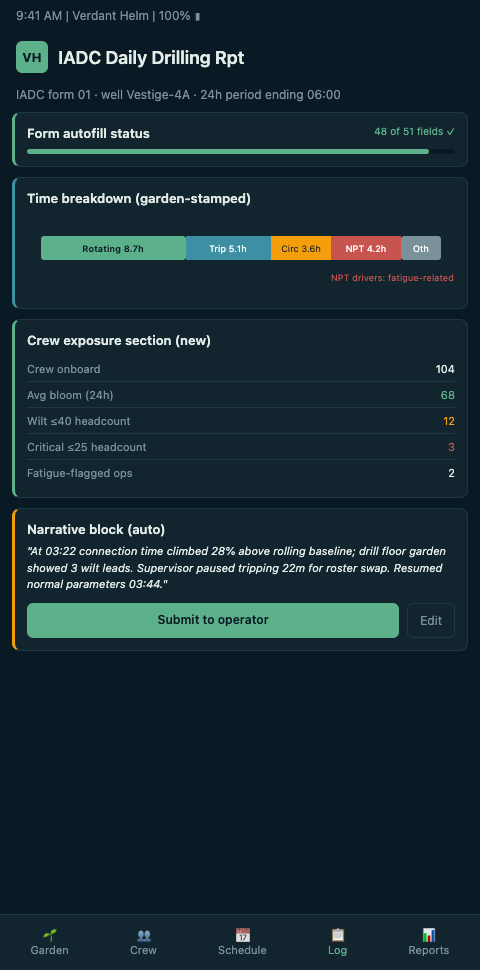
Verdant Helm renders crew as a living botanical garden. Each perennial's bloom state, each bed's energy, each shared sink, each pruning decision — all of it is structured data suitable for mapping into DDR Plus fields. The integration targets five specific field groups the schema already defines.
Crew rotation context. The DDR Plus has schema fields for crew changes, hitch day, and continuous-duty hours. Garden data populates these from the underlying perennial assignments. An operator's office reading the morning DDR sees "day 17 of 21-day hitch, three crew members at elevated wilt, one compensator in drill floor bed" as structured XML rather than absent data.
Non-productive-time attribution. The DDR Plus supports richer NPT cause tracking than the legacy schema. Garden data adds welfare-signal NPT context: whether the crew that experienced the NPT was already showing wilt before the event, whether a sink pattern preceded the NPT by 12-24 hours, whether the compensator who was carrying load collapsed. The OnePetro SPE-163402 DDR automation paper documents that DDR Plus granularity enables richer benchmarking and automation integration, and welfare-attributed NPT is a clear fit.
Safety observation counts. Garden data counts pruning decisions, sink interventions, and compensator-reduction actions across the 24-hour window. The DDR Plus has safety-observation fields that operators typically populate only with count totals; garden-derived observations add qualitative categorisation that the office can actually act on.
Handover quality. Garden data renders handover deltas — how much the incoming shift's bloom pattern differs from the outgoing shift's expectation. DDR Plus handover fields usually carry a timestamp and nothing else.
Look-ahead risk. Day-in-hitch context plus rotation decay curves plus current wilt state produces a next-24-hour risk signal. DDR Plus look-ahead fields are schema-defined but usually unpopulated. Garden data populates them with a numeric score and three structured rationales.
The Integration Architecture
The mechanics use WITSML as the transport layer. The Energistics WITSML data standards documentation describes the XML-based real-time rig-to-office transfer standard that DDR Plus builds on. Garden data gets serialised into WITSML-compatible XML segments and attached to the DDR Plus document. The operator's office reads a single DDR, not a DDR plus a separate welfare feed.
The OnePetro innovative automated data-driven DDR paper describes automated DDR generation from digital execution platform real-time streams — the same architectural pattern, applied to welfare data. The integration does not require a new system. It requires that the welfare data system already speak WITSML or be bridged to a platform that does.
Three implementation decisions matter for making the integration load-bearing rather than decorative.
First, populate the fields with data suitable for the office audience, not the rig audience. OIMs want bloom/wilt detail. The office wants numeric scores, attributable NPT categories, and three-bullet narratives. The serialisation layer has to translate rig-level complexity into office-level summary, or the DDR becomes unreadable at 08:00.
Second, timestamp the welfare observations consistently with drilling activity timestamps. NPT reconciliation across welfare and drilling data is only useful when the timelines align. The Coherent Market Insights analysis of the drilling software market projects growth from $4.17B in 2026 to $7.29B by 2033 at 8.3% CAGR — and a non-trivial fraction of that growth is driven by integration like this one.
Third, pilot the integration on one rig for 60 days before fleet rollout. Office readers take time to adjust to richer DDRs. If the integration adds five new fields on day one across 14 rigs, the office ignores them. One rig's DDRs as the pilot lets the office team learn what to do with the new fields.
Why the Office Morning Call Changes Shape
Operator offices reading 14 rigs' DDRs at 08:00 have a specific rhythm. The lead reviewer opens the fleet summary, scans wellbore status across rigs, flags NPT events, and assigns follow-up calls. That rhythm is tuned for a DDR that carries well-and-equipment data but treats crew as an implicit constant.
Welfare-enriched DDRs change three specific elements of that morning call. First, the NPT review acquires a second layer. Instead of "why did this NPT happen?" the reviewer asks "why did this NPT happen, and was the crew already wilted when it happened?" The second question produces different investigations. A pump-failure NPT on a well-rested crew is a mechanical investigation; the same NPT on a crew showing three days of sink pattern is a scheduling investigation.
Second, the 24-hour look-ahead acquires actionable structure. Office teams have historically used look-ahead for logistics — helicopter flights, material orders, visitor schedules. Welfare look-ahead adds a risk dimension. A rig with elevated compensator concentration and day-18-of-21 hitch timing triggers a different set of office-side preparations than a rig at day 6 with distributed bloom.
Third, contractor comparison shifts from monthly safety-statistics review to daily welfare-signal review. The office stops comparing contractors on TRIR trends because those trends are quarterly at best. It starts comparing them on garden-health trends because those are daily and actionable. The cumulative effect is that contractor conversations become more frequent, more specific, and less statistical. The implications for contract management are significant — welfare-enriched DDRs create a feedback loop that conventional drilling reports did not support.
Advanced Tactics: Reading the DDR at 08:00 With Welfare Signal
Operations managers and drilling superintendents in the operator's office should add three reading habits when welfare-enriched DDRs arrive. First, scan the day-in-hitch column before the NPT column. Context precedes event. An NPT on day 3 of a 21-day hitch reads differently than the same NPT on day 18.
Second, treat the compensator-concentration field as a leading indicator for the next 24-48 hours. A single crew carrying elevated compensator load across three consecutive DDRs typically produces either a near-miss or a rotation adjustment within a week. Office readers who spot this pattern early can prompt the OIM to rebalance before the event.
Third, compare welfare-attributed NPT across contractors at fleet scale. The Drilling Contractor coverage of DDR Plus launch emphasised industry-wide digital coordination. Operators with welfare-enriched DDRs across multi-contractor fleets can surface contractor-level welfare patterns that drive contract negotiations.
For the cross-industry parallel on how cruise-line welfare reporting is absorbing similar enrichment, see CLIA seafarer welfare reports powered by garden data. For the upstream workflow that makes welfare-enriched DDRs audit-ready, see HSE audits moving to continuous telemetry. For the operator-contractor interface document changes required to formalise welfare data in DDRs, see bridging document revisions for energy-aware drilling ops.
What the 60-Day Pilot Reveals
Operators who have run the 60-day DDR enrichment pilot report three operational findings that shape fleet rollout decisions. First, the office team's initial reaction is skepticism followed by adoption around day 20. For the first three weeks the office reviewers note the new fields but rarely act on them; by week four, the reviewers start asking follow-up questions anchored to welfare data. The cultural inflection is predictable and can be planned for.
Second, the rigs that generate the cleanest welfare data are not the rigs with the most mature welfare programmes. They are the rigs where the toolpusher and OIM have integrated garden review into their own morning routines. The upstream discipline — the OIM actually reading the garden before populating welfare fields — determines the downstream data quality. Rigs where welfare data is filled in mechanically produce fields that the office team correctly ignores. Rigs where welfare data reflects genuine OIM reading produce fields that drive office decisions.
Third, the integration exposes contractor gaps quickly. A multi-contractor fleet running welfare-enriched DDRs produces comparisons across contractors that become visible to the operator's office within the first month of broader rollout. Contractors with stronger welfare culture show up in the DDRs as providing richer, more actionable fields. Contractors with weaker culture produce empty or rote fields. That visibility tends to drive contractor conversations in the first quarter of broad rollout, which is ahead of where most operators expected the conversations to emerge.
The Morning Call Gets Sharper
OIMs on rigs that already generate garden data and drilling supervisors whose offices consume DDRs should pilot welfare-enriched DDR Plus on one rig for 60 days starting next quarter. The pilot rig keeps its existing drilling report workflow; the welfare fields populate automatically and the office reads them alongside the usual drilling data. Verdant Helm handles the WITSML serialisation as a standard integration. Book a DDR integration scoping call and bring one recent DDR from a rig with known welfare data — we will show the same report enriched and walk through what the office team would read differently.