CLIA Seafarer Welfare Reports From Garden Data
The End Of Narrative Welfare Reports
For most of the last decade, cruise operators have submitted welfare data to CLIA and flag states through annual narrative reports. A welfare officer on each ship wrote a few pages summarizing crew wellbeing, survey results, shore leave statistics, and incident counts. The CVP of Hotel Operations signed it. The legal team reviewed it. It landed in an archive that nobody read until the next audit. The welfare officer on a 2,100-crew megaship could genuinely believe she was capturing the ship's state, while simultaneously missing the mid-contract wilt of her Filipino cabin stewards and the social-withdrawal patterns of her Croatian maître d' team, because neither showed up in the narrative structure the submission required.
That model is ending. The April 2025 MLC amendments require operators to report on shore leave access, bullying, and harassment by December 2027, with evidence that goes beyond narrative description. CLIA's State of the Cruise Industry Report 2025 and its sustainability data template both signal a shift toward aggregated operator data feeding industry-wide benchmarks. The industry is moving from "write a few pages" to "produce continuous evidence." Flag-state inspectors who used to accept narrative assurances now ask for shore-leave utilization logs by port and by crew role. Port state control officers arriving for an inspection in Southampton or Miami ask for the welfare dashboard, not the welfare memo.
For a cruise operator, the problem is concrete. The welfare officer on a single megaship cannot produce continuous evidence without a data layer underneath. The shoreside welfare team cannot aggregate across 32 ships without a system feeding them consistent signals. The legal team cannot sign a submission under the new regime without the underlying data being defensible to auditors. The annual narrative was a shortcut that papered over a missing capability. The new reporting regime surfaces the gap. Operators who discover the gap during a 2027 audit will be scrambling to reverse-engineer 18 months of telemetry they never captured, while operators who built the data layer in 2026 will already have a year of clean submissions behind them.
The Garden As Welfare Reporting Source
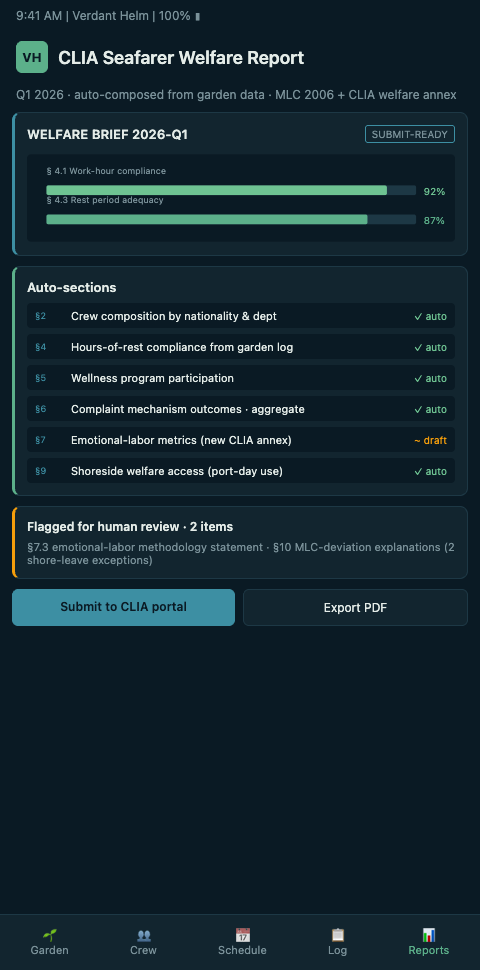
Verdant Helm's garden telemetry produces exactly the kind of continuous, evidence-backed welfare data the new regime expects. The reporting stack has three layers, and each one aligns with a specific regulatory requirement.
The daily garden layer captures the signals the ship itself uses to tend crew welfare: bloom and wilt cycles across stateroom attendant and cabin steward teams, sink formation where crew energy pools below recovery thresholds, pruning and recovery activity logs, and the shore-to-ship social graph patterns that indicate isolation or connection. On a seven-day Eastern Caribbean itinerary, the daily layer records which crewmembers took shore leave in Cozumel versus St. Thomas, which attendant rotations triggered wilt signals, which recovery activities the Hotel Director's welfare officer executed in response, and which maître d' teams stayed within their rest-hour floors across the third and fourth sea days. This layer corresponds to MLC Regulation 2.3 on work and rest and MLC Titles 3 and 4 on welfare, producing the evidence that rest hours are being honored and welfare infrastructure is operational.
The monthly shipboard roll-up aggregates the garden signals into the submission format the welfare officer assembles. Bloom-to-wilt ratios by department. Shore leave utilization rates by port and by crew role — Filipino cabin stewards at 78% utilization in Cozumel versus 42% in Costa Maya, Indonesian F&B servers at 65% in Grand Cayman versus 91% in St. Thomas. Sink recovery times and the operational interventions that produced them. Harassment and bullying flags raised through the garden's social signal layer, linked to the reporting requirements in the 2025 MLC amendments. This layer is what the Hotel Director signs off on before the report leaves the ship, and it carries the operational context that makes the numbers defensible to a port state control officer.
The fleetwide CLIA submission layer aggregates across all ships in the operator's fleet, producing the industry-level data that feeds CLIA's annual cruise industry report. Verdant Helm's aggregation matches CLIA's sustainability data template structure, so the submission moves from the operator into the industry benchmark without manual reformatting. The ILO Maritime Labour Convention is the underlying international standard this submission is measured against, and IMO's seafarer fatigue and harassment briefing frames the enforcement trajectory. An operator running Verdant Helm across 32 hulls produces a CLIA submission that reconciles across flag states, ship classes, and itinerary types without the three-week manual aggregation that used to precede every submission window.
The shift from narrative to continuous evidence has a second-order effect worth naming. Operators who run the garden for welfare reporting discover that the same data is directly useful for port state control inspections, flag state audits, and ITF/Nautilus union reviews. The reporting burden consolidates. One source of truth feeds multiple compliance layers. A Panama flag state audit and a Bahamas port state control inspection can both be answered from the same garden logs, and the legal team sees the same data the welfare officer sees and the CVP sees in her quarterly review. The failure mode this prevents is the common one where three compliance audiences get three different slices of the truth because each audience is answered from a separate spreadsheet.
Advanced Tactics For Welfare Reporting Leaders
The welfare reporting shift rewards operators who get ahead of it. Three tactical moves separate the leaders from the scramblers.
Structure the garden data schema to match CLIA's submission taxonomy from day one. The operators who are running garden telemetry without a reporting target are generating interesting data that requires extensive rework to submit. Verdant Helm's welfare reporting module maps the garden schema to CLIA and MLC submission fields at the source. A Hotel Director running the system on a single ship is already producing submission-ready data for the fleet welfare officer to roll up. The counterfactual is expensive: if you build the garden data in one schema and the submission expects another, you pay for the schema migration in 2027, during the reporting window, when every welfare officer in the industry is also scrambling.
Build the welfare review cadence around the reporting cycle. The monthly shipboard roll-up becomes the welfare review meeting artifact. The CVP of Hotel Operations reviews the same data the CLIA submission will carry, so there is no gap between what the fleet uses operationally and what the industry submission says. The ships that align these two artifacts avoid the common failure mode where operational welfare reviews surface issues the submission never mentions — and where the submission paints a clean picture the welfare team knows is incomplete. On a 32-ship fleet, the aligned cadence also means every Hotel Director uses the same vocabulary in the quarterly review, which makes cross-ship comparison legible for the first time.
Align the harassment and bullying reporting with the 2025 MLC timeline. The December 2027 deadline for the new MLC amendments is close enough that the welfare schema needs to be ready in 2026. Operators who wait until 2027 will be running a schema change mid-reporting-cycle, which is how submissions get delayed and welfare officers get burned out. The SMS Revisions That Protect Guest-Facing Crew post documents how the same data layer supports SMS clause revisions in parallel with welfare submissions. Running the MLC schema and the SMS revision on the same 2026 timeline produces one coordinated compliance project rather than two overlapping ones.
Run a pre-submission audit every quarter, not just before the annual filing. Operators who hold their breath for twelve months and then discover gaps in November when the submission is due in January produce rushed, defensive submissions. Running a pre-submission audit at the end of each quarter — where the fleet welfare officer pulls the garden data as if a port state control inspection were tomorrow — catches schema drift, missing shore-leave fields, and unresolved harassment flags early enough to correct them cleanly. One operator running quarterly audits cut their submission-window overtime by roughly 60% in the first year, freeing the welfare officer to spend December and January on operational work rather than data reconciliation.
The garden-as-reporting-source model has a parallel in cargo shipping, where port state control evidence packs use the same underlying telemetry for inspection readiness.
And the always-on monitoring trust patterns piece is directly relevant — welfare reporting only works when crew trust that the data is being used to tend them, not to surveil them.
Where Cruise Welfare Officers Should Start
If you are a Hotel Director, Cruise HR leader, or fleet welfare officer preparing for the 2027 MLC deadline, the time to build the reporting stack is now. Pull your last four welfare submissions and map which fields were narrative, which were supported by ad-hoc data, and which had continuous evidence underneath. The gaps are your 18-month project plan. Schedule a Verdant Helm welfare reporting review with your CVP of Hotel Operations and your flag-state compliance lead, and walk through what the December 2027 submission looks like in the new regime. The operators who run this review in 2026 are going to have a much easier 2027 than the ones who wait.
The sequencing matters. Build the daily garden layer first on two pilot ships in Q2 2026, the monthly shipboard roll-up in Q3, and the fleetwide aggregation in Q4. The 2027 submission window then lands on a system that has been producing evidence for twelve months, which means the welfare officer's December 2027 workload is a review-and-sign rather than a reconstruct-and-submit. Fleet welfare officers who have lived through a rushed submission know the difference: a reconstructed submission under time pressure is also the one most likely to miss a harassment flag or a shore-leave utilization discrepancy that a port state control officer will ask about six months later.
The sequencing is the insurance policy against the reconstruction scenario, and it costs materially less in 2026 than remediation costs in 2027 or defense costs in 2028 when the first post-deadline audit cycle begins. Cruise HR Leaders should calendar the quarterly pre-submission audit on their fleet operations calendar alongside the NPS review and the retention review — treating welfare evidence with the same cadence as commercial performance, not as a parallel compliance obligation.