SMS Revisions That Protect Guest-Facing Crew
When SMS Catches Up To Emotional Labor
A cruise line's safety management system is the operating procedure document every ship runs by. Under the IMO International Safety Management Code, the SMS defines how the ship is operated, who holds which responsibilities, and how non-compliance is detected and corrected. Historically, cruise SMS documents have treated crew welfare as a work-rest hours compliance question answered by MLC Regulation 2.3's 14/24 work-hour cap and 10/24 rest-hour floor. The question was whether the hours logged met the floor. The answer was usually yes, because the system was designed to log compliant hours even when the underlying work pattern was grinding crew toward inflection.
That framing is no longer sufficient. The 2025 MLC amendments add mandatory bullying and harassment protections that flow directly into SMS revision requirements by 2027. The IMO seafarer fatigue and harassment press briefing signals regulatory momentum toward emotional-labor protections in the SMS framework. The ICS guidelines on application of the ISM Code, 6th edition added an internal audit chapter that shapes how operators are expected to revise SMS procedures in response. Flag states including the Bahamas, Panama, and Malta are already signaling they will audit against the revised framework rather than accept SMS documents that address only hours-logged compliance.
Cruise Hotel Directors and their safety officers are being asked to revise SMS clauses that treat stateroom attendants, cabin stewards, Lido cast members, and maître d' teams as guest-facing crew whose protection requires more than hours-logged compliance. The question is how to write clauses that are operationally real, auditable by flag states, and responsive to what the garden data actually shows about emotional fatigue. An SMS revision that looks good on paper but cannot be executed on a 2,100-crew megaship during a sea-day sequence produces the worst of both worlds: audit exposure and crew cynicism.
The Garden-Aware SMS Clause
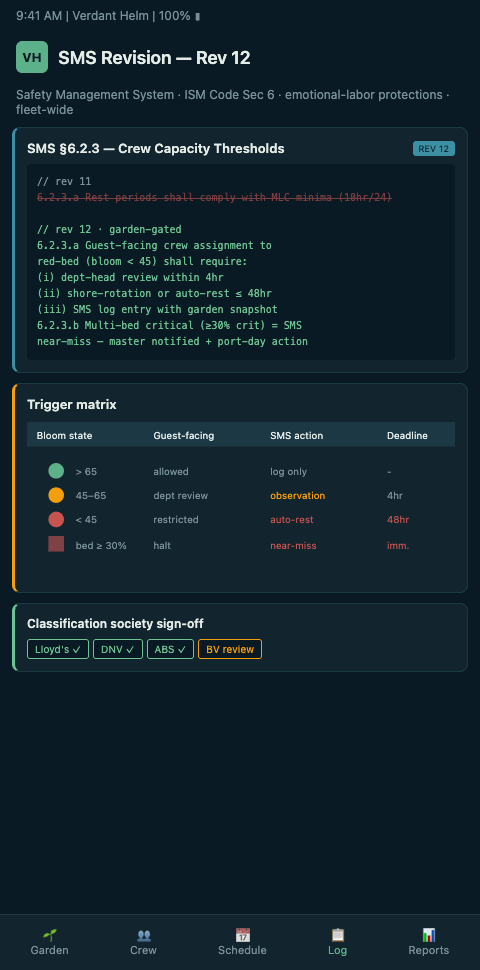
Verdant Helm's SMS revision framework takes the garden metaphor and turns it into procedure language. Each garden-aware clause has three required elements: a definition of the signal the SMS monitors, a threshold at which the ship must act, and a documented response action with accountability.
Clause one addresses wilt detection. The SMS defines what constitutes a wilt signal for guest-facing crew — for instance, a cabin steward whose bloom-to-wilt ratio drops below a defined threshold over a rolling seven-day window, or a Lido cast member whose recovery-after-shore-leave signal fails to return to baseline. The threshold triggers an entry in the ship's non-conformity log. The accountability sits with the Hotel Director's welfare officer, whose response actions are documented in the welfare standup log. An Indonesian F&B server flagged for wilt on the second sea day of a seven-day Mediterranean itinerary produces a non-conformity entry; the welfare officer's response — rotation to a lower-intensity station, pre-booked Valletta port activity, or cross-assignment to a specialty restaurant — closes the non-conformity with documented evidence.
Clause two addresses sink formation. When a garden bed — a specific department on a specific deck on a specific ship — shows repeated sink formation across multiple crew, the SMS requires a formal operational review. This aligns with the UK MSIS 2 ISM Code guidance framework for detecting systemic patterns rather than treating each crewmember as an isolated case. Sink formation in the main dining room on four consecutive itineraries is evidence of structural work design failure, not individual fatigue. The operational review investigates whether the seating density is wrong, the maître d' staffing is thin, or the itinerary pattern is loading the dining venue beyond its sustainable emotional-labor capacity, and it documents the remedy in the ship's safety circular.
Clause three addresses harassment and bullying signals. The 2025 MLC amendments require SMS clauses that define the operator's detection and response procedures. Verdant Helm's social graph layer flags social-withdrawal patterns that correlate to harassment at statistically meaningful rates, and the SMS clause defines the escalation path — from welfare officer to Hotel Director to fleet safety officer to flag state — when those patterns emerge. The clause specifies the detection threshold, the investigation timeline (48 hours for initial interview, 7 days for substantive response), and the documentation requirements that make the escalation auditable by a Bahamas or Panama flag state inspector.
Clause four addresses shore leave adequacy. MLC Regulation 2.3 defines the minimum work-rest structure. The revised SMS goes further by requiring shore leave utilization tracking tied to the garden recovery signals. If a guest-facing crewmember's recovery signal is not returning to baseline after routine port days, the SMS triggers a formal shore activity pre-booking by the shoreside welfare office. The accountability is procedural, not optional. A Filipino cabin steward whose recovery signal has flatlined across three consecutive Cozumel port days triggers a shoreside welfare office pre-booking for the next port, and the welfare officer logs the intervention in the SMS non-conformity close-out record.
Together, these four clauses convert emotional-labor protection from aspiration into auditable procedure. Flag state auditors can read them, evaluate compliance against the garden logs, and write findings. The SMS becomes an operating document that actually reflects how the ship protects guest-facing crew rather than a compliance artifact that sits in a drawer. The counterfactual is the current state on many cruise ships: an SMS that describes welfare commitments in aspirational language, a welfare officer with no data layer to execute against those commitments, and a flag state auditor who writes a pass-through finding because the SMS language was present even if the operational reality was not.
Advanced Tactics For SMS Revision Teams
The operators who are ahead of the 2027 MLC deadline are running three specific plays that SMS revision teams should consider stealing.
Pilot the revised clauses on one ship before fleetwide adoption. A single ship with the four garden-aware clauses in its SMS produces 6-12 months of audit-relevant data before the clauses are rolled out across the fleet. The pilot ship surfaces the real procedural friction — which response actions are actually executable, which signal thresholds produce too many non-conformity log entries, which escalation paths need rewiring. One premium operator running a single-ship pilot in 2025 discovered that their wilt-detection threshold was set too tight, generating 23 non-conformity entries per week that the welfare officer could not close within the documented response window. The fix was to retune the threshold and extend the response window from 7 to 10 days before fleetwide rollout, which prevented the fleet from inheriting a non-conformity backlog. The ICS ISM Code 6th edition guidance specifically emphasizes this internal audit pattern before scaling.
Align the SMS revision cycle with the welfare reporting cycle. The CLIA welfare reporting shift puts operators on a continuous-evidence cadence that the SMS needs to match.
An SMS that requires monthly welfare reviews and a CLIA submission that aggregates monthly data produce one coherent artifact. An SMS that requires annual welfare reviews while the CLIA submission wants monthly data produces two incompatible cadences, and the welfare officer spends her time reconciling the two instead of tending crew.
Tie the SMS revision to the MLC amendment timeline explicitly. The December 2027 deadline for the 2025 MLC bullying and harassment protections is a hard date. SMS revisions that do not explicitly cite the MLC amendment timeline leave operators exposed to audit findings that the revision did not address the specific regulatory driver. Flag state auditors reading the revised SMS will look for the explicit citation, and SMS documents that address the spirit of the amendment without naming it produce weaker audit findings than SMS documents that cite the regulation by section and date. The garden-gated contract reform post frames how the MLC amendments connect to longer-term contract structure changes that SMS revisions need to anticipate.
The cargo shipping industry is revising SMS documents under similar pressure — circadian energy gates in cargo SMS documents parallel clause design work for bridge watchstanders that cruise teams can learn from.
What Cruise Safety Officers Should Do Next
If you are a cruise safety officer or Hotel Director preparing SMS revisions for the 2027 deadline, the sequencing matters more than the clause language. Start with a single-ship pilot, run it for at least six months, and audit the garden logs against the revised clauses before proposing fleetwide adoption. Schedule a Verdant Helm SMS revision review with your CVP of Hotel Operations and your flag-state safety lead, and walk through how the garden data would appear in an ISM Code audit under the revised clauses. The operators who run this review in 2026 will have audit-tested SMS documents when the deadline lands. The ones who wait will be writing clauses in 2027 without the data to back them up.
The pilot ship selection matters more than safety officers typically acknowledge. Pick a ship with an experienced Hotel Director, a stable welfare officer who will not rotate off during the six-month pilot window, and an itinerary pattern representative of the fleet's dominant routing. A Mediterranean seven-day itinerary is usually a cleaner pilot target than a Caribbean turnaround megaship, because the turnaround tempo on a four-day Nassau loop produces too much signal noise for the clauses to calibrate cleanly in six months. Cruise safety officers should also pair the pilot with a specific flag-state liaison from day one, so the auditor who will eventually review the fleetwide SMS is familiar with the clause structure before the first formal audit window.
That familiarity is how the brand gets credit for the pilot work rather than having to re-justify the clause design across every flag state in the fleet's registry portfolio. Cruise HR Leaders supporting the SMS revision should also loop the cabin steward leads and senior maître d's into the clause-review cycle — the crew who live under the SMS daily will catch language that reads clean to the legal team but produces operational friction on the ship, and catching that friction in the pilot phase is much cheaper than discovering it during a 2027 flag-state inspection.