Circadian Energy Gates for the Cargo Ship SMS
The DPA had been drafting SMS revisions for eleven years when the Master on a new container vessel asked him the question that restructured his 2026 workplan. The SMS had a section on fatigue, a section on bridge watchkeeping, and a section on rest hours. All three were MLC, STCW, and ISM compliant. None of them were actually a decision aid. When the Chief Officer's perennial wilted on voyage day nine at 0315 and the Master had to decide whether to slow the vessel, call the Master early, or reshape the watch for the rest of the voyage, the SMS had nothing to say.
The Master made the call from experience. The DPA's question back to himself was obvious: why is the SMS not the place that call gets structured? This post walks through how circadian energy gates are being inserted into cargo-ship SMSs as first-class decision triggers, what the revision pattern looks like, and how it aligns with the ISM regime. The revision pattern has been tested across container operators running Marshall Islands and Liberian flags, VLCC operators running Liberian flag, and bulk carrier managers running Panamanian flag; each has encountered a slightly different audit-cycle calendar, but the gate-structure vocabulary has held up across the sample.
The problem: SMS documents built for paperwork
The cargo-ship SMS is the central instrument of the ISM regime. The IMO ISM Code homepage is the foundational text. ICS's Guidelines on the ISM Code 6th Edition, published in 2024, adds a dedicated internal-audit chapter and is the current baseline. ClassNK's ISM Safety Management System Handbook is the class-society audit handbook informing how SMS procedural revisions land. ClassNK's ISM safety management overview documents the audit pathway per IACS PR9 and Resolution A.1188(33). Lloyd's Register's ISM Code services describe the certification pathway when operators revise the SMS for new instrumentation.
Most SMSs are excellent at documenting the policies, roles, and procedures that the ISM regime requires. Most SMSs are weaker at giving the Master on the bridge at 0315 an actionable decision framework when the signal on hand is a physiological one. The MAIB's interim report on the Solong-Stena Immaculate collision is the current canonical example of how a fatigue-and-watchkeeping gap becomes an SMS gap. What the SMS needs is a gate: a defined set of inputs that trigger a defined set of decisions, with the Master's authority anchored at the top.
The flag-state and class-society sequencing complicates the revision calendar. A Liberian-flag VLCC running DNV classification and running on a five-year ISM audit cycle with annual intermediate audits has different touch-points from a UK MCA-supervised container vessel classed with Lloyd's Register. Marshall Islands and Panama open-registry rules accommodate SMS revisions through the operator's Document of Compliance (DoC) holder; IACS PR9 governs the audit cadence across member societies. ClassNK, DNV, Lloyd's Register, and ABS each publish their own internal audit interpretation documents on top of the ISM base. An SMS revision that has not been sequenced against these cycles can trigger an unexpected non-conformity even when the operational content is sound.
The garden as the input layer for SMS gates
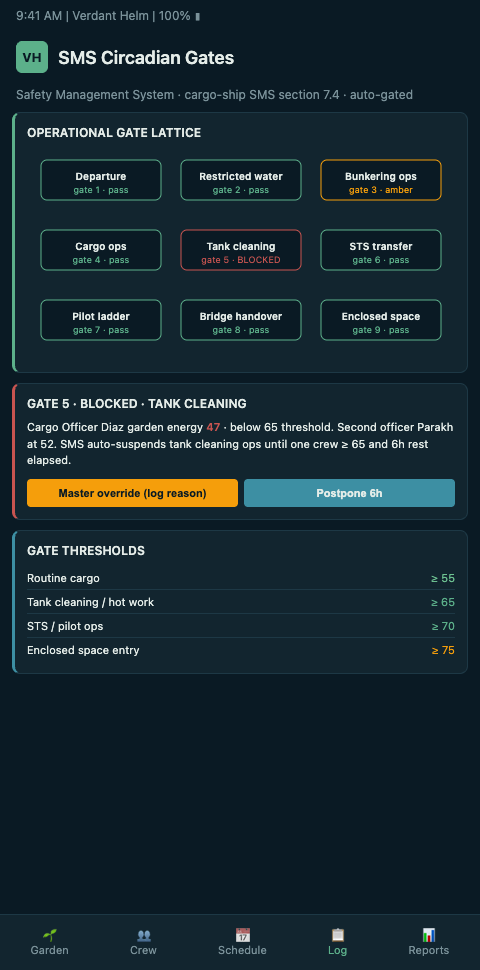
Verdant Helm's bridge-team garden renders each watchkeeping officer's circadian state as a plant, with perennials for senior officers, annuals for juniors, bloom-and-wilt per watch, tend at handover, prune of voluntary overtime, and sink fill for accumulated debt. For SMS purposes, the garden is the input layer. The gates are the decision-structuring wrappers that sit between the garden signal and the Master's action.
The gate pattern we have seen operators converge on has three tiers. Tier one is an advisory gate. When the garden shows a single officer perennial drifting into mild wilt on a non-critical watch window, the SMS asks the Master to note the pattern in the next watch-handover brief and to consider schedule adjustment at the next port call. No operational change is mandated.
Tier two is a procedural gate. When the garden shows the same officer's perennial drifting into severe wilt or shows two or more officers drifting simultaneously, the SMS requires the Master to take one of three defined actions: schedule reshape for the next 48 hours, DPA notification with a documented rationale, or a voluntary speed reduction if the passage permits. The Master's authority remains; the choice is not automated; but the decision is structured and auditable.
Tier three is a hard gate. When the garden shows sink fill above a threshold, a cascading wilt across multiple officers, or a drift that exceeds the vessel's class-profile tolerance, the SMS requires DPA notification, a documented Master response, and a scheduled fleet-safety-officer engagement before the next port call. The SMS authority does not override the Master but requires specific contemporaneous documentation.
Each gate maps cleanly to an ISM clause. Advisory gates sit inside the procedures for day-to-day operation of the ship. Procedural gates sit inside emergency-preparedness and risk-assessment procedures. Hard gates sit inside the non-conformity reporting procedures. The audit trail required for each gate is the same audit trail the class society's handbook already expects, now anchored against a physiological input rather than a form check.
Advanced: how to land the revision without an audit non-conformity
Revising a cargo-ship SMS in the middle of a running class certification cycle is a sensitive undertaking. The operators who have landed these revisions cleanly have followed a five-step pattern. First, pre-audit engagement with the class society. The revision is shared with the class society's ISM audit lead before it is proposed to the DPA's office; the handbook-aligned mapping shows the auditor that the new gates are an addition to existing ISM structures, not a replacement.
Second, parallel operation. The garden-based gates run alongside the existing SMS for one full audit cycle before the old language is removed. Third, the gate thresholds are derived from the operator's own fleet data, not from a generic industry number. Each threshold is documented in the SMS with the supporting aggregate. Fourth, the Master's authority is preserved explicitly. The SMS language makes the gates a structuring aid, not an automated override. Fifth, the DPA-side infrastructure is stood up before the gates are activated. Hard-gate notifications that have no one to receive them are worse than no gate at all.
DNV's ShipManager QHSE platform is a reference for how existing digital SMS platforms accept telemetry hooks procedurally. Operators extending their SMS with circadian gates often use the same integration pattern.
Case-level rollout evidence is helpful for operators planning their own revision. A container operator running 32 mainline vessels under Marshall Islands flag landed its gate revision across a full audit cycle in 2025 without a single ISM non-conformity in the subsequent intermediate audit; the DoC holder reported the revision in the internal audit summary, and the class society's ISM audit lead signed off on the handbook-aligned mapping in the next external audit. A VLCC operator running under Liberian flag followed a similar pattern across 14 crude carriers; the Liberian flag-state administration's inspection coordinator requested the revision package as a reference document for other operators preparing similar revisions. IMO MSC circulars on SMS best practice, including the fatigue-specific circulars in the MSC.1/Circ series, give the drafting vocabulary that maps cleanly onto the gate structure.
P&I club reaction to the gated SMS has been constructive. Britannia's loss-prevention team has published internal commentary that treats tier-three hard-gate documentation as supportive evidence in collision and contact claims; the documentation produces a contemporaneous record of the Master's decision that is difficult to reconstruct after the fact. Skuld's legal team has taken a comparable view on incident claims arising from fatigue-contributory factors. West of England's claims handlers have begun asking operators about gate-based SMS documentation during incident-investigation interviews.
The MAIB, NTSB, and Japan Transport Safety Board have not formally recognized gate documentation as a specific evidence category, but each has accepted gate-generated records into its investigation files on cases where operators have offered them. Paris MoU and Tokyo MoU PSC officers treat the documentation as strengthening the rest-hour evidence chain rather than as an additional inspection burden. The overall pattern across the external-interface map is that the gated SMS produces better outcomes for the operator across almost every touch-point.
The SMS revision is one of three regulatory substrates converging. The PSC evidence packs built on garden data are the port-state-inspection output of the SMS gate structure. The how circadian telemetry will rewrite STCW enforcement analysis tracks how the flag-state drafting side is moving. Offshore oil-and-gas operators have worked through the bridging-document version of this on their rigs; the bridging document pattern for energy-aware drilling is the rig-side analogue.
Verdant Helm's architecture produces the input layer that these SMS gates read from, and the gate language is now being shared across our operator user base as a reference revision. If you are a DPA, fleet superintendent, or ISM internal auditor handling an SMS revision cycle on a deep-sea cargo fleet, we will share the redacted revision language and walk you through the three-tier gate pattern against your current SMS. Bring your current SMS table of contents and your next scheduled ISM internal audit date; we will show you the gates that would land inside your existing cycle without triggering a non-conformity.