How Circadian Telemetry Will Rewrite STCW Enforcement
The IMO Sub-Committee on Human Element, Training and Watchkeeping closed Phase 1 of the STCW comprehensive review in February 2025 with 22 gap areas on the table. Rest-hour enforcement was on the list. So was fatigue. So was the relationship between paperwork compliance and the physiological realities of modern watchkeeping on cargo vessels. The chair of the working group, in an industry briefing a week after the session, made the observation that shaped the rest of the conversation. Phase 1 identified the gaps. Phase 2 must draft provisions that will be enforceable against the ship and the officer, not just against the logbook. That is where circadian telemetry becomes the forcing function.
This post maps how circadian telemetry is going to rewrite STCW enforcement, what that means for flag states and bridge teams, and why the operators who are instrumenting their fleets now are the ones who will shape the provisions rather than react to them. The transition has implications for every Master, Chief Officer, OOW, and cadet standing a 4-on-8-off watch on VLCCs, container vessels, ULCCs, and bulk carriers; for every flag-state administrator writing domestic implementing regulations; for every Paris MoU, Tokyo MoU, and USCG PSC officer running concentrated inspection campaigns; and for every DPA drafting SMS revisions against a moving regulatory target.
The problem: STCW enforcement is a paper tiger on rest hours
The bridge-team Master, Chief Mate, and OOW already know this in their bones. STCW rest-hour rules require minimum off-watch hours and restrict working hours across any seven-day window. Every modern vessel has a rest-hour log that documents compliance. Most flag-state inspectors and most PSC officers can audit that log in twenty minutes. What none of them can audit is whether the rest hours logged on paper translated into actual recovery on the bunk.
The MAIB's interim report on the Solong-Stena Immaculate collision made the enforcement gap uncomfortably specific: lone watchkeeper, no lookout, fatigue and watchkeeping posture at the center of the findings. The IMO press briefing on renewed focus on seafarer fatigue, work and rest hours, and harassment names the problem in regulator language. Phase 1 of the STCW comprehensive review produced the 22-gap list; Safety4Sea's coverage of Phase 1 completion walks through what Phase 2 drafting will touch.
The scale of the enforcement gap is documented in the Paris MoU and Tokyo MoU annual reports. The Tokyo MoU 2024 Annual Report records 32,054 inspections, 1,189 detentions, and 77,526 deficiencies; rest-hour-related findings represent a growing share year-over-year, and the secretariat's narrative notes that deficiencies for hours-of-rest documentation are rising on both Liberian and Panamanian tonnage. The Paris MoU 2024 concentrated inspection campaign on crew wages and SEAs brought the human-element line items further forward. USCG Port State Control Annual Reports document comparable upward trends on deficiencies related to hours of rest on vessels calling US ports. The gap between what the logbook attests and what the inspector can verify is widening, not narrowing.
Incident-investigation authorities have been documenting the same gap from the casualty side. MAIB tanker and container-vessel investigations published between 2020 and 2025 include contributory-fatigue findings on more than a third of the cases reviewed for UK-flag cargo tonnage. NTSB Marine Accident Reports on US-port and Gulf of Mexico incidents produce comparable ratios, with the NTSB often going further in identifying specific watch-rotation and rest-hour attestation gaps. The Japan Transport Safety Board's published tanker-incident reports on Tokyo Bay and Osaka Bay approaches add a third corpus with similar findings. EMSA's Casualty Investigation Committee tracks the pattern at the European level.
The garden as an enforcement substrate
Verdant Helm renders each watchkeeping officer as a plant in the bridge-team garden, with perennials for senior officers whose circadian rhythms have hardened, annuals for juniors still establishing, and a bloom-and-wilt signal for each watch. This is not a compliance dashboard. It is an operational one. But the garden has a property that makes it regulator-interesting: every bloom, every wilt, every tend at handover, every prune of voluntary overtime, and every sink fill is timestamped against the watch cycle, the vessel, the passage, and the officer.
For enforcement, that changes the audit surface. Today a flag-state inspector looking at a rest-hour log sees attestations. In a circadian-telemetry future, the same inspector sees a garden layered under the log. The question moves from did you write down that the Chief Mate was off-watch to what did the Chief Mate's perennial look like across that off-watch window. The log and the garden have to agree. When they diverge, the garden is the closer record of what actually happened.
For operators, the garden becomes the substrate for self-auditing before the inspector arrives. A Master can see on voyage day four that the Second Officer's annual is not establishing on his watch cycle and can adjust before the day-eight inflection. A DPA ashore can see that one ship in the fleet consistently runs thinner tend actions at the 0400 handover and can route a fleet safety officer to ride a voyage and coach the bridge team. A flag-state inspector who wants to audit the fleet's actual rest-hour hygiene can look at the garden across ninety days, not at three rest-hour logs in a folder. The compliance stance shifts from attest-and-hope to instrument-and-prove.
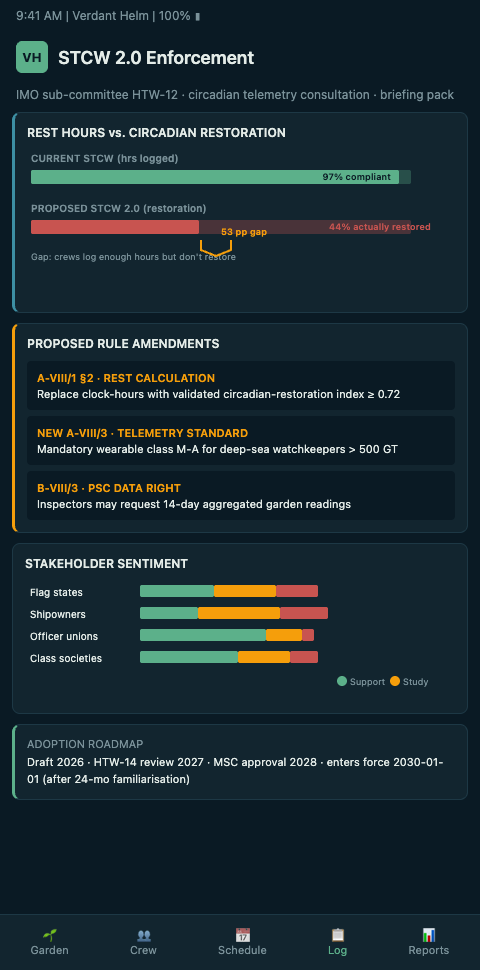
Advanced: how Phase 2 drafting will unfold
The working groups drafting Phase 2 provisions will not mandate a specific product or platform. That is not how STCW works. What they will do is specify evidence standards. An enforceable fatigue provision needs three ingredients: a measurable state of the officer, a timestamp against the watch, and an audit trail that survives both the voyage and the first two rounds of investigation if anything goes wrong. Circadian telemetry satisfies all three. Paper rest-hour logs satisfy one and a half.
Peer-reviewed analysis of the STCW review process, including the 10th HTW session analysis in the WMU Journal of Maritime Affairs and stakeholder perspectives on the comprehensive review, tracks the drafting posture. Cyprus Shipping News' coverage of the IMO's fatigue-rest-harassment focus reports on how flag-state administrators and industry bodies are positioning for the drafting phase. The direction of travel is unambiguous: the instruments that produce inspectable evidence will define the boundaries of what regulators can require.
Flag-state posture on Phase 2 is already diverging along expected lines. Liberia and Marshall Islands, the two largest open registries by gross tonnage per ICS flag-state performance tables, have made public their preference for evidence-based provisions that can be audited in port without adding days to the inspection cycle. Panama, the third-largest by tonnage, is taking a comparable position. The UK MCA, supervising the UK Ship Register, has circulated internal drafting notes that reference MGN 477 as the domestic harness into which Phase 2 provisions would land. The three PSC regimes that will enforce the provisions once Phase 2 is ratified, Paris MoU, Tokyo MoU, and USCG, have each indicated through secretariat communications that they expect to update their concentrated inspection campaign cycles to match. IACS classification societies, with DNV, Lloyd's Register, and ClassNK running the largest classed fleets, will carry the certification pathway.
Industry association positions cut across the flag-state map. ICS's human-element working group, representing national shipowner associations on five continents, has submitted formal comment on Phase 1 outputs that asks for workable evidence provisions rather than prescriptive platform mandates. INTERTANKO has taken a similar position focused on tanker-specific watchkeeping realities. BIMCO has framed its contribution around charter-party and documentary implications. The ITF seafarers' section has pushed from the labor side for stronger enforcement anchors. OCIMF's vetting-and-compliance committee has indicated that any Phase 2 provisions will flow into SIRE 2.0 observation categories within one inspection cycle. The cumulative message to the drafters is that evidence-based enforcement has industry-wide support at the principle level, with the detail work happening in Phase 2 session papers.
Casualty-investigation authorities are also shaping the evidentiary expectation. The MAIB, NTSB, Japan Transport Safety Board, and EMSA Casualty Investigation Committee each maintain investigative protocols that currently accept rest-hour logs as documentary evidence. Each has indicated through public briefings that telemetry-based evidence will be accepted on the same basis where available, with the forensic weight rising as the instrumentation matures. The Cardiff Fatigue@Sea and Solent Project MARTHA research teams have each published commentary on the evidentiary standards question. P&I clubs, led by Britannia, Skuld, West of England, and the Swedish Club, are each adjusting their underwriting and loss-prevention models to accommodate the new evidence category; Gard and Standard Club have taken comparable positions. The shift is not theoretical; it is already reshaping how casualty investigations read the physiology of the bridge team in the hours before an incident.
This is already visible in adjacent regulatory tracks. The circadian energy gates pattern for cargo-ship SMS revisions is how operators are bridging the SMS side of the same shift. The PSC evidence packs built on garden data show how port-state inspectors are already being handed garden readouts alongside rest-hour logs. Offshore wind teams are running a parallel track; the continuous fatigue streams for wind O&M crews is how the same regulatory substrate is taking shape in the renewables sector.
For fleet DPAs and safety superintendents reading this in 2026, the strategic question is not whether telemetry will rewrite STCW enforcement. It is whether your fleet is positioned to be an input to the drafting rather than a scramble once Phase 2 lands. Operators who are instrumented today have the benefit of real data to comment into the working groups. Operators whose rest-hour logs are their only evidence will be implementing other people's provisions. ICS, INTERTANKO, and the World Shipping Council have each published comment letters on Phase 1 outputs; each explicitly notes that evidence-based enforcement will shift the burden of proof toward the operator and away from the inspector. That burden-of-proof shift is exactly what circadian telemetry was built to carry.
Verdant Helm produces the exact evidence layer that Phase 2 drafters are asking for. If you are a flag-state administrator, DPA, Master, fleet superintendent, or industry association representative who expects to be close to the Phase 2 drafting work, we will share the redacted garden data formats we are already producing and walk you through what a compliant evidence pack would look like against the currently proposed provisions. Book a walkthrough — bring your fleet profile and your flag state; we will show you where your existing compliance stack already maps and where Phase 2 will demand new instrumentation.