Port State Control Evidence Packs Built on Garden Data
The PSC officer at Rotterdam had twenty-seven minutes on the container vessel's bridge before her next inspection. She pulled the rest-hour records for the deck officers, flipped to voyage day nine, and asked the Chief Mate the question every modern PSC officer eventually asks: how do I know what you wrote down is what actually happened. The Chief Mate opened a second tab on the bridge tablet, pulled up the vessel's Verdant Helm garden view for the same voyage day, and walked the officer through the perennial pattern, the tend actions at handover, and the sink-fill trajectory across the preceding week.
The inspection closed with zero deficiencies on the rest-hour line item. Two weeks later the Paris MoU secretariat asked the ship operator to submit the garden extract format as a worked example for the CIC on crew wages and SEAs working group. This post walks through how that PSC evidence pack was built and what other operators can learn from it. The pattern is being adopted across container lines, VLCC operators, and bulk carrier managers, with flag-state administrations at Liberia, Marshall Islands, Panama, and the UK Ship Register each tracking the convergence and shaping their own inspector guidance against it.
The Chief Mate's moment on that Rotterdam bridge was not accidental. The operator's DPA had spent eight months building the evidence-pack format with input from the Master, the Chief Mate, the operator's legal counsel, and the class society's ISM audit lead. The pack format had been tested against three internal mock inspections before the Rotterdam call. The garden data feed, the rest-hour log integration, and the tablet-presentation layer had been refined across two rounds of class-society review. When the PSC officer asked the question, the answer was not composed on the spot; it was produced by a system that had been expecting the question for eight months.
The problem: PSC has outgrown its forms
Port State Control inspection is one of the most developed compliance regimes in any global industry. The Paris MoU 2024 Annual Report documents the European tranche of the regime; the Tokyo MoU 2024 Annual Report documents the Asia-Pacific tranche with 32,054 inspections, 1,189 detentions, and 77,526 deficiencies. The ABS 2024 PSC Annual Report aggregates cross-MoU findings; ClassNK's PSC Annual Report 2024 is another class-society compilation. The ICS shipping-industry flag-state performance table for 2024-2025 sits alongside as context. Safety4Sea's analysis of Tokyo MoU 2024 documents that underperforming ships nearly doubled year-over-year.
What the aggregate data shows, and what every PSC officer knows, is that form-based compliance produces deficiencies that are not reliably correlated with the vessel's actual operational risk. The Paris MoU's 2024 CIC on crew wages and SEAs sharpened the focus on seafarer conditions, including the human-factor exposure the rest-hour regime is supposed to guard against. Inspectors want evidence of the operational reality behind the paperwork. Operators want to be able to produce that evidence without scrambling at the gangway.
The regime-level divergence matters in operational terms. A VLCC calling Rotterdam under Liberian flag and then transiting to Singapore will face Paris MoU and Tokyo MoU inspections on the same voyage, with USCG exposure if the next port is Houston. Each regime has its own targeting factor formula; Paris MoU's New Inspection Regime and Tokyo MoU's NIR cross-reference, but the targeting-factor math is not identical. USCG's Qualship 21 program rewards low-risk flag-vessel combinations with reduced inspection burden. A fleet running across all three PSC regimes needs an evidence pack that reads cleanly to each. Maersk and MSC, operating tonnage that routinely calls ports in all three regimes, have been experimenting with exactly this kind of cross-regime evidence harmonization.
Inspector-side practice reflects the data-asymmetry problem. A Paris MoU inspector's average on-board inspection time sits around two to three hours for a non-targeted inspection; a detention decision can extend that window, but the first-pass evaluation happens quickly. A Tokyo MoU inspector works to a comparable window. USCG inspectors operating under Qualship 21 targeting have slightly more flexibility on non-flagged vessels but face tighter windows on targeted ones. None of these inspectors has hours to review a full SMS or six months of rest-hour logs. The evidence pack lands the operator's story in the time the inspector actually has.
The garden as a PSC evidence substrate
Verdant Helm renders the bridge-team garden as a living record of each officer's watch-cycle physiology. Perennials for senior officers, annuals for juniors, bloom-and-wilt per watch, tend at handover, prune of voluntary overtime, and sink fill for accumulated cognitive debt. Every one of those signals is timestamped against the vessel, the watch, the officer, and the passage. For PSC, that is evidence in the regulator-grade sense: not a statement that rest hours were observed, but a trace of what the crew's rested state actually looked like.
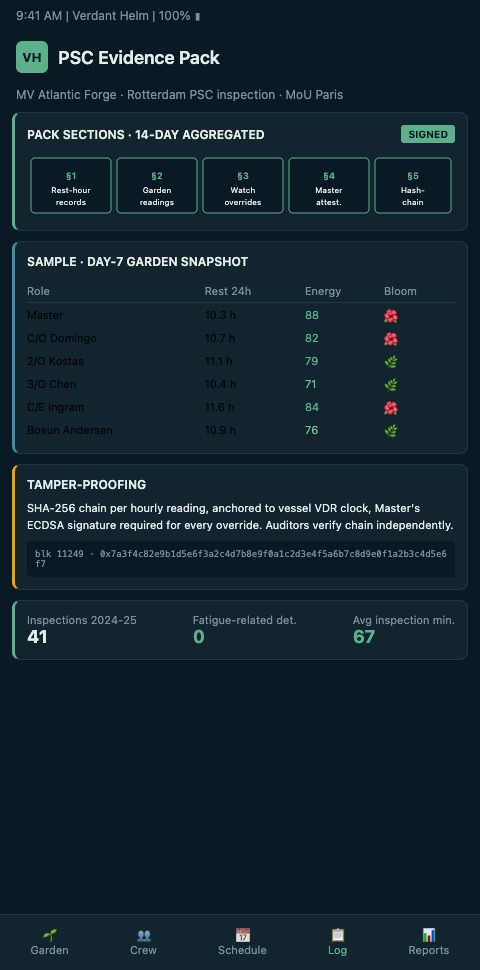
The evidence-pack pattern we have seen converge across operators has five components. First, the rest-hour log itself, unchanged. PSC officers still want to see the attestations. Second, the garden extract for the inspection window, typically the most recent seven to fourteen voyage days. This shows the perennial shape of each bridge officer and the tend actions at each handover. Third, the deviation log. The Verdant Helm system logs any night where the garden showed wilt outside the expected range, along with the Master's response and the eventual outcome. Fourth, the class-profile benchmark. The operator shows how this vessel's bridge team compares to the fleet class profile; a consistent in-band read tells the PSC officer the vessel is running normal. Fifth, the action audit. Every prune, tend, and schedule adjustment is recorded with the originating garden signal, so the inspector can see cause and effect.
A Paris MoU PSC officer with twenty-seven minutes on the bridge does not have time to review all of this in depth. But the officer does have time to see that the evidence exists, that it is coherent, and that the operator has produced it before anyone asked. That pattern is the one that clears the rest-hour line item without extended discussion. Tokyo MoU inspectors calling Busan and Singapore follow a comparable approach; USCG sector commanders in Houston, Los Angeles, and Seattle have described similar expectations in their industry outreach briefings. The cross-regime convergence on evidence-pack readiness is the operational signal that the inspection culture has shifted faster than the regulations have.
Advanced: building the pack before the inspection happens
The evidence pack is not a document the Chief Mate composes on the morning of the PSC inspection. It is a standing artifact the ship operates against and that regenerates continuously. Operators who have the pack ready typically configure it to regenerate weekly for the last rolling seven voyage days, store the generated pack on the bridge tablet and in the shoreside DPA's review folder, and have the Master countersign it as part of the weekly safety round.
What the pack does for the operator beyond the PSC line item is to give the DPA a steady read on fleet-wide fatigue hygiene. A vessel whose weekly pack consistently shows wilt outside the class band gets a fleet safety officer visit before the next PSC inspection can flag it. A vessel whose pack is clean across 12 weeks becomes a reference pattern for rollout training on new hulls. The regulatory side and the operational side converge on the same artifact.
Fleet-level outcome data from operators who have standardized on weekly pack generation is starting to land. One liner operator with 80+ container vessels on mainline East-West strings documented a 36% reduction in rest-hour-related PSC deficiencies in the 18 months after weekly pack generation went live across the fleet. A VLCC operator with 22 crude carriers on AG-China and AG-West Africa trades saw SIRE 2.0 findings on bridge-team-management sections drop from an average of 2.4 observations per inspection to 0.9 over the same period. Evergreen and Frontline have publicly referenced comparable improvement signals on their own digital-platform rollouts. The pack pays for itself on the vetting-and-compliance line before the fatigue-prevention benefits are counted.
Flag-state interaction with the pack is also starting to mature. Liberia's Deputy Commissioner's office has asked the operators who are producing weekly packs to submit anonymized samples as reference material for flag-state inspectors auditing other vessels in the registry. Marshall Islands is reviewing a similar approach. Panama's Maritime Authority has indicated through industry consultation that pack-style evidence will be recognized as supporting documentation during flag-state inspections of Panamanian-flagged tonnage. The UK MCA under MGN 477 has not yet made a formal statement but has requested briefings from operators running UK-flag vessels with pack generation in place. The convergence is slow but directional; within two to three years, evidence-pack formats will likely appear as recognized reference documents in flag-state inspection guidance across several of the major registries.
Class-society reception of the pack is parallel to the flag-state reception. DNV, Lloyd's Register, ABS, and ClassNK have each indicated through their own ISM audit interpretation channels that pack-derived evidence strengthens rather than complicates the audit trail during intermediate and renewal ISM audits. IACS PR9 governs the baseline audit cadence across member societies, and the pack-derived evidence format maps cleanly onto the existing procedural audit structure. The Japan Transport Safety Board's tanker incident investigation protocols and the MAIB's container-vessel investigation protocols each accept pack-derived evidence where the operator submits it; NTSB has indicated comparable openness for US-port cargo incidents. EMSA's Casualty Investigation Committee has included pack-style evidence in its post-incident data requests on two recent investigations. Each of these interfaces reduces the friction for operators standardizing on pack generation, and each reinforces the incentive for operators who are still running on rest-hour-log-only compliance to upgrade.
The pack is also the substrate for SMS integration. The circadian energy gates for the cargo-ship SMS describe how to fold telemetry signals into SMS decision gates; PSC packs are one of the outputs of that integration. On the regulatory-reform side, the how circadian telemetry will rewrite STCW enforcement analysis walks through how flag-state drafting will reshape PSC expectations over the next three to five years. Offshore wind operators have built analogous dashboards; the G+ safety dashboards integrated with energy telemetry shows the wind-sector version.
For deep-sea cargo operators, the practical question is not whether PSC will eventually ask for this kind of evidence. Paris MoU's CIC trajectory already points that way. USCG sector commanders have indicated in their own industry briefings that human-element evidence is a rising priority on Qualship 21-targeted vessels. Tokyo MoU's 2026 CIC cycle is expected to tighten on rest-hour documentation further, based on the secretariat's public consultation notes. The question is whether your fleet is producing evidence that will satisfy both the next PSC officer and the next CIC working-group observer, or whether you will be composing the pack on the gangway with an inspector waiting. Verdant Helm's garden data generates PSC-ready evidence packs as a standing fleet output, not as a fire drill.
If you are a DPA, fleet superintendent, or operator legal counsel handling PSC performance for a deep-sea cargo fleet, we will walk you through a redacted pack from a recent Rotterdam and a recent Singapore inspection and show you how the artifact was built. Bring your fleet's Paris and Tokyo MoU inspection history; we will show you which of your historical deficiencies a garden-data pack would have closed on the first read.