Bridging Document Revisions for Energy-Aware Drilling Ops
The Interface Document That Decides What Counts
When an operator and a drilling contractor work the same rig, their separate Safety Management Systems have to be reconciled through a bridging document. The IOGP Guide to Preparing HSE Plans and Bridging Documents — the supplement to IOGP Report 423 — is the canonical framework for bridging document structure across the industry. It defines how operator and contractor SMS elements map, how responsibilities are allocated, how stop-work authority flows, and how reporting cascades up the chain.
The Rigzone analysis of HSE management in offshore projects describes bridging documents as the required interface between operator and contractor SMS to eliminate policy conflicts. The Drilling Contractor account of bridging documents in GOM safety-case preparation describes how bridging documents enabled deepwater Gulf of Mexico safety case work by clarifying interface details before drilling started. None of these frameworks anticipated continuous welfare telemetry as a category of data that needed interface definition.
The result: most bridging documents written before 2023 are silent on who owns continuous welfare data, how anomalies flow from contractor systems to operator systems, what happens when welfare telemetry is lost or corrupted, and what welfare signals trigger shared decision-making. Operators who deploy welfare platforms on contractor rigs run into this gap within the first hitch. The revisions coming now are the ones that close it.
The Five Revisions Being Written Now
Working with operators on welfare rollouts across UK, Norway, and US Gulf jurisdictions over the last 12 months surfaced five specific bridging-document revision categories. Each addresses a gap that became visible only once welfare telemetry was flowing.
Revision one: data ownership and access. Who owns the welfare data stream when the operator's platform runs on the contractor's rig? Pre-2023 bridging docs are typically silent. New clauses explicitly define operator-owned data, contractor access rights, crew-level privacy protections, and retention timelines. The IADC bridging documents legal issues briefing covers the general contract-hygiene principles; welfare data adds a specific dimension that legacy clauses did not anticipate.
Revision two: anomaly escalation. When the welfare platform surfaces a significant anomaly — a crew bed in sustained wilt, a sink pattern across multiple tours, a compensator pattern that has not self-corrected — who acts? The bridging document must specify whether this is an operator call, a contractor call, or a joint call. New clauses define escalation thresholds, decision authority at each threshold, and time-bound response obligations. The Rigzone HSE manager responsibilities overview describes HSE manager bridging duties; welfare anomalies are an additional interface for those duties.
Revision three: telemetry loss and degradation. What happens when the welfare feed goes dark — dashboard offline, sensors failing, network disrupted? Legacy bridging docs treat telemetry loss as a minor IT issue. Welfare-aware revisions treat it as an operational signal: the contractor must notify the operator within X hours, the rig runs on backup protocols until telemetry is restored, and loss events are logged alongside operational events.
Revision four: welfare signals in JSA and PTW. New bridging clauses allow welfare signals to adjust JSA review depth and permit-to-work approval criteria. A crew bed in wilted state triggers elevated JSA review; a drill-floor crew with a single compensator carrying load triggers a PTW checkpoint. These are operational clauses, not policy statements — they change day-to-day permit behavior.
Revision five: welfare in safety case updates. The OnePetro offshore drilling agreements overview describes the commercial frame that bridging documents implement operationally. Safety case submissions increasingly reference welfare telemetry as evidence supporting the ALARP determination. Bridging clauses specify who produces welfare summaries for safety case updates, on what cadence, and using what format.
The Garden as the Shared Reference
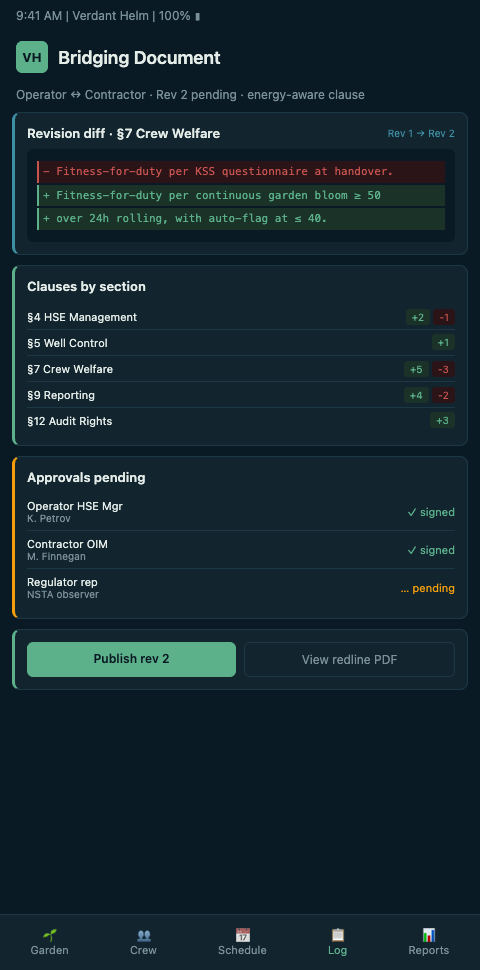
Verdant Helm renders crew energy as a living botanical garden. The reason this framing matters for bridging documents is that operator and contractor both need to read the same artefact to make the revisions workable. A bridging clause that references "welfare telemetry" abstractly fails in implementation because operator HSE and contractor HSE interpret the term differently. A clause that references "the rig's garden view as of 06:00 UTC daily" is implementable because both parties are reading the same dashboard.
Bridging revisions drafted this way turn the garden into the shared SMS object — bed-level bloom data, sink formation records, compensator logs, pruning decisions. The garden's monthly summary becomes a document both operator HSE and contractor HSE sign off on. The Drilling Contractor SIF prevention coverage shows how bridging docs are increasingly updated to include SIF-prevention metrics beyond legacy LTI tracking; welfare telemetry sits naturally inside that updated frame.
A drafting tactic that repeats across operator-contractor pairs: write the revision clauses in the language the garden uses, not in abstract HSE language. "When more than 30% of a crew bed shows sustained wilt across three consecutive tours, the contractor OIM and operator rep will convene a scope-adjustment review within 8 hours." That is more specific, more implementable, and more auditable than "Significant welfare anomalies shall be addressed promptly by joint review."
How the Revisions Play Out in Day-to-Day Rig Operations
Bridging-document clauses are only worth what rig operations actually implement. Three operational shifts follow from welfare-aware bridging revisions, and each reshapes how the operator-contractor interface functions on the drill floor.
First, the 06:00 operations call changes participants. Pre-revision calls typically involve OIM, toolpusher, and operator rep. Post-revision calls add the rig medic or welfare lead when garden-derived anomalies are on the call agenda. The addition sounds procedural; in practice it reshapes the call's centre of gravity. Conversations that used to run through the toolpusher's NPT list now include a welfare status review early in the agenda, which reorders the priorities the call surfaces.
Second, stop-work authority gains welfare triggers. Pre-revision bridging docs typically scope stop-work to process-safety and immediate-hazard conditions. Post-revision clauses extend stop-work triggers to sustained welfare anomalies — a crew bed in sustained wilt for 72 hours triggers mandatory review with authority to pause non-critical operations pending resolution. The threshold is high enough to avoid false positives but low enough to matter when the welfare signal is genuine.
Third, handover protocols absorb welfare context. Crew-change handover checklists historically covered operational status, permit handoff, and equipment state. Post-revision checklists add garden-state summaries: which beds are wilted, which sinks are active, which compensators are carrying load. Incoming OIMs arrive with context they previously would have discovered in the first week of their own hitch. The incoming-hitch first-week incident rate drops measurably when this handover discipline is in place.
Advanced Tactics: Getting the Revisions Into Live Bridging Documents
Operators and contractors currently renegotiating bridging documents have a 12-18 month window to fold welfare clauses in alongside other revisions. Three tactics separate operators who land the clauses cleanly from those who leave them for the next cycle.
First, pair the bridging document revision with the existing biennial SMS review cycle rather than scheduling it as a separate project. Standalone welfare bridging revisions get deprioritised; integrated revisions ride with document cycles that have legal, commercial, and operations sign-off already scheduled.
Second, draft the clauses in operational language and translate to legal language second, not the reverse. Legal-first drafts tend to produce clauses that cannot be implemented on the rig. Operational-first drafts produce clauses that can — and the legal translation usually preserves the operational specificity rather than abstracting it away.
Third, run a 60-day pilot of the new clauses on one rig before rolling across the fleet. The welfare-aware clauses have implementation surprises that only surface under live use. The IADC bridging documents legal briefing documents that revision discipline is the core risk in bridging-doc life cycles; a pilot lets the rig team surface operational issues before legal language gets frozen.
For the upstream view on why HSE audit methods are moving the same direction, see HSE audits moving to continuous telemetry. For the forward look at how rotation policy itself is changing and where bridging documents will need welfare clauses even more, see beyond 28/28 fatigue-gated drilling rotations. For a cross-industry reference on circadian energy gates inside shipboard SMS, see circadian energy gates in cargo ship SMS.
Jurisdictional Variation That Shapes the Revisions
Bridging-document revisions are not jurisdiction-neutral. UK, Norwegian, and US Gulf operators face different regulatory reference points that shape which clauses land cleanly and which create friction. Understanding the variation matters for any operator working across jurisdictions.
UK operators reference the HSE's SCE verification framework and the Offshore Safety Directive regime. Welfare-aware bridging clauses align naturally with HSE expectations around human-factors management, and UK revisions tend to integrate welfare telemetry into existing performance-standard language. The friction in UK revisions is usually around crew privacy — UK data-protection expectations set a higher bar than some contractor home jurisdictions apply.
Norwegian operators work under the Working Environment Act and Havtil's oversight. Norwegian jurisdiction is more prescriptive about working hours and rest requirements, which means bridging clauses have to respect working-hours boundaries that other jurisdictions treat as advisory. Welfare-aware clauses in Norwegian bridging docs tend to be more specific on rest-period enforcement, with the telemetry serving as a verification tool rather than a discretionary input.
US Gulf operators work under BSEE and Coast Guard frameworks. BSEE has moved aggressively on real-time drilling data, which creates natural tailwind for welfare telemetry integration. The friction in US Gulf bridging docs is around multi-contractor coordination on rigs with many service-company staff; welfare clauses have to account for subcontractor welfare data flowing through the primary drilling contractor. Revisions that work cleanly on North Sea rigs with fewer third-party personnel often need adaptation before landing on US Gulf drillships.
Opening the Revision Conversation
OIMs, drilling superintendents, and HSE managers at operators or contractors heading into a bridging-document revision window inside the next 12 months should add welfare telemetry as an explicit revision category before the first drafting session, not after. The five clause categories — data ownership, anomaly escalation, telemetry loss, welfare in JSA/PTW, welfare in safety case — make useful section headings in the draft scope. Verdant Helm can provide a reference bridging-clause library drawn from operator rollouts. Book a 90-minute bridging-doc scoping workshop with your HSE manager and contract legal lead — we will walk through your current bridging document and identify the five specific clause insertion points.