Swapping Officer Rounds for Live Crew Energy Dashboards
Eighteen Months of Rounds, Three Lost Stewards
The staff captain had walked his evening rounds on the 3,800-guest megaship at 22:30 almost every sea night for 18 months. He was conscientious. He knew the cabin stewards by name. He asked the real questions — how is your section, how is your rest, is the guest on deck 9 being difficult again. His rounds log showed nothing unusual in the six weeks before three senior stewards — all with multiple prior contract renewals — declined to extend in the same week. The exit interviews surfaced a compounding pattern: each of the three had absorbed progressively more difficult guest assignments over a 14-week arc that never appeared on any single night's rounds.
The rounds weren't lying. The rounds were doing exactly what Marine Insight describes as standard officer-on-watch duties — periodic checks that verify systems and crew safety in the moment. The 22:30 conversation captured the snapshot. The snapshot couldn't show the 14-week trend.
There's a second limitation to rounds that only becomes apparent when you try to scale them. A 3,800-guest ship employs roughly 1,500 crew across hotel, F&B, deck, and engine divisions. An evening rounds path touches 12-18 named crew members at most. Even if every conversation goes well, the sampling coverage is less than 1.5% of the crew population on a given night. The unsampled 98.5% could be wilting quietly and the rounds won't detect it until the wilt becomes a visible incident. Live telemetry sees the full population at once. The rounds continue — the humanity of the walk matters — but they operate on a shortlist the dashboard generates rather than a fixed route that treats every deck equally.
The Live Dashboard As Garden
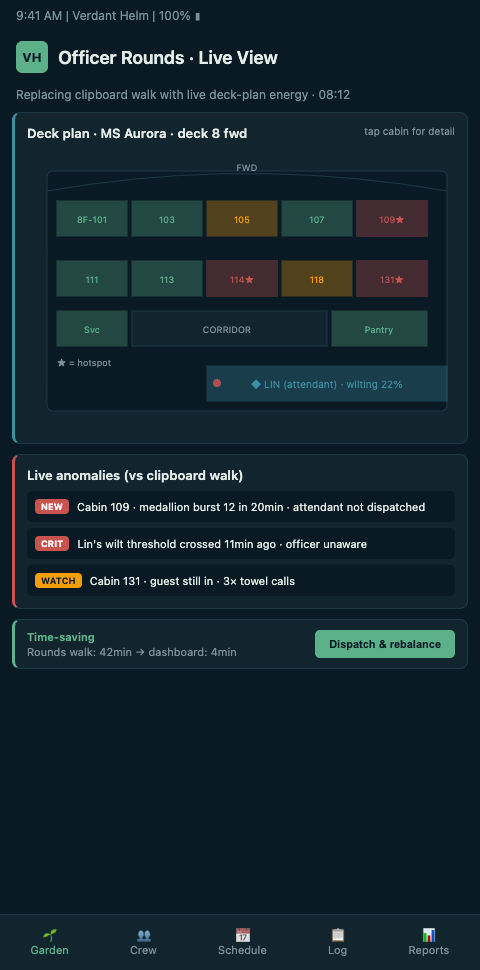
Verdant Helm replaces the rounds snapshot with a living garden view. The walk-through still happens — the staff captain still wants to see his team's faces, and the Oracle Hospitality cruise platform documentation confirms the industry is moving toward integrated shipboard dashboards without eliminating human presence. What changes is what's on his screen before he walks out of the bridge. Instead of a rounds checklist, he sees a live map of the ship where every guest-facing bed carries a color indicating current perennial state.
A cabin steward whose energy has been stable across 14 weeks shows as a deep green perennial. A steward whose 14-week curve is bending downward shows amber, then orange, then red — well before any single night's rounds would reveal the compounding. The HospitalityNet piece on employee engagement and service industry success argues real-time engagement visibility lets managers intervene before service quality slips, and the dashboard implementation makes that argument operational at the bed-by-bed level.
The garden view layers three data streams behind each colored perennial. First is the scheduled-hours stream — how many working hours the perennial has logged against the MLC and STCW minima, a compliance layer that the FURUNO BR-500 BNWAS documentation describes for officer alertness monitoring extended to hospitality roles. Second is the absorbed-load stream — guest-complaint absorption, overflow shifts taken, difficult-cabin assignments, Medallion-tagged high-touchpoint guests. Third is the recovery stream — port-day release blocks actually taken versus scheduled, shoreside overnight patterns, sleep-window protection on sea nights.
When all three streams are stable for a perennial, the color stays green. When one of them bends for more than two consecutive voyages, the color shifts. The staff captain sees the bend in the color before he sees it in the rounds conversation. The Actabl hospitality data visualization documentation describes real-time dashboards aggregating PMS, labor, and guest-experience KPIs — Verdant Helm fuses that class of telemetry with crew-state readings to produce the bed-level coloring.
The board is also specifically designed for the bridge context. It runs on the same screen format the staff captain already uses for ops. It uses the same vessel map orientation. The perennials sit on the map where the crew members actually work — the stewards colored on the deck they tend, the F&B crew colored on the dining bed they work, the excursion-desk staff colored at the desk location. The Bold BI hospitality dashboard examples show the staff-efficiency KPI pattern the industry has converged on; the garden coloring layers crew state on top of those KPIs without replacing them.
The Hospitality Technology piece on Medallion-driven live ops visibility notes that Medallion-class ships already produce the raw telemetry needed to render this view. The work is in the fusion, not the instrumentation. Verdant Helm's dashboard reads from the existing Medallion data stream, the existing HR system for schedule and contract context, and the wearable layer that Nautilus International documents for seafarer wellbeing.
For ships that don't run Medallion, the dashboard still functions. The fusion degrades gracefully — on non-Medallion vessels, the touchpoint layer comes from PMS booking data, reservation platforms, and entry-point swipe systems, which together produce a reasonable approximation of guest-facing interaction density. The energy-state layer still runs from the same wearable and shift-pattern sources. The resolution is lower than on a full Medallion ship, but the compounding-trend detection — which is the main thing the staff captain missed for 18 months — still works. The underlying read is built on the medallion-touchpoint fusion logic applied against alternative sensor sources when Medallion isn't available.
The botanical frame matters because a dashboard built on raw number-grids tends to produce alert-fatigue — a red cell on row 147 at 22:00 on a Tuesday gets scrolled past. A garden bed with a wilting perennial doesn't scroll past. The visual metaphor holds the staff captain's attention on the specific perennial in the specific bed that needs tending, in a way a numeric grid doesn't.
Advanced Tactics for Live Dashboard Operations
The dashboard handles the problem of rounds-shift coverage gaps. A single staff captain walks rounds on one watch. On a 3,800-guest ship, there are three watches per 24 hours, and each watch captain sees only the crew on duty during their window. A cabin steward wilting during the 10:00-18:00 day watch might never be seen by the 22:00 rounds captain. The live board bridges the shifts — every officer sees the same colored beds on the same ship map, regardless of which watch they hold, and the trend data persists across shift boundaries. This continuity was impossible with walked rounds alone.
Three tactics let the dashboard replace rounds without losing the rounds' relational value.
The first is compounding-trend flags tuned to the voyage cadence. A standard alert threshold — "flag when energy drops below X" — floods the bridge with voyage-normal signal. The compounding flag fires only when a perennial's 14-week trend bends more than the baseline voyage variation. The staff captain who sees three amber perennials on his board knows which three conversations to have on his walk.
The second is Hotel Director coordination. The live dashboard doesn't isolate the staff captain — it mirrors the same view to the Hotel Director's iPad and the HR Lead's office terminal. When the board shows a compounding pattern, all three see it simultaneously and can coordinate who raises it with the perennial. This pattern is described in the Hotel Director pre-empt playbook, and the dashboard is the shared canvas that makes the coordination work.
The third is cross-niche compliance integration. Cruise ships under MLC documentation requirements carry a paperwork load that the deep-sea cargo MLC rest-hour dashboard playbook addresses for bridge teams. Verdant Helm extends the same dashboard architecture to hospitality crew, so the rest-hour compliance stream and the energy-state stream live on one board, and the staff captain isn't toggling between compliance and welfare views.
Try One Bridge Watch and Let the Dashboard Drive the Walk
Hotel Directors and Cruise HR Leaders who want the dashboard to replace one night of rounds should pick the next sea night. Load the board on the bridge screen at 22:00. Let the staff captain pick his three walk destinations based on what the board flags rather than his usual route. Have him come back to the bridge and compare the conversations to a usual-route sampling from the prior night. The pattern that emerges on the first run is usually enough to convince the staff captain to keep the board running. Verdant Helm's bridge-view module can be enabled per-ship without a fleet rollout, so one ship, one night, one comparison is a realistic first step.
The staff captain who keeps the board running tends to change his walk-planning habit within three sea nights. The board flags three compounding perennials at 21:30; the staff captain walks to those three specific cabin stewards, dining servers, or desk agents rather than the standard deck rotation. One of the three conversations almost always surfaces a pattern the steward would not have raised at the 22:30 door check — a back-to-back VIP assignment three voyages running, a maître d' overflow that keeps landing on the same server, a desk agent absorbing a specific complaint-escalation pattern from one deck.
Hotel Directors and Cruise HR Leaders should read the post-walk notes the next morning and watch for the language shift. When the staff captain writes "she mentioned the Haven handoff has been stacking on her for six weeks" instead of "all good," the dashboard has already paid for itself on that voyage. The rounds do not disappear; they sharpen. The walk is shorter and the conversations are bigger.