How Hotel Directors Pre-Empt Complaints Using Garden Views
The Complaint That Never Reached the Guest Services Desk
On a Mediterranean loop megaship on day three of a ten-night sailing, the Hotel Director caught a cabin-service complaint cluster 48 hours before a single guest stopped at the guest services desk. The Deck 9 concierge-corridor attendants were showing a wilt pattern on her garden view — three of the nine attendants flagged yellow, audit completion slipping on five repeat-guest suites, two peer-anonymized tone observations in the bottom quintile. No guest had complained yet. But the pattern had been through the same progression on the prior voyage, and by day five of that sailing, eleven comment-card entries had pointed at Deck 9. The Hotel Director pulled two attendants off the corridor for a shoreside recovery in Palma, planted a fresh perennial into the sink suites for two nights, and rebalanced the turndown load. Day five passed with zero Deck 9 complaints.
Revinate's NPS framework for hotels treats complaint prevention as the upstream discipline that protects loyalty; once the complaint arrives, the guest has already categorized the stay. Prostay's breakdown of the 15 most common hotel complaints shows that cabin-service and service-pace complaints dominate the volume — both are direct downstream outputs of cabin steward and dining-team wilt. Research on front-office complaint management finds that 70% of guests remain loyal when complaints are resolved, and that speed and follow-up matter most — but the Hotel Director's leverage is even higher when the complaint is pre-empted.
The gap the Hotel Director closed on Deck 9 was not reactive skill. It was the garden view.
The Garden View as a Pre-Complaint Radar
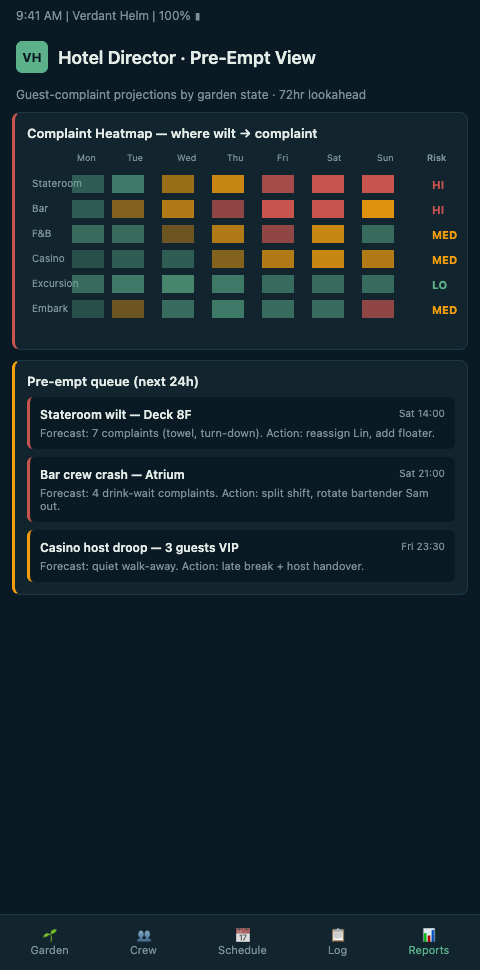
The Hotel Director role on a cruise ship owns hospitality, F&B, entertainment, and guest services. That span is what makes the garden view uniquely powerful in this seat — the HD sees beds that no other role sees from the same vantage. Verdant Helm's pre-complaint radar is built around that vantage.
The radar has three lenses. The first is the wilt-to-complaint lag: historical data shows how many days typically pass between a bed hitting yellow and the first complaint arriving. On most megaships that lag is 36 to 72 hours. The second is the bed-cluster detector: when three or more beds that historically correlate (Lido + main dining + Deck 9 cabins, for instance) enter yellow together, the complaint cluster that follows tends to be thematic rather than isolated. The third is the recovery trajectory: whether a bed that entered yellow 24 hours ago is now recovering, flat, or deepening.
Think of the garden view as the Hotel Director walking the full garden at 0630 every morning. Without the view, she is inspecting beds one at a time and catching the ones that are already in guest-visible trouble. With the view, she sees the water table across every bed at once, knows which sinks are forming, and has the day to reroute resources before the bloom breaks. The metaphor holds on prune timing especially. A bed pruned at yellow recovers in three to five days. A bed pruned at red — meaning complaints already active — takes two voyages to fully bloom again, and carries a measurable NPS cost in between.
Role stress and turnover research on front-line hotel employees shows service climate and burnout mediating role stress into turnover. Pre-complaint intervention is also pre-exit intervention; the two move together. Verdant Helm exposes both trajectories in a single view so the Hotel Director is making one decision that buys both outcomes.
The practical workflow runs through three daily checkpoints. At 0630, the HD reviews the overnight bed-state change against the voyage-week trajectory. At 1100, during the departmental huddle, the garden view drives the rotation decisions that day. At 1700, the late-afternoon read catches any wilt that developed through the day's service peaks and sets up evening service adjustments. The rhythm is the key; isolated daily use without the rhythm produces the same fragmented view as no tool at all.
Scaling Pre-Complaint Discipline
The first scaling move is to tie the garden view into existing complaint-routing tools rather than replacing them. Platforms like xCreate's cruise guest service management dashboard already route active complaints to accountable departments. Verdant Helm adds the pre-complaint layer in front of those tools — not as a substitute but as a radar. The integration is one-way: the garden view reads complaint history as a wilt input but does not need to replace the incident workflow. Hotel Directors who attempt to consolidate onto a single system tend to lose the live complaint workflow during the switch. The parallel deployment model is lower risk and faster to value.
The second move is to train the departmental leads to read the view, not just the Hotel Director. The Executive Housekeeper, F&B Director, Cruise Director, and Guest Services Director each see their bed slice with the same wilt semantics.
When cruise director huddles become garden-state actions, the HD's daily rhythm scales horizontally across the hotel department.
Without that horizontal scale, the HD becomes the sole reader and the radar's latency climbs because every rotation decision routes through her.
The third move is to surface fleet-wide bed-state data for Cruise HR Leaders. Live energy dashboards replace legacy officer rounds at the ship level, but at the fleet level they surface which ships are building sinks in the same beds across voyages. That pattern often traces to itinerary shape or recruitment sourcing, not to individual Hotel Director decisions, and the fix is systemic.
The adjacent pattern in other maritime sectors reinforces the approach. Offshore wind O&M managers sequence turbine climbs using the same pre-depletion logic the Hotel Director applies on Deck 9 — route the most demanding work to the beds with the most reserves, and protect the beds that are drawing down. The industry is different; the tending discipline is identical.
One edge case: pre-complaint radar needs calibration for voyage-specific patterns. A holiday sailing with a high proportion of first-time cruisers generates a different complaint shape than a repeat-guest loyalty sailing. Verdant Helm's voyage-mix input adjusts the radar thresholds so the HD doesn't over-prune on a voyage where the wilt is driven by unusual manifest composition rather than crew depletion. Without the adjustment, the first voyage of a new itinerary tends to trigger false alarms that erode trust in the view.
The second edge case: comment-card lag varies by cruise line and itinerary. Some lines capture comment-card feedback daily; others aggregate at disembarkation. Verdant Helm calibrates the wilt-to-complaint lag per line and per itinerary type so the HD is comparing apples to apples across voyages.
A third edge case worth addressing: the pre-complaint radar can produce false positives during unusual manifest events — charter groups, incentive-cruise bookings, branded theme sailings. These voyages behave differently because the guest profile is more homogeneous and the interaction pattern is more predictable. Applying standard complaint thresholds to a charter sailing over-alerts the HD to bed states that are operating normally for that specific manifest. Verdant Helm's charter-mode setting loosens the radar thresholds for these voyages and surfaces a different set of complaint precursors — group-cohesion signals, excursion-booking density, and venue-capacity stress — that are more relevant to charter guests.
A fourth edge case concerns voyage length. A three-night short hop generates a complaint distribution concentrated on day two and disembarkation; a fourteen-night Mediterranean voyage spreads complaints across the middle third of the sailing. Wilt-to-complaint lag that calibrated on seven-night Caribbean itineraries shifts on these lengths, and Verdant Helm recalibrates per voyage shape. Hotel Directors rotating between short and long itineraries need to refresh the radar thresholds at the start of each new product, which the system prompts automatically.
The fifth scaling consideration is the crew-facing feedback loop. When the Hotel Director acts on the pre-complaint radar and the intervention prevents a complaint that would otherwise have formed, the crew involved often never learn that their bed was read as wilting and then pruned. That silence erodes engagement over time because the intervention feels like arbitrary schedule changes. Verdant Helm supports an anonymized feedback layer where department leads can tell crew members that a rotation was made in response to bed-state reads without identifying individual wilt scores. This keeps the intervention visible as care rather than opaque reshuffling.
For Hotel Directors and Cruise HR Leaders
Complaint prevention and complaint management are two different disciplines. If your current workflow starts when a guest walks up to the guest services desk, you are doing management; Verdant Helm is built for prevention. Hotel Directors who adopt the garden view report a 20 to 35% reduction in comment-card volume within four voyages — the comment cards that used to show up on day five simply never form because the bed was pruned on day three. Cruise HR Leaders who share this data with Hotel Directors across a fleet build a common language for bed-state accountability that transfers with crew and captains. The first-month move is to run the radar in parallel with your existing complaint workflow and compare the two at voyage end.
The attribution exercise at the end of the first two voyages is where the shift takes hold. Walk back through the complaints that did arrive and check which beds the radar had flagged yellow 36 to 72 hours earlier. Walk through the beds the radar flagged where no complaint materialized and verify which pruning moves the department leads made. That reconciliation is what turns the garden view from a novelty dashboard into the Hotel Director's primary operating picture.
Cruise HR Leaders should demand this reconciliation as a standing item in the quarterly operations review so the retention conversation gets grounded in specific pre-complaint interventions rather than general wellbeing narratives. Hotel Directors who commit to the 0630, 1100, and 1700 rhythm for a full contract cycle report that the hardest habit to break is the old reactive instinct — the pull to wait for the comment card to confirm a problem before acting. The garden view makes that wait unaffordable; the cost of pruning at yellow is trivial next to the cost of recovering a bed from red.