Turning Cruise Director Huddles Into Garden-State Actions
The Huddle That Drove Nothing
On a Caribbean-loop megaship, the cruise director's 0900 huddle ran 22 minutes every morning. It opened with the previous day's entertainment-ops highlights, covered guest-feedback anecdotes from comment cards, reviewed the day's program, and ended with departmental shoutouts. The agenda had been stable for seven years. The average outcome per huddle was one schedule tweak and two follow-up questions. The meeting took 11 department leads off the floor for 22 minutes and changed very little.
In the same corridor, on the same ship, the Deck 9 stateroom bed was wilting for its third consecutive voyage. The guest-services complaint cluster on day five traced directly back to the Deck 9 pattern. Neither surfaced in the huddle. The huddle was answering yesterday's questions while today's sinks formed unobserved.
Princess's public job description for Entertainment Directors describes the Daily Compass team meeting as a core accountability — covering the day's schedule and operational coordination. The cruise director role reports to the Hotel Director, runs entertainment staff, and collects guest feedback. The huddle is the operational hinge of the voyage. Most huddles still run on anecdote and schedule readout. Verdant Helm's model rewires them into garden-state action meetings.
The cost of a stale huddle is not the 22 minutes. It is the 23 hours and 38 minutes that follow — hours during which every rotation decision was made with yesterday's information and today's sinks were never named. On a 3,200-guest megaship, that compound cost shows up as a 3 to 5 point NPS drift across a seven-day voyage. Cruise HR Leaders pulling exit-interview summaries from mid-contract leavers almost always find the same phrase: "nothing changed when I said something." The huddle is where that sentence either becomes true or becomes false. A huddle that produces four named pruning actions and closes them by 1700 is the operational evidence that saying something changes something.
The Huddle as the Morning Garden Walk
Think of the cruise director's huddle as the gardener's 0900 walk through the full garden with the section leads present. Without a shared map, each lead reports on their own bed in isolation and the network pattern — how the Lido sink is feeding the main dining wilt that will show up at the 8:30 seating — stays invisible. With a shared map, the huddle becomes a coordinated prune-and-water session that sets up the day's rotations, schedule adjustments, and guest-interaction priorities.
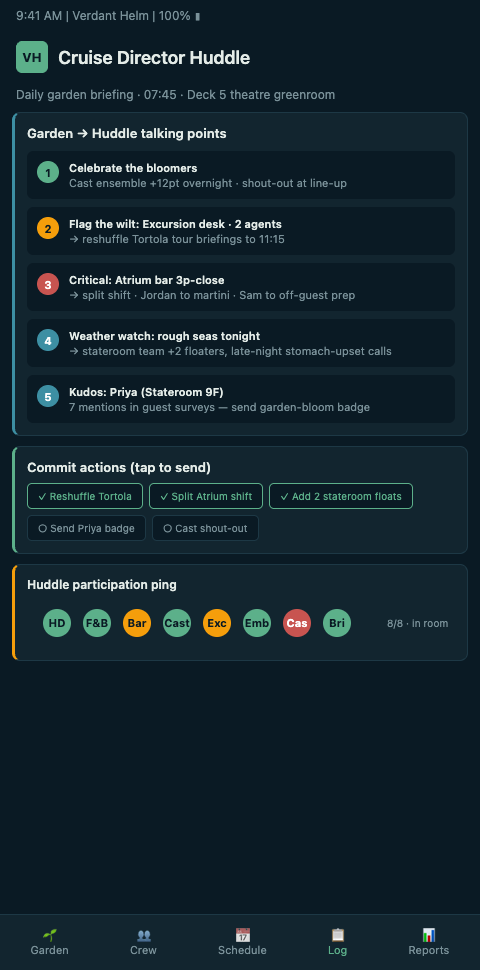
The restructured huddle has five elements. First, the overnight bed-state change — which beds moved yellow or red, which recovered toward green. Second, the complaint-risk forecast — which beds are on a trajectory to produce guest complaints in the next 24 to 48 hours if not pruned. Third, the day's schedule cross-pressure — where multiple beds face simultaneous peaks (muster drill plus specialty restaurant opening, for instance). Fourth, the rotation decisions — which cast members, attendants, or servers rotate where today. Fifth, the follow-up accountability — each rotation decision has a named owner and a 1700 check-in.
The five elements map to the botanical cadence. The bed-state change is the overnight weather report. The complaint-risk forecast is the seven-day outlook. The schedule cross-pressure is the day's heat map. The rotations are the pruning. The follow-up is the watering check. Each huddle produces 4 to 8 named actions that close by 1700 the same day.
Job demands-resources research on cruise employees provides the academic grounding — resources buffer burnout when they land at the bed level and when leadership actively deploys them. IMO's Guidelines on Fatigue explicitly include company-level fatigue management as a module — the huddle is the ship-level execution of that module. The Seafarers Happiness Index provides a quarterly benchmark feed that the cruise director can use as a contextual input to the morning talking points; Verdant Helm overlays the live bed state on top.
Crew Center's Q3 2025 report notes the cruise-crew happiness score fell from 8.4 to 7.6 between Q2 and Q3 2025. That drop is a sector-wide signal that huddles across the fleet need to act on garden signals faster, not slower. The rewired huddle is what turns the sector-level number into ship-level action.
Scaling the Huddle Across the Hotel Department
The cruise director's huddle is one of multiple huddles on a megaship. The Executive Housekeeper runs a housekeeping huddle, the F&B Director runs a food-and-beverage huddle, the Guest Services Director runs a guest-services huddle. Without a common language, the four huddles produce parallel conversations that never integrate. Verdant Helm's garden-state semantics — wilt, sink, prune, bloom, tend — unify the vocabulary across huddles so the rotation decision in housekeeping is visible to F&B when the same crew member's energy profile shifts.
The first scaling move is to put the garden dashboard on the shared display in each department huddle. The dashboard is the same shape for every lead; only the bed filter changes. The Executive Housekeeper sees the stateroom attendant beds; the F&B Director sees dining and bars; the Guest Services Director sees the desk and excursion beds; the Cruise Director sees cast and entertainment. The Hotel Director's huddle an hour later pulls the four views together.
The second move is to connect huddles across ships in the fleet. Hotel Directors pre-empting complaints using garden views use the same dashboard shape at the ship level.
When Cruise HR Leaders and fleet operators see the ship-level huddles aggregated, they spot fleet-wide patterns — itinerary shape, recruitment sourcing, sister-ship differences — that individual ships cannot see. The huddle becomes fractal: same pattern at ship level, at department level, at fleet level.
The third move is to build the garden dashboard for megaship scale so the huddle has 20 beds to walk rather than a dozen. On a 3,500-guest vessel, the huddle has to cover more surface area in the same 20 to 22 minutes. The restructured agenda accomplishes this through the bed-state summary — instead of reading out every bed, the huddle opens with the top five wilt changes and drills down only where action is needed. That density is what keeps the huddle crisp at megaship scale.
The adjacent pattern in offshore oil and gas is close. Rig medic rounds that read garden signals use a similar daily walk-and-read structure, with the medic and HSE officer covering different bed types at different cadences. The cruise director's huddle is the cruise industry's equivalent of that round, and Verdant Helm's model crosses the two contexts because the underlying gardening discipline is the same.
One edge case: cruise director handover between contracts. When a cruise director rotates off the ship and a new one rotates on, the garden-state context transfers imperfectly through handover notes. Verdant Helm's continuity feature captures the last 30 days of bed trajectory, rotation decisions, and follow-up outcomes into a handover pack the incoming cruise director can use on day one. Without it, the first two voyages of a new cruise director typically show a dip in huddle efficacy that the crew feels directly.
The second edge case: huddle-fatigue itself. Leads burn out on meetings where nothing happens. The rewired huddle's 20-minute duration with 4 to 8 named actions is intentionally boundaried — the discipline of naming actions and closing them by 1700 is what keeps department leads engaged with the meeting. Without that discipline, the huddle slides back into readout mode.
A third edge case is the huddle during port days. Port-day huddles tend to be shorter and more rotation-focused because the rest of the day is structurally different — reduced guest load, heavier provisioning, and the shoreside recovery window for crew. The huddle agenda adjusts for this: bed-state change, shoreside recovery dispatch, and next-day readiness. Verdant Helm's port-day huddle template reduces the standard elements to three and adds a dedicated shoreside slot. Hotel Directors who skip the port-day huddle entirely miss the single highest-leverage recovery-planning conversation of the week.
A fourth edge case concerns multi-language crew considerations. Megaship cast and entertainment teams often span 40+ nationalities, and the huddle leads balance language accessibility with meeting pace. The garden-state dashboard's visual layer — color-coded wilt bars, bed-level icons, trajectory arrows — matters here because it reduces the English-language load of the huddle content. Leads can walk the dashboard with minimal verbal narration and land the same operational picture for the full team. Verdant Helm's visual design is intentionally language-light for this reason.
A fifth consideration is the relationship between the cruise director's huddle and the Hotel Director's departmental huddle. The two should share data but not content. The cruise director's huddle owns entertainment, cast rotations, and guest-program coordination; the Hotel Director's huddle pulls fleet-wide accountability across housekeeping, F&B, guest services, and entertainment. When both huddles pull from the same Verdant Helm dashboard, the handoff between them stays clean. When each pulls from separate reports, the two huddles diverge on the same underlying data and the Hotel Director's decisions conflict with the cruise director's rotations within hours.
For Hotel Directors and Cruise HR Leaders
If your cruise director's huddle still opens with yesterday's highlights and closes with a schedule readout, the meeting is a ritual rather than an operating rhythm. Rewire it around five elements — bed-state change, complaint risk, schedule cross-pressure, rotations, follow-up — and run the new format for two voyages. Hotel Directors who do this report that the huddle becomes the highest-leverage 22 minutes of the day. Cruise HR Leaders who standardize the restructured huddle across a fleet build shared vocabulary that transfers with crew rotations and makes sister-ship comparison immediately legible. The starting move is pulling the next huddle's agenda, overlaying Verdant Helm's bed-state dashboard, and running the first garden-state huddle tomorrow.
The observable sign that the rewire has taken hold is behavioral, not verbal. After two weeks on the new format, department leads start walking into the huddle with their rotation preferences already shaped by the overnight bed-state read rather than by yesterday's complaint residue. The Executive Housekeeper arrives with three specific stateroom rotations in mind because she has already seen which Deck 9 attendants need off the back-to-back loop. The F&B Director comes in with the main dining room seating reshuffled because the pre-theater specialty restaurant absorbed heavier emotional-labor than expected last night.
The Guest Services Director knows which of his agents had the worst tail on the prior voyage and should not anchor the escalation queue today. That preparation is what makes the 20-minute meeting produce eight named actions instead of two. Hotel Directors should be blunt with the team during the transition: a huddle that produces fewer than four named actions has wasted the room's time. Cruise HR Leaders can use the action-count as a fleet-visible indicator — ships where huddles consistently produce under four actions are the ships where retention is quietly slipping even when the headline numbers still look steady.