Building an Energy Garden for a 3,500-Guest Megaship
Day One on a 1,200-Crew Megaship
The incoming Hotel Director on a 3,500-guest megaship sailing a Caribbean-to-Mediterranean repositioning inherited 1,200 crew, 19 dining venues, 14 bars, two main theaters, eleven lounges, a 120-seat spa, a casino floor, and an excursion desk that processed 2,400 bookings on a typical port day. The first crew turnover briefing listed the hotel department's current headcount, the active vacancy list, and the contract-renewal calendar. What it did not list was the emotional-labor shape of the operation — where the sinks had been forming across the last three sailings, which beds were in bloom, and which perennials were running on reserves two months before contract renewal decisions. On a ship this size, that shape is not optional data. It is the operating picture.
Milken Institute research on the cruise workforce reports 77-hour workweeks across 10 continuous months on megaships. Cruise Industry News's 2025 Annual Report catalogs 370 ships, roughly 635K capacity, with the crew-to-passenger ratio averaging 1:3. CLIA's 2025 outlook adds 56 new oceangoing ships on order through 2036, representing $56.8B of investment, with megaships dominating the order book. Every incoming Hotel Director is inheriting a bigger, more complex garden than their predecessor — and the tools to read it have not scaled with the ships.
Seatrade reporting shows 82% of cruise workers plan a job change within 12 months. On a 1,200-crew megaship, that is 984 potential retention conversations across the next year. The Hotel Director who approaches day one without a garden view is not short on effort; they are short on surface area.
Planting the Garden in the First Two Voyages
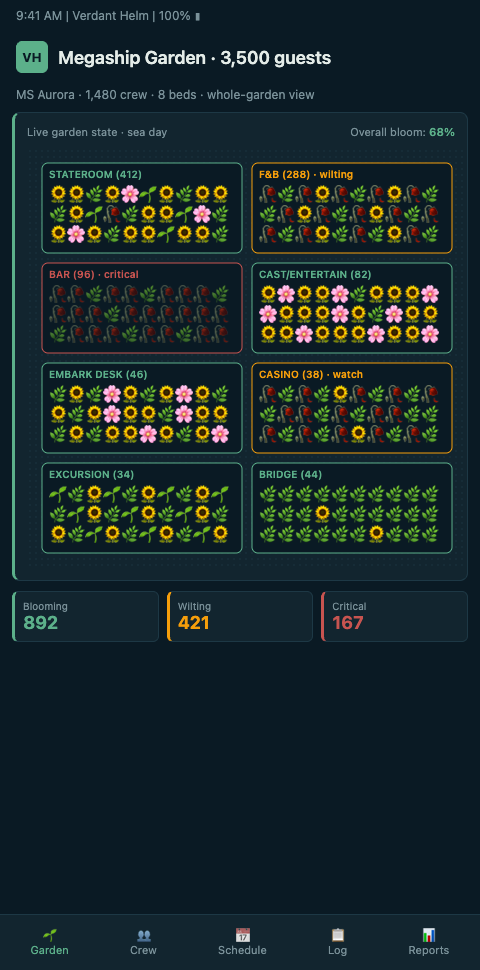
A megaship garden is not a single bed. It is a network of beds connected by service flows. Verdant Helm's deployment model for a new Hotel Director plants the garden across 10 days and two voyages. Days one through three map the beds — 19 dining venues, 14 bars, guest services, excursion desk, spa, casino, cast and entertainment, stateroom attendants split across deck ranges, and the behind-the-scenes crew (galley, provisioning, engineering support for hospitality). Days four through seven calibrate the per-bed labor weights against three sailings of historical complaint, NPS, and service-recovery data. Days eight through ten light up the live wilt reading so the Hotel Director enters voyage three with a working dashboard.
The botanical frame keeps the scale legible. Without it, a 19-venue dining operation reads as a spreadsheet. With it, the Italian specialty restaurant is a bed of perennials that bloom on a 7:00 and 9:00 two-seating cadence, drawing emotional labor from repeat guests and anniversary tables; the Lido buffet is an annual planting that must refresh every 90 minutes across breakfast, lunch, and dinner waves; the main dining room is a hedgerow that sets the voyage's NPS floor. Each bed has its own watering cycle, its own wilt signature, and its own prune-and-rotate rhythm. Verdant Helm's dashboard is a map of the garden with wilt overlaid in color — green bloom, yellow stress, red sink.
Job demands-resources theory applied to cruise employees explains why the bed-level resolution matters on megaships. Resources — autonomy, supervisor support, skill variety, peer connection — buffer burnout, but only when they land at the bed level. A blanket ship-wide wellness initiative does not help the specialty restaurant maître d' whose sink is a specific repeat-guest table pattern; a targeted rotation does. Existing ops platforms such as ITsynch already carry inventory, maintenance, and workflow data at megaship scale. Verdant Helm sits on top of that data and adds the energy overlay that turns operations into garden tending.
Four early-voyage moves matter most for the new Hotel Director. First, name the beds publicly — crew recognize when their work is seen as its own unit. Second, schedule the first port-day recovery rotations against the beds showing the deepest sinks, not the beds with the most complaints. Third, hold a weekly bed-state review with the Executive Housekeeper, F&B Director, Cruise Director, and Guest Services Director to walk the dashboard together. Fourth, tie non-renewal outreach to bed-state data — a cabin steward in a yellow bed hears a different retention conversation than one in a green bed.
Scaling Mistakes the First-Time Megaship Hotel Director Makes
The most common scaling mistake on a 1,200-crew ship is to start with a single flagship bed and try to perfect the garden view there before rolling it out. That approach fails because the value of the garden view is the network — seeing how the excursion desk's sink this week sets up the main dining room's wilt next week. Verdant Helm's deployment model is explicitly fleet-shaped: plant all beds with low-fidelity reads in week one, then improve the labor-weight calibration across voyages two through five. By voyage six, the fidelity matches a single-bed deployment and the network effects are already visible.
The second mistake is confusing crew happiness surveys with bed-state reads. The annual survey is a slow-moving backward snapshot. The garden is a daily living read. They answer different questions, and the survey's low-cadence nature actively hides the wilt pattern when used as a proxy. Verdant Helm keeps the survey as a contextual input but treats the live bed signals as the operating picture. A Hotel Director who rolls out Verdant Helm should plan to sunset any redundant pulse-survey infrastructure within two quarters.
The third mistake is under-investing in onboarding the new crew member into the garden. A cast member's first-contract experience is what determines whether the reads stay honest.
If new hires don't understand that peer observation is anonymized and bed scores don't drive compensation, the input quality collapses. Onboarding must include the garden model, not just the operational SOPs.
The fourth mistake is running the garden without a tight weekly ritual. Turning cruise director huddles into garden-state actions is how the dashboard translates into schedule changes and rotation moves. Without the huddle, the dashboard becomes wallpaper. With the huddle, it becomes the ship's operating rhythm.
The network pattern extends across the fleet and even into adjacent maritime sectors. SOV energy garden rollouts shows the same deployment arc — bed-mapping first, calibration second, network effects third. The scale is different; the arc is identical.
The fifth mistake the first-time megaship Hotel Director makes is ignoring the behind-the-scenes beds. Galley crew, provisioning, laundry, maintenance support for hospitality, and backstage cast and entertainment support are not guest-facing, but they feed the guest-facing beds directly. When galley wilts, the dining room wilts one voyage later because prep quality, portion consistency, and pass-window speed all degrade. Verdant Helm includes back-of-house beds in the garden map for exactly this reason. Hotel Directors who focus only on guest-facing beds find themselves chasing symptoms rather than causes by voyage four.
The sixth mistake is failing to adjust the garden for itinerary change. A ship repositioning from Caribbean loops to Mediterranean transatlantics and back again carries different guest-mix, different provisioning rhythm, different port-day recovery shape. The labor weights that calibrated on Caribbean data need to re-calibrate within the first two Mediterranean sailings, and the reverse on return. Verdant Helm's itinerary-aware calibration layer handles this automatically, but the Hotel Director still needs to flag the repositioning to the system so the recalibration window is planned rather than accidental.
One operational note on measurement discipline: bed-state readings should be timestamped against service peaks, not against clock time. A 0900 reading on a port day means something different than a 0900 reading on a sea day because the morning service density differs by two orders of magnitude. Verdant Helm's dashboards anchor readings against service state rather than wall clock to avoid this apples-to-oranges comparison. Hotel Directors who ignore this quickly lose trust in the data because yellow readings on port-day mornings look alarmingly worse than yellow readings on sea-day mornings even when the underlying energy state is identical.
A seventh practical note: megaship bridge and hotel department operational cultures differ, and the Hotel Director's Verdant Helm rollout sometimes stalls at the bridge-side interface. Safety-critical crew (deck officers, engine department) are outside the hotel department's bed map, but their rest-hour compliance and overall ship energy shape the operational baseline that hotel crew operate against. Verdant Helm's fleet view includes a bridge-side read-only pane so the Hotel Director can see whether the ship-wide fatigue picture is setting up hotel-department strain. When bridge-side fatigue spikes (heavy weather routing, port authority complications), the hotel department tends to absorb downstream emotional-labor bursts from anxious guests.
For Hotel Directors and Cruise HR Leaders
If you are inheriting a megaship and your first 30 days look like a headcount audit and a vacancy review, you are starting where the predecessor finished. Plant the garden in your first two voyages. Hotel Directors who do this report that their first non-renewal conversations land differently — specific, bed-aware, grounded in visible trends rather than exit-interview hindsight. Cruise HR Leaders who stand up bed-state data across a fleet find the sister-ship comparison becomes possible for the first time: which vessels build sinks faster, which beds drain together, which itineraries produce the highest recovery debt. The starting move is one ship, 10 days, Verdant Helm's deployment playbook — book a walkthrough to scope the first voyage.
The hand-off test with the predecessor — or, if no predecessor is available, with the F&B Director and Executive Housekeeper who stayed across the turnover — is where the new Hotel Director either plants real roots or inherits a dashboard that no one trusts. Walk the 19 dining venues and 14 bars in the first three voyages. Stand on each deck range with the head attendant. Ask the cruise director which cast members he would not schedule back-to-back again and why. These walks are what populate the labor weights with operational judgment, not just historical data.
Cruise HR Leaders running the fleet view should calendar a quarterly bed-state calibration across sister ships, aligning how wilt thresholds were set so a yellow reading on one ship is comparable to a yellow reading on another. Without that alignment, the fleet view generates false confidence and masks the ship that is actually the worst sink — usually the one whose leadership has the loosest thresholds. The garden model works; the discipline is what sustains it across 1,200 crew and a fleet of sister megaships.