A New Cast Member's First Contract With Verdant Helm
Day Minus 60
Sixty days before boarding, the cast member accepts the contract. Her offer letter names her ship, her role as a lead singer and cast ensemble member, and her seven-month contract length. Between day minus 60 and day one on the ship, she completes pre-boarding training, visa documentation, medical screening, and brand-specific production rehearsals. CLIA's workforce development resource notes that cruise onboarding officially begins approximately two months before a new hire boards the ship. But until day one, she has no visibility into the operating reality — what it feels like to hit month four, what the garden looks like from the inside, what is being watched beyond performance quality.
The onboarding gap is the single largest driver of first-contract non-renewal. Research on onboarding and cruise retention shows structured onboarding significantly boosts new hire preparedness and retention. Hospitality industry onboarding learnings from CHART converge on a similar finding — first-contract cruise hires who understand the operating context survive month four at meaningfully higher rates.
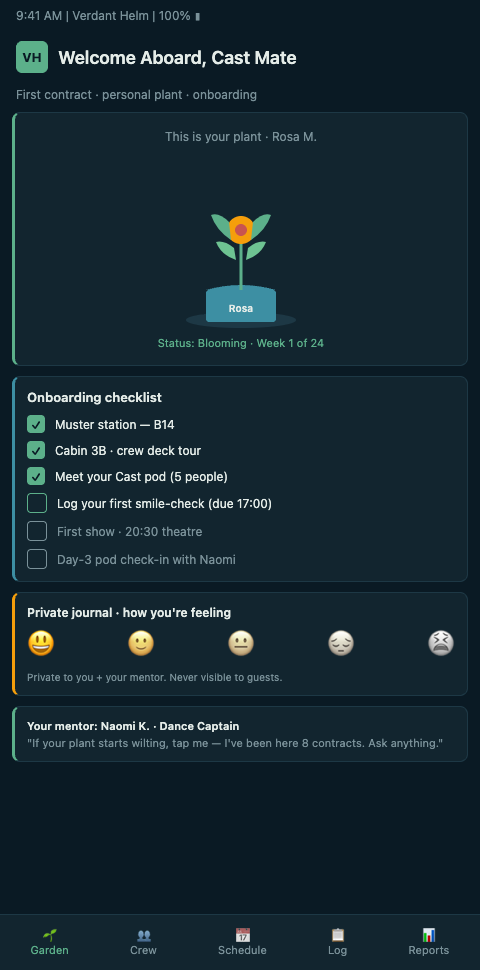
What Verdant Helm adds to first-contract onboarding is transparent visibility into the garden from day minus 30. The cast member sees her bed — the cast ensemble — and how it is read. She sees that the signals being watched are workload patterns, recovery traces, and peer-anonymized mood reads, not performance judgments. She sees that her contract has a month-four cliff pattern the product is built to flatten. Day one on the ship is no longer an introduction to an invisible system.
What the First Contract Feels Like With the Garden Visible
Picture the cast member as a freshly planted perennial in the cast ensemble bed. The bed has been blooming through prior voyages; her job is to take root, establish through the first-voyage production cycles, and settle into a sustainable bloom rhythm. Verdant Helm's onboarding rollout gives her three things the prior generation of cast members did not have.
First, a visible garden map on day one. She sees her bed — cast and entertainment — sitting alongside the 19 dining venues, 14 bars, and stateroom attendants across deck ranges. She understands that her work is tended inside a network, not evaluated in isolation. Second, a personal bloom trajectory. From day one forward, she sees her own wilt score — not for disciplinary purposes, but so she can learn to read her own early warning signs. By month two, most first-contract cast members develop an accurate self-read that matches the system's read within 10 percentage points. Third, the month-four heads-up. Verdant Helm surfaces a voluntary "approaching month-four" check-in at contract week 13 — a non-mandatory conversation with a cast director that explicitly addresses the cliff pattern and what pruning-and-watering moves are available.
Emotional labor research in hospitality documents anxiety and depression onset within the first three months of employment. BMC Psychology's systematic review of maritime personnel mental health identifies young age, poor sleep, and long hours as clustered risk factors at contract start — exactly the profile of a first-contract cast member. The first-contract period is the window where emotional-labor vulnerability is highest. Transparent garden visibility is a protective factor; SOLAS muster drill requirements and first-week compliance training are already present, but the emotional-labor context is new.
The onboarding rollout includes a day-seven garden walk with the cast member's cast director. The walk covers her bed in context — how the cast ensemble connects to dining venue service, why her post-show schedule overlaps with the late dining seating, where her recovery windows are positioned in the weekly cycle. The walk is not a briefing; it is a literal dashboard review where the cast member learns the language of wilt, bloom, prune, and sink by looking at the same live data the cast director uses.
Scaling First-Contract Onboarding
The first scaling move is to build the day-minus-30 visibility into the pre-boarding digital experience. Most cruise lines already run a pre-boarding portal for documentation and training modules. Verdant Helm's onboarding add-on becomes one of those modules — a 20-minute interactive walkthrough of the garden model, the cast member's expected bed, and the voluntary monthly check-in rhythm. Pre-boarding completion is tracked as a leading indicator of first-month retention.
The second move is to connect first-contract onboarding to the megaship garden rollout. The megaship garden build establishes the beds and the labor calibration; onboarding plants the cast members into those beds with full visibility.
The two are complementary — without the garden build, onboarding produces informed cast members entering an invisible system; without onboarding, the garden build reads cast members who don't understand what they're contributing to.
The third move is to extend the first-contract model to stateroom attendants, dining servers, and bar staff on similar timelines. Reading stateroom attendant energy patterns is a different bed with different labor mix, but the onboarding principle is identical — transparent visibility from day minus 30, day-seven garden walk, voluntary month-four check-in. Cruise HR Leaders often start the rollout with cast and entertainment because the bed is smallest and the measurement is cleanest, then extend outward.
The adjacent pattern in other maritime sectors matters. A turbine technician's first month on Verdant Helm runs the same onboarding arc — pre-boarding visibility, day-seven garden walk, voluntary month-based check-ins calibrated to the tech's rotation shape. The industries are different; the principle — crew members thriving when they can see how their work is tended — is the same.
One edge case: first-contract cast members whose role places them in especially high-emotional-labor beds (casino hosts, specialty-restaurant maître d's, spa front-of-house) need accelerated onboarding with the week-seven and week-eleven check-ins brought forward. Verdant Helm's onboarding engine adjusts the check-in cadence automatically based on the bed's historical wilt trajectory, so a casino-host first-contract cast member sees their first voluntary check-in at week six rather than week thirteen.
The second edge case: cast members rotating between ships during a first contract face a continuity break in garden-state context. Their reads on Ship A do not transfer cleanly to Ship B because the beds are different. Verdant Helm's onboarding flow includes a Ship B recalibration conversation at the point of transfer so the cast member's month-four trajectory stays visible across the move.
A third edge case is the pre-boarding dropout pattern. Some cast members complete pre-boarding training and then withdraw from the contract before day one on the ship. Verdant Helm's pre-boarding portal surfaces early signals — portal-completion pace, question patterns in the walkthrough, self-reported confidence — that distinguish likely-to-board from likely-to-withdraw. Cruise HR Leaders who catch the withdrawal pattern two weeks before the scheduled boarding date can replace the slot with a second-choice candidate without a production-rehearsal gap. Without the signal, the withdrawal lands three days before boarding and the production team absorbs the cost.
A fourth edge case applies to cast members returning for their second or third contract. They do not need the same day-minus-30 onboarding module; they need a contract-start recalibration that compares their prior contract's trajectory to the new ship's bed shape. Verdant Helm's returning-cast onboarding compresses the pre-boarding module to 10 minutes and adds a new-ship bed walkthrough. The recalibration is where returning cast members tend to over- or under-estimate the new ship's labor profile based on prior experience; the walkthrough corrects for both directions.
A fifth edge case worth flagging is the interaction between first-contract onboarding and the ship's muster drill requirements. SOLAS muster training is a compressed first-week activity that draws disproportionate emotional-labor for new cast members because they are learning safety protocols, meeting peers, and adjusting to shipboard life simultaneously. Verdant Helm's first-contract onboarding schedules the day-seven garden walk for the day after muster drill completes, not during the drill week, because the drill week itself is a depletion event that distorts baseline reads.
A sixth edge case concerns cast members on repositioning sailings. A cast member boarding in Miami for a Caribbean season that will reposition to the Mediterranean in October faces a changed operational reality mid-contract — different itinerary shape, different guest mix, different shore-leave ports. The onboarding framework originally calibrated on Caribbean loops may no longer match the operational reality by month five. Verdant Helm's mid-contract recalibration flags the repositioning as an onboarding event and offers a 20-minute refresher to the cast member ahead of the transition. Without this touchpoint, cast members often experience the repositioning as an unplanned stressor rather than an anticipated phase change.
For Hotel Directors and Cruise HR Leaders
First-contract non-renewal is the single most expensive retention failure in cruise operations. The cast member you spent two months training, documented, and onboarded leaves month four; the sunk cost is irrecoverable and the replacement cycle restarts. Hotel Directors who fold Verdant Helm into the first-contract experience from day minus 30 see first-contract completion rates move by 10 to 18 percentage points within two cohorts. Cruise HR Leaders who build pre-boarding garden visibility into their onboarding portal generate a leading indicator — portal completion quality — that predicts month-four retention before the ship even boards. The first cohort to pilot is your next class of cast members joining a ship already running Verdant Helm at the garden level; the onboarding effect compounds with the operational effect.
The on-ship hand-off from pre-boarding to day-seven garden walk is the point where the program either takes root or becomes another training checkbox. The Hotel Director should personally attend the first cohort's day-seven walk on each ship, not as a supervisory presence but as a visible signal that the garden model is operational doctrine rather than an HR initiative. Cast directors running the walk should be given 45 minutes on the ship's schedule, not 20, so the dashboard review can absorb the cast member's first-week questions without getting cut short by the production call time.
Cruise HR Leaders tracking the rollout should watch three leading indicators across the first four voyages: the percentage of cast members who opt into the voluntary month-four check-in, the number of cast-initiated rotation requests that reference bed-state data, and the cast director's own huddle action count in the same window. When all three trend up, the onboarding is working. When any one lags, the issue is usually a single cast director who is reading the dashboard but not making it visible to the ensemble. That is a coaching conversation with the Hotel Director, not a product fix.