Reading Stateroom Attendant Energy Like a Mini-Bar Report
The Deck 11 Swap Request
On a 3,200-guest vessel sailing a western Caribbean loop, the senior stateroom attendant on Deck 11 walked into the Executive Housekeeper's office on day 43 of his contract and asked for a fourth straight late swap. His corridor — 21 suites on the port side — had been missing the 1600 mini-bar audit three voyages in a row. The Executive Housekeeper granted the swap, pairing him with a more junior steward who would handle the evening audit while the senior attendant covered turndown. It felt like a reasonable rotation.
It was the wrong call. The audit misses were not a schedule problem. They were a garden-state signal.
The mini-bar audit is a deceptively rich read. Stateroom attendants on cruise ships typically manage 20 or more cabins in split shifts, which means the afternoon mini-bar swing is one of the windows where their hidden workload surfaces. When audits slip, the usual assumption is that the corridor had a late-checkout guest or a heavy turndown request. What the pattern on Deck 11 showed, voyage over voyage, was that the same attendant was slipping audits on the same segment of cabins — the aft suites with repeat guests who expected personalized service. Those were the cabins drawing the most emotional labor from the smallest number of interactions.
Workload and wellbeing research on cruise line employees quantifies the relationship directly: higher workloads degrade cruise hospitality wellbeing, and the fatigue shows up in task-completion variance before it shows up in self-report. Hotel housekeeping carries an injury rate of 4.3 per 100 full-time employees against 3.1 across all industries — and on cruise ships, the physical load compounds with emotional labor in exactly these repeat-guest cabins.
The Mini-Bar Report as a Garden Thermometer
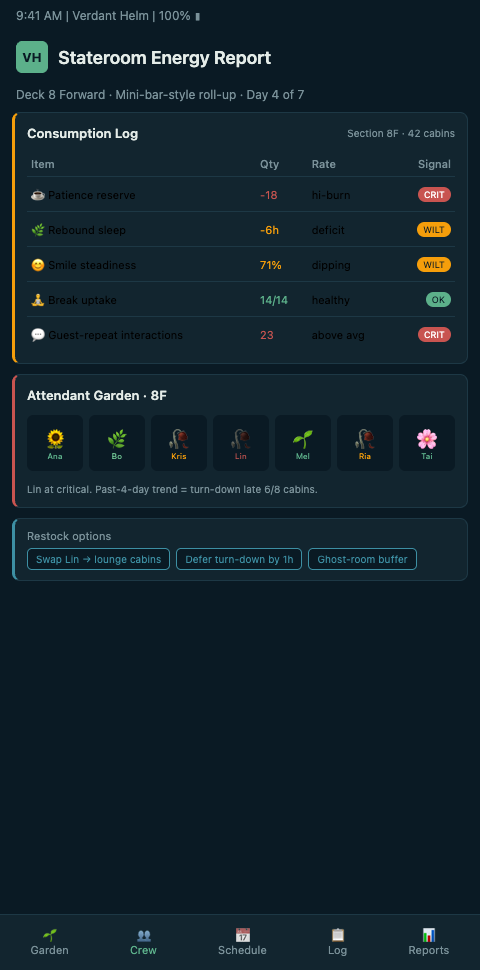
Treat a stateroom attendant as a perennial bed. The cabins in their corridor are the beds' bloom points. The mini-bar audit is the thermometer the gardener carries through the bed — not because the drinks matter, but because the completion pattern reveals which parts of the bed are wilting. When the attendant skips the audit on the cabins that require the most guest interaction, the signal is not laziness; it is emotional-labor preservation. The roots are thin, so the crew instinctively protects them by dropping the most energy-intensive audit segment. Verdant Helm is built to read that protection pattern in real time.
The core read Verdant Helm does on stateroom attendants has four layers. The first is the cabin-completion heatmap: for each attendant, which specific cabins are slipping turndown, audit, or morning reset on time. The second is the emotional-labor weight of each cabin — repeat guests, complaint history, special-occasion flags, and noted service requests all lift the labor score. The third is the recovery trace between shifts: how much of the rest window is protected versus eaten by pull-ins. The fourth is the peer-anonymized mood read, aggregated across three or more observers to protect identity.
Joined, those layers produce a bed-level wilt score that looks very different from traditional housekeeping KPIs. Traditional KPIs show cabin-completion percentage and rework rate. Verdant Helm shows which attendant is running 95% completion at the cost of a 30% sink depth — productive today, exit candidate in five weeks. Academic work on emotional exhaustion in hotels confirms the mechanism: workload plus thin supervisor support converts exhaustion into degraded service quality with a lag of two to four weeks. The mini-bar audit miss is the early edge of that lag.
The Deck 11 senior attendant's pattern was a classic sink: five repeat-guest suites pulling twice the emotional labor of his other cabins, zero recovery window during turnaround, and a peer-observed mood that had been yellow for two voyages. The right intervention was not a swap. It was rotating him off that corridor for one voyage, planting a deep-acted peer into the sink suites, and giving him a shoreside recovery on the next port day. Bartenders read consumption variance similarly — the rate of drink output versus the shift reveals fatigue well before the staff member admits it. Housekeeping has the same telemetry; it just hasn't been read that way.
Scaling Across a Housekeeping Fleet
The first scaling challenge when Verdant Helm rolls into a housekeeping operation is the temptation to publish attendant-level wilt scores. Do not. The score belongs in the Executive Housekeeper's view for rotation decisions, never in a crew-visible ranking. Internal visibility collapses the peer-observation input within two voyages; attendants stop giving honest peer reads once they believe scores drive compensation or shore-leave priority.
The second challenge is handling cabin mix. Suites, balcony cabins, and inside cabins carry different emotional-labor weights. A 20-cabin corridor of inside cabins draws less emotional labor per guest than a 14-cabin concierge corridor — the concierge corridor attendant is doing fewer cabin resets but carrying more personalized interactions. Verdant Helm calibrates the per-cabin weight from complaint history, repeat-guest flag, and service-request density so the wilt score remains comparable across deck types. Without that calibration, the Lido deck attendants look falsely healthy and the concierge-corridor attendants look falsely strained.
The third challenge is integration with existing onboard tools. Most cruise housekeeping teams already run a service-ticket system such as cruisePAL's IssuTrax platform, which logs cabin-service tickets and ties them to steward routes. Verdant Helm pulls from those systems rather than duplicating them; the steward route plus ticket cadence plus audit completion feeds directly into the garden state. The value-add is the energy layer — a layer that makes ticket data read as a living garden rather than a ledger. When combined with split-shift stateroom scheduling data, the garden state also shows which shift configurations systematically produce deeper sinks, giving Executive Housekeepers a schedule-design lever rather than just a rotation lever.
The pattern scales beyond cruise. The same thermometer logic — completion variance within a route as an early wilt signal — works for offshore wind turbine visit cadences. Where the cruise stateroom attendant skips the mini-bar audit, the wind tech skips the secondary vibration readings. Different industry, same root cause: crew protecting reserves by quietly shedding the most emotional or cognitive-expensive task first.
One edge case worth flagging: short-itinerary attendants (three- and four-night cruises out of Miami or Port Canaveral) compress the wilt cycle. What takes five weeks to surface on a seven-night Mediterranean loop surfaces in three weeks on a short-itinerary stack because turnaround density doubles. Verdant Helm's calibration accounts for the itinerary shape so the wilt thresholds stay meaningful.
A second edge case is the specialty-cabin mix. Ships with a high ratio of grand suites, concierge-class, and haven-class cabins pull disproportionate emotional labor per stateroom because the expected service density is higher and the repeat-guest rate is typically elevated. A steward assigned to a 14-cabin concierge corridor can be wilting more than a steward with a 22-cabin standard-balcony corridor, even though the raw cabin count says otherwise. The wilt calibration has to weigh each cabin type, and the weight should be re-validated every three months against current complaint and NPS data. Static weights drift as itinerary and clientele change.
A third edge case applies to team leaders — the deck supervisor or assistant housekeeper running 8 to 12 attendants. Their wilt profile looks different from line attendants because their emotional-labor load is team conflict mediation rather than direct guest-facing service. Verdant Helm models supervisors on a separate curve where peer-conflict volume, scheduling-change burden, and coaching-conversation density feed the wilt score. When a supervisor wilts, the full corridor they manage tends to follow within two voyages because coaching quality and schedule tending both degrade. Hotel Directors who track only line-attendant wilt miss the upstream signal that the supervisor is running dry. Pulling the supervisor view alongside the attendant view is what catches the full picture.
A fourth edge case is the mini-bar-free cabin. Some premium lines have eliminated mini-bars or converted to on-demand stocking. The audit signal then moves to adjacent routines — turndown chocolates, amenity refresh, bed-turn quality checks. The underlying thermometer logic holds; only the specific routine changes. Verdant Helm's per-ship configuration lets the Executive Housekeeper designate which routine serves as the bed thermometer for that ship's product, so the pattern-read stays valid across different brand operating models.
For Hotel Directors and Cruise HR Leaders
If your Executive Housekeeper is granting swap requests without pulling the audit-miss heatmap first, you are swapping the symptom rather than rotating the sink. On your next voyage, ask for the last four voyages' audit-completion data by attendant and by cabin. If the same attendant is missing the same cabins, you have a sink, not a scheduling conflict. Hotel Directors who shift their housekeeping huddle to open with the mini-bar pattern catch stateroom attrition in the month it forms rather than at non-renewal. Cruise HR Leaders who pull the pattern across a fleet see which ships are building sinks faster than their sisters — and that is where the retention levers should land.
The second-order move is to change what the Executive Housekeeper reviews in her 0730 stand-up. When the first slide of the stand-up is the cabin-completion heatmap with wilt overlay, the language of the rotation decision changes. A steward with two yellow voyages behind him does not get handed the new VIP Haven cluster on day one of the next sailing. A senior attendant flagged in a sink does not get stacked onto back-to-back turnaround Saturdays.
Cruise HR Leaders, meanwhile, should tie the audit-miss record into the contract-end conversation directly. "Your completion rate was strong, but three of your last four voyages showed the same repeat-guest suites slipping — what did those cabins cost you?" is a different conversation than the usual engagement check. It treats the steward as someone tending a bed that ran dry, not as someone who underperformed. That framing is what keeps the senior attendants — the ones with four contracts behind them and deep deck knowledge — from quietly deciding during month three that voyage six will be their last.