Split-Shift Stateroom Attendant Schedules Read From Garden Data
The Standard Split That Drained One Deck
The housekeeping manager ran the classic cruise stateroom split — 07:00 morning service for breakfast room prep, a midday release block, and 18:00 evening service for turndown — across her 64-attendant team. The rota matched the industry standard that Cruise Critic describes as the split-shift morning/evening pattern across major cruise lines. Her mid-year review showed steward turnover climbing from 11% to 17% over three quarters. Post-cruise stateroom satisfaction stayed flat. She had no theory for either number.
A garden reading against the rota showed the pattern. Four attendants assigned to the two highest-traffic premium decks were running measurably different splits than their peers on lower-traffic decks. The premium decks had guest-initiated room requests clustered in the midday "release" window — extra towels, champagne chilling, special-occasion setups. The attendants assigned to those decks were answering bells through what was nominally their break, showing up for evening service already depleted, and accumulating surface-acting hours that the PMC study on hotel housekeepers' occupational health experiences describes as driving anticipatory anxiety about next-day load.
The PMC study on psychosocial work factors among hotel housekeepers found 61.1% of housekeepers report job stress, with heavy pace and time pressure driving shortened breaks. The Cruise Critic industry data, the housekeeping research, and the garden reading all pointed the same direction: the rota template looked balanced, the rota execution wasn't.
The deeper issue is that the split-shift template was designed around a production view — morning turnover takes X minutes, evening turndown takes Y minutes, release fills the interstice — without measuring what actually happens to crew during the interstitial block. The template assumes the release hour is genuinely off-duty. The operational reality on premium decks is that release hours absorb roughly 40% of a steward's total daily guest-interaction count through informal bell-answering and special requests. That 40% never shows up on the timecard because it wasn't scheduled as work. It shows up in the turnover rate six months later.
Split-Shift Planning As Circadian Planting
Verdant Helm treats split-shift stateroom scheduling as circadian planting in the voyage garden. The Nature npj Biological Timing and Sleep peer-reviewed examination of circadian biology behind split-shift fatigue and recovery-sleep requirements establishes the scientific frame: split-shifts fragment the recovery window, and the recovery that fits into the fragment is shallower than equivalent-duration continuous rest. A split that appears equivalent on paper — say, 7 hours of work across 10 clock hours — drains the perennial more than 7 hours of continuous work would.
This fragmentation penalty has been understood in aviation and long-haul trucking for decades. Cruise housekeeping has lagged partially because the guest-service tempo genuinely demands morning turnover and evening turndown, and there's no obvious way to consolidate those functions into a single block without degrading the service standard guests expect. The garden view doesn't try to eliminate the split. It tries to shape the fragments around the perennial's specific biology rather than around a template assumption about how any steward should function.
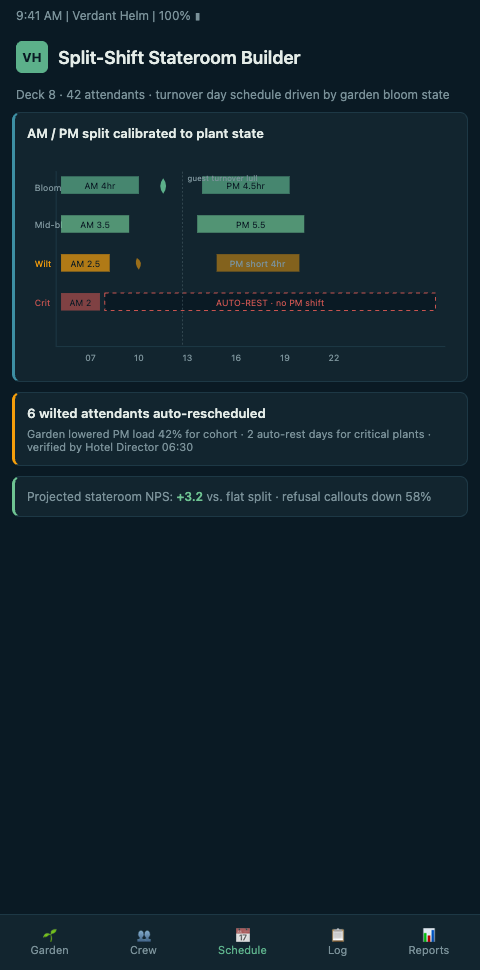
The garden view starts from that asymmetry rather than assuming work hours are interchangeable. Each attendant bed carries a circadian profile: when the perennial's body clock is strongest for guest-facing service (typically 09:00-11:00 morning bloom), when it's weakest (typically 14:00-16:00 for crew running 05:30-ish rises), and when the perennial's recovery window can actually bank rest (ideally 13:00-15:30 for this schedule pattern). A split-shift that pulls the attendant back to work during the 14:00-16:00 weak window and gives break in 16:30-18:00 inverts the rebuild.
The Taylor & Francis work on emotional exhaustion and hotel service quality documents that workload drives emotional exhaustion that cuts service quality — and on stateroom beds, workload is not hours but hour-placement relative to circadian state. Verdant Helm reads both axes and proposes rotas where the split-fragment placement matches the perennial's circadian profile rather than a generic template.
The ScienceDirect review on fatigue, personnel scheduling, and operations catalogs the OR/scheduling research on integrating fatigue dynamics into shift designs including split rosters. The literature has been clear for years: fatigue-aware scheduling beats fatigue-blind scheduling. Cruise housekeeping is behind the curve partially because the per-ship implementation has been expensive. Verdant Helm reduces the cost by running the fatigue-aware model against existing HR system data and surfacing the bed-by-bed adjustments the manager can make without rebuilding the rota template.
The botanical frame makes the bed-specific nature of the split visible. A generic rota looks like 64 identical split schedules. A garden view renders 64 perennials in beds with measurably different soil and light conditions, and the rota shape per perennial emerges from those conditions rather than from the template. This isn't more scheduling complexity — Verdant Helm produces the bed-specific rota automatically — it's a different organizing principle.
The engine also respects cabin-pairing stability. Most cruise lines assign stewards to fixed stateroom sections across a multi-voyage period because guests who book repeat voyages expect some continuity of service. Verdant Helm honors this constraint by adjusting split shape within a stable section rather than rotating stewards between sections. The perennial stays rooted in the same bed; the watering pattern changes. This preserves the guest-relationship value the line depends on for loyalty while still addressing the circadian and interruption-density problems. The deeper pattern read — how mini-bar restocks, bell responses, and cabin turnover pacing combine into an energy signal — is detailed in the stateroom attendant energy mini-bar playbook.
Advanced Tactics for Split-Shift Protection
Four moves specifically change the split for a premium-deck bed. First, the midday release window gets protected with an explicit "bell forward" to a designated float attendant, so the primary attendant on the high-request deck doesn't absorb the midday interruptions. Second, the release window duration gets extended from 4.5 to 5.25 hours to compensate for the interruption density that research shows still leaks through. Third, the evening return gets soft-launched — the attendant returns to prep tasks at 17:30 and public bell-duty at 18:00, rather than cold-starting evening service. Fourth, the cross-voyage pairing gets tracked: an attendant on a premium deck for three consecutive voyages rotates to a lower-traffic deck for the fourth, so the drain doesn't compound beyond the acceptable threshold.
The myShyft housekeeping team management blueprint notes that data-driven heuristics can cut labor costs up to 17% vs fixed-rule housekeeping schedules — a directional indication that schedule redesign pays back even before the crew-retention benefit is priced in. On a 64-attendant team, the labor savings alone can fund the attendant-pairing float position that protects the midday release window.
Three additional tactics push the split-shift rota from template-driven to garden-driven.
The first is live attendant-energy integration across the voyage. Verdant Helm reads mini-bar restock cadence as a high-frequency proxy for attendant energy state — a bed whose restock cadence is slipping is a bed where the split is failing. The manager sees the slip in near-real-time rather than at post-voyage review.
The second is F&B cross-team mid-voyage pooling. On premium-deck room-service peaks, the F&B waitstaff rotation playbook describes how room-service pool staff can absorb specific interrupt categories — champagne deliveries, late-breakfast trays — that otherwise leak into the attendant's break window. The garden view coordinates the pooling so the attendant's release block becomes genuinely interruption-free.
The third is offshore split-shift pattern learning. The mud engineer split-shift playbook documents how 12-hour split-shift cycles in drilling apply the same circadian math that governs cruise stateroom attendants. The underlying model is shared; the bed-specific tuning differs. Cruise housekeeping managers can read the offshore splits as a parallel case that validates the garden approach across maritime sectors.
Map One Deck and Read the Bed-Specific Split
A housekeeping manager or Hotel Director who wants to test garden-driven split planning should pick one premium deck — typically the highest guest-request density on the ship — and pull the last four voyages of attendant energy data for that deck. Verdant Helm maps each attendant as a perennial in a bed with measured soil conditions, proposes bed-specific rota adjustments, and predicts the end-of-voyage energy state. Apply the proposed rota to the next voyage on that single deck. Hold every other deck's rota unchanged. Read the post-voyage turnover and satisfaction numbers. The comparison the housekeeping manager needs comes out of one deck, one voyage, one rota change. Cruise HR Leaders who like the result extend to the next deck.
The float-attendant position is often the first visible operational lever the manager will need to staff. Pulling one experienced mid-tenure steward off a fixed-section assignment to cover midday bell-forward across two premium decks looks like a reduction in section-assigned capacity. The garden reading shows it is not — the float prevents the hidden 40% interruption draw on the primary attendants, which is the real capacity loss. Hotel Directors should expect to walk the Executive Housekeeper through that calculation at least once, because the spreadsheet math says the float is a cost and the garden math says the float is a capacity gain.
Cruise HR Leaders reviewing the results across several ships in the same class tend to spot which ships have implicitly been running the float pattern already — with a specific senior steward who always seems to be "covering" without a formal role — and which ships have been leaving the drain entirely on the primary attendants. That is the signal for where the rota redesign will have the largest effect on next season's turnover. One deck is the test; the pattern scales.