Blending Medallion Touchpoint Data With Crew Energy Trends
The Medallion Report That Should Have Flagged This Sooner
The Hotel Director had the touchpoint dashboard open on her iPad during the Wednesday morning ops meeting. On one specific maître d' at the main dining room, the Medallion log showed 412 guest-initiated interactions across a seven-day voyage — almost double the average for his peer group at comparable venues. His service-score trend line had slipped from 9.4 to 8.6 over three consecutive sailings. Nobody on the shipboard team had connected those two numbers.
That disconnect is the norm, not the exception. A Carnival-class ship running the Medallion platform produces up to 40 million intelligence events per ship per day through roughly 7,000 sensors and 4,000 interactive portals per vessel. Guest-side analysts mine that stream for personalization. Crew-side analysts rarely see it. The signal that a named maître d' is absorbing twice the emotional load of his peers sits inside the same data warehouse as the guest-facing recommendations — separated only by a query nobody is running.
Meanwhile, the contract non-renewal shows up four months later and gets coded as "personal reasons." The Medallion record that would have explained it is never pulled.
The Hotel Director's situation was not a data shortage. The Medallion platform, as the Princess MedallionClass Ocean FAQ describes, captures touchpoint-level guest interactions through the xIoT sensor network and wearable Medallion tokens — a stream rich enough to power guest personalization in real time. The data is there. The question is whether the crew-side views read it. Most cruise lines, surveyed informally at maritime HR conferences over the last three years, report they do not. Crew rosters, tip reports, and guest-feedback surveys remain the primary crew-management instruments, with Medallion treated as a guest-side product rather than a dual-purpose stream.
Reading Touchpoints as a Garden
Verdant Helm treats each guest-facing crew member as a perennial in the fleet's garden. Wearable and Medallion-style telemetry, which Nautilus International documents as already deployed for seafarer wellbeing, feeds the soil-moisture reading under each plant. A maître d' absorbing 412 touchpoints on a seven-day voyage is a perennial in dry soil. A bar lead with 180 touchpoints in the same period is a perennial in loam. Same species, different beds.
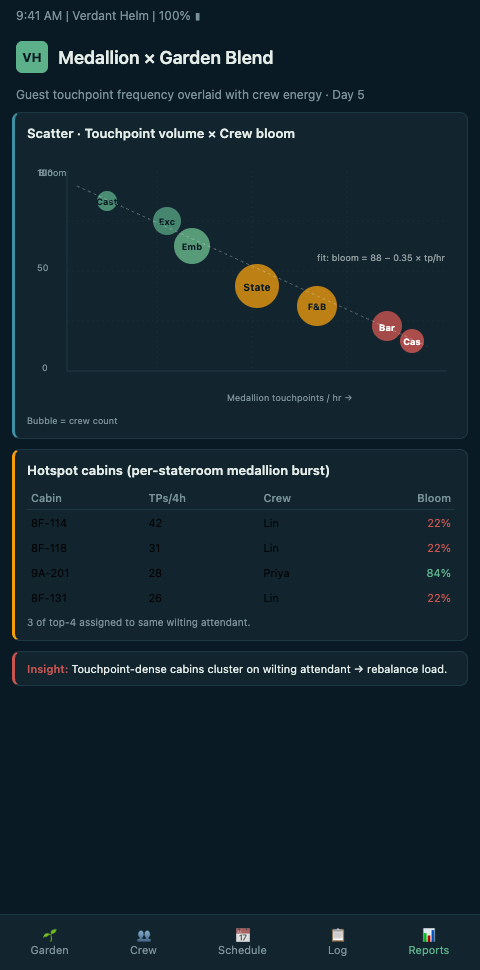
The garden view merges two inputs per crew member. The first is guest-initiated touchpoint count — how many Medallion-tagged guests chose to engage with this specific person, broken down by venue and hour. The second is the energy reading the Shipowners Club describes as bio-mathematical fatigue modeling applied to shipboard roles. One tells you the load. The other tells you how the plant is absorbing it.
A third input refines the picture: touchpoint duration. A Medallion event marks the start of an interaction; the platform can also capture dwell time at the venue or beside the specific crew member. Twenty touchpoints of 90 seconds each are a different load than twenty touchpoints of four minutes each. The duration layer lets Verdant Helm distinguish rapid check-ins from embedded conversations, and it lets the fusion attribute the actual time cost per interaction rather than assuming uniform intensity.
When both readings are plotted against each other, patterns appear that neither number shows alone. A maître d' with high touchpoints and a stable energy curve is a healthy perennial thriving in a sunny bed — leave him alone, maybe study what he's doing. A maître d' with high touchpoints and a declining energy curve is a perennial wilting under load — reduce his guest-facing hours before the wilt becomes permanent. A maître d' with low touchpoints and a declining energy curve is a perennial in the wrong bed — the load isn't the problem, the placement is.
Verdant Helm renders this as an overlay on the existing Medallion ops map. Venues become garden beds. Crew members become perennials placed within those beds. Touchpoint density shades the soil. Energy readings shade the leaves. The Hotel Director doesn't learn a new tool — she learns to read a second layer on the map she already checks daily.
The JISEM study on IoT-enabled services and hotel guest satisfaction found statistically significant correlations (p<0.05) between IoT quality indicators and customer satisfaction in hospitality. The research already links sensor data to guest outcomes. Verdant Helm extends that link backward into crew state, so the Hotel Director sees why a touchpoint-dense venue is sliding before the guest survey tells her — the same backward-tracing logic the live crew energy dashboards on the bridge apply to hotel-wide watch coverage.
The botanical frame matters here because it resists the temptation to average. Emotional-labor load doesn't distribute evenly across a team the way a spreadsheet implies. One server in a four-top rotation absorbs the escalations; one cabin steward on a deck absorbs the special requests. Perennials, not fungible widgets. The garden view makes the uneven absorption visible in a way a spreadsheet cell cannot.
Advanced Tactics for Touchpoint Fusion
Once the overlay is running, three second-order patterns become operational.
The first is touchpoint gradient across a venue shift. A dining venue isn't flat — the 19:30 seating absorbs different guest energy than the 21:00 seating. A maître d' whose Medallion touchpoint count skews heavily to one seating is a perennial absorbing its hardest light at a predictable hour. Verdant Helm flags these gradients and proposes a second anchor in that hour-bed so the load spreads. The Hospitality Technology piece arguing Medallion-style wearables reshape crew-guest service choreography describes exactly this kind of choreography tuning — but the post-by-post application requires the energy layer that Verdant Helm adds on top.
The second is cross-venue perennials — crew members whose touchpoints span two or more Medallion-tagged venues during a single voyage. On paper they're flexible assets. In the garden reading they're perennials being uprooted and replanted mid-bloom. Cross-venue touchpoint fusion, when layered on energy data, typically reveals these crew members hold service scores together for ops while burning themselves out faster than their single-venue peers. Verdant Helm tags cross-venue flags so the Hotel Director sees them before a rotation change.
The third is embarkation-day touchpoint surge. The Medallion log shows a characteristic spike at embarkation — guest onboarding interactions, first-venue visits, special requests logged into the system. Crew who absorb the surge without a corresponding recovery window show energy-bed decline by day three that the voyage never recovers. Always-on monitoring as described in the retention-monitoring post catches this compounding effect on the continuous timeline, not inside a single-voyage snapshot. And teams pulling in external feeds — the forecast-fusion playbook — can blend port congestion and weather-driven itinerary changes into the same model.
A fourth pattern worth flagging is the Lido-deck absorption during sea-day peak. Medallion touchpoint density on the Lido at 12:00-14:00 on sea days is typically 3-4x the ship average for any other venue. Crew members whose schedules place them on Lido beverage service during that window absorb a concentrated touchpoint load that their per-shift hour count doesn't capture. The fusion view weights Lido touchpoints higher for energy-impact calculation, reflecting the specific intensity that the Hospitality Technology coverage of OceanMedallion in live ops documents as a characteristic touchpoint cluster.
A fifth pattern is guest-journey recurrence. Medallion tags each guest's repeat interactions with specific crew members — a guest might touchpoint the same cabin steward 8-12 times across a voyage. Returning to the same perennial builds familiarity, which can reduce emotional-labor cost for standard interactions but concentrate it for difficult-guest scenarios. The fusion tracks guest-recurrence at the crew level and flags when a specific perennial is absorbing repeat contact from guests flagged in the Medallion system as frustrated-state or high-complaint-risk. These are the perennials most likely to be carrying invisible load.
Start With One Venue, One Voyage
Hotel Directors and Cruise HR Leaders who want to run this fusion for the first time should pick a single high-touchpoint venue — usually the main dining room or the specialty steakhouse — and pull one voyage of Medallion data and one voyage of shift-level energy data. Overlay them by named crew member. The patterns the Hotel Director spotted on her Tuesday morning will show up inside an hour. Verdant Helm packages the fusion so the analyst writing the query doesn't need to build the join by hand, and the onboarding path is venue-by-venue rather than fleet-wide. Start there, read the first overlay, and decide whether to extend it.
The second voyage is where the learning sharpens. Pull the same venue again, compare the named maître d's trajectory against his peers, and check whether the week-over-week touchpoint distribution shifted. If the load concentrated further on the same individual, the rotation move has not happened yet — and the fusion view has now told you twice. The F&B Director who ignores the second-voyage read is the one whose main dining room is staffing up from the replacement bench in month six. Cruise HR Leaders should calendar a standing review of the top-three touchpoint-dense beds across the fleet at the end of each voyage; it takes 15 minutes and catches the slow-compounding concentration that the per-ship views miss. The venue-by-venue extension that follows is almost mechanical once the first fusion lands.