Embarkation Desk Scheduling Around Emotional-Labor Reserves
Guest 420 at the Boarding Carpet
At 1530 on a turnaround Saturday in Miami, the senior embarkation agent at the gangway had smiled at 420 guests, answered 80+ elevator questions, resolved three passport complications, located two missing guests' reservations, and directed six wheelchair requests to the appropriate support team. Her nine-hour shift had two scheduled 15-minute breaks — both of which she ate through a muster-drill documentation task. Muster drill briefing started at 1600; her post ran until 1830. By the time the first sea-day guest complaint reached her desk on Sunday morning, the agent was 22 hours into a 90-minute recovery window.
This is the embarkation desk staffing pattern on most ships. It is scheduled for throughput, not for emotional-labor reserves. And the first-night service recovery rate reflects that gap.
Lean Six Sigma research on cruise embarkation documents how peak delays cluster on turnaround while desk staff juggle arriving and departing passengers simultaneously. Frontiers research on front-line hotel role stress finds role ambiguity and role conflict driving burnout and turnover intent — both heightened at embarkation desks where the agent shifts between greeting, documentation, escalation, and compliance roles within minutes. MLC 2006 Regulation 2.3 sets a legal ceiling of 14 hours work per 24 and 72 hours per 7 days, with rest-split rules that constrain scheduling. SOLAS requires muster drills before or immediately after departure — compressing the embarkation window further.
The scheduling frame has to change. Verdant Helm treats embarkation desk scheduling as a reserves problem, not a headcount problem.
Emotional Reserves as the Scheduling Primitive
Think of the embarkation desk team as a planting of perennials in the hardest-exposed bed on the ship. Turnaround day is the heat wave. The agents at the gangway face the highest emotional-labor burst per hour on the vessel — each guest interaction is high-emotion, novel, and documentation-heavy. Without a reserves-aware schedule, the heat wave kills off the bed's strongest perennials first because they absorb the most demanding guests. Verdant Helm's embarkation scheduling model is built to water the bed continuously rather than draining it.
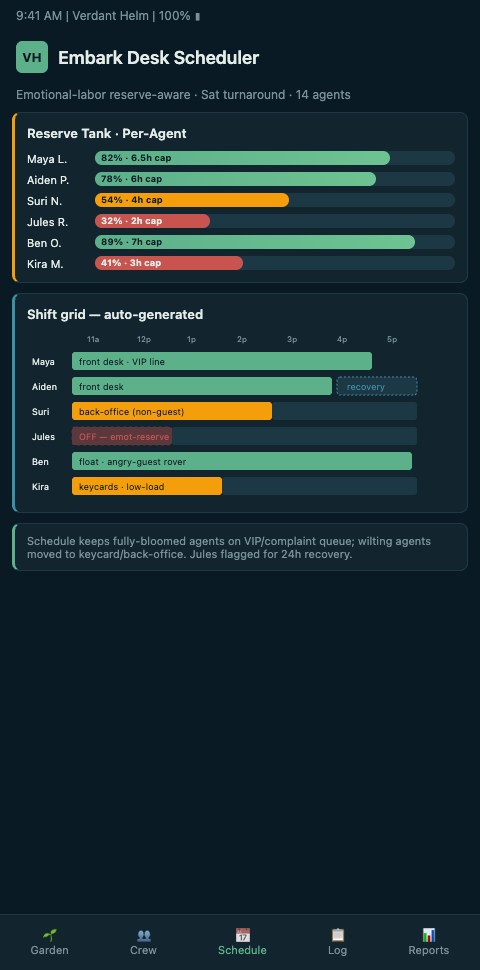
The model has four inputs. First, agent reserve score at 0700 on turnaround day, reading from the prior voyage's wilt trajectory, shore-leave recovery, and off-shift rest quality. Second, expected guest volume and complexity — wheelchair requests, special-needs flags, first-time cruisers, languages requiring interpretation, VIP loyalty tier. Third, muster drill schedule and the agent's role in it. Fourth, predictive scheduling constraints — research on predictive scheduling laws shows measurable employee satisfaction lift when schedules are published with enough advance notice for genuine recovery planning.
Combining the four produces a shift pattern that looks different from standard throughput scheduling. Agents with lower reserve scores start later in the turnaround window, rotate off the highest-complexity queue after 90 minutes, and take enforced breaks at 1030 and 1330 — not because headcount allows it, but because emotional-labor recovery requires it. Agents with high reserve scores take the gangway anchor positions during peak. The muster drill briefing is covered by a different rotation than the gangway greet so no single agent absorbs both peaks.
The botanical view here is specific: the embarkation desk is a bed of perennials that cannot be replanted mid-season. Unlike dining or stateroom roles, the desk crew is locked in for the voyage. So the tending logic is maximal water, maximal prune, no rotation once the heat wave starts. Verdant Helm's scheduling engine optimizes the day around that constraint. Dynamic scheduling systems in hospitality have shown measurable workload balance and guest satisfaction improvements when run on real operational data; embarkation is the application where the leverage is highest.
The First Sea Day Depends on Saturday
The direct downstream consequence of embarkation desk depletion is first-night service recovery failure. The agent who worked through her breaks on turnaround Saturday is the same agent staffing the guest-services desk on Sunday morning when the first complaint batch arrives. Her emotional-labor reserves are still in deficit. The complaint that should have taken 12 minutes and produced a retained guest takes 28 minutes and produces a lukewarm comment card. Multiply across the desk and the voyage's NPS takes a hit that traces directly back to the Saturday schedule.
The turnaround day NPS ceiling effect is the parent pattern; embarkation desk scheduling is a primary lever inside it. The two posts share a physics: reserves burned on turnaround do not rebuild overnight.
When port-day recovery windows are properly sequenced in the first 48 hours, the embarkation cohort stabilizes by day three and the remaining voyage runs at full reserve. When they are not, the deficit compounds through the sailing.
The adjacent pattern outside cruise ships is instructive.
Heli-deck arrival teams on offshore rigs manage a structurally similar peak — inbound crew, documentation, safety briefings, emotional-labor bursts — inside a fixed operational window. The scheduling discipline that works on heli-deck reception works at the cruise embarkation desk, and Verdant Helm's reserve-based model draws from both contexts. The shared primitive is the same: schedule around reserves, not throughput, for roles where the operational window cannot expand.
The first scaling move is to run reserve-aware scheduling for one voyage, compare first-night complaint resolution time against the prior voyage, and let the numbers settle the debate internally. Most operations see a 15 to 25% reduction in first-night resolution time within two voyages of switching. The second scaling move is to standardize the muster drill separation — no gangway-peak agent covers muster drill briefing in the same shift. The third is to build the 36-hour shoreside rotation so the embarkation cohort gets a real recovery window on the first port day.
One edge case: back-to-back passengers — guests who sail consecutive voyages without disembarking — generate additional emotional-labor in the embarkation desk because they expect personalized treatment during what should be a clean reset. Verdant Helm's reserve model accounts for back-to-back volume; operations running heavy B2B loops should adjust desk staffing upward on turnaround relative to a standard sailing.
The second edge case: embarkation desks serving CLIA-affiliated lines operating under stricter CLIA's workforce frameworks face additional documentation load per boarding. The model's per-guest complexity weight should be tuned accordingly during onboarding rollout.
A third edge case is embarkation on itineraries with multiple boarding ports. Some repositioning cruises board passengers at two or three ports across the first 48 hours. Each boarding peak generates its own reserve-draw, and crew who worked Miami boarding on day zero are often asked to work Port Everglades boarding on day one. Without a reserve-aware rotation across boarding ports, the second-port agents are already in deficit before a single guest walks the gangway. Verdant Helm's schedule engine handles multi-port boarding with explicit recovery windows between boarding sessions, which most existing scheduling tools do not support.
A fourth edge case concerns weather delays and port disruptions. When a scheduled 1000 embarkation start slips to 1400 due to weather, the gangway team's scheduled work window compresses while the documentation load stays constant. Verdant Helm surfaces a real-time reserve-burn rate so the Hotel Director can make a call on whether to extend the team's shift at a higher depletion cost, call in off-shift agents, or delay boarding further. The decision is operational and must be made in real time; reserve-burn visibility is what makes it a data-driven call rather than gut-feel.
The fifth consideration is the transition from embarkation desk to guest-services desk. On most ships, the same team or an overlapping subset handles both roles across the voyage. The reserve state at end-of-turnaround is the starting state for the guest-services week. Verdant Helm surfaces this handoff explicitly so the Hotel Director sees not only the turnaround-day state but the week-ahead trajectory it sets up. Teams that end turnaround day in deficit produce measurably worse first-night complaint resolution, and the cascade effect shows up in the week's NPS tail.
A sixth scaling consideration concerns the Hotel Director's direct daily involvement. Some Hotel Directors prefer to approve each embarkation rotation personally; others delegate to the Guest Services Director. The reserve-aware model works in both arrangements, but the delegation pattern shapes the dashboard access — Verdant Helm supports a delegated-approval workflow where the Hotel Director sees a summary of reserve-aware decisions without approving each one. The trade-off is speed versus direct visibility; most operations settle on delegation with a morning review by voyage three of the rollout.
For Hotel Directors and Cruise HR Leaders
If your embarkation desk schedule is built from turnaround throughput projections and minimum-headcount rules, you are scheduling a bed at the moment of its heat wave with no watering plan. Switch to a reserves-first schedule for one voyage. Hotel Directors who run this comparison find the first-night recovery times drop measurably and the desk team's wilt trajectory flattens inside two voyages. Cruise HR Leaders who standardize the reserve-aware model across a fleet remove one of the four or five biggest mid-contract stress concentrators for guest-facing crew. The starting move is pulling last month's turnaround schedule, overlaying the agents' reserve scores, and asking which agent had the hardest heat wave without a watering plan. That agent is the next intervention.
The harder part of the rollout is not the scheduling logic — it is the operating habit of the Guest Services Director and the Hotel Director through turnaround morning. For years the default question at 0700 has been "are we staffed?" That question is a headcount question. Reserve-aware scheduling demands a different first question: "which of our staffed agents are entering Saturday with reserves already drawn down from last voyage?" The answer sits on the Verdant Helm dashboard and changes which agents hold the gangway anchor slots, which cover muster drill, and which get the mid-afternoon break enforced rather than skipped.
Hotel Directors who build this first question into their turnaround stand-up find that within four voyages the team starts self-flagging reserve states before the dashboard prompts them. That is the indicator the culture has shifted. Cruise HR Leaders monitoring the fleet should watch for the ships where the self-flagging habit takes root — those ships are the ones where the embarkation bed stops acting as a sink and starts acting as the operational bloom that first-night service recovery depends on.