Why Turnaround Day Sets Your NPS Ceiling Before Boarding
0930 at Port Canaveral
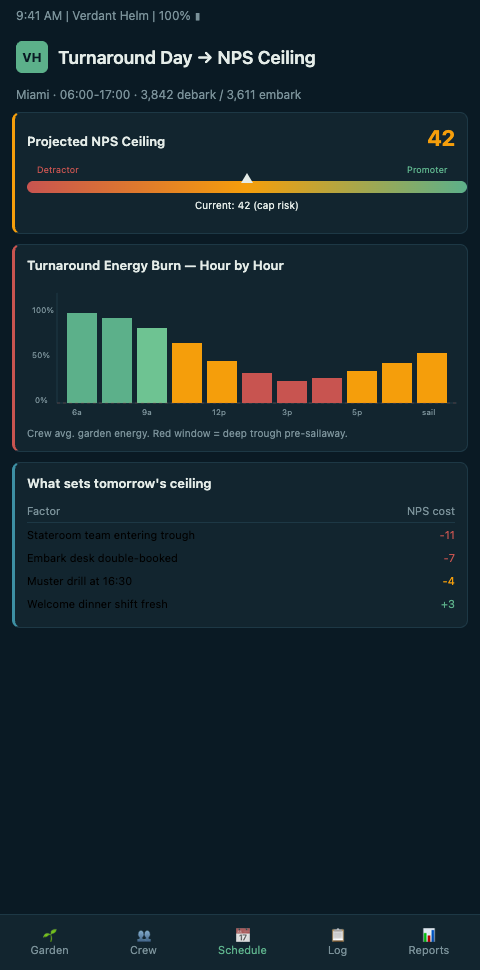
At 0930 on a Saturday in Port Canaveral, the Hotel Director already knew the voyage's Net Promoter ceiling. Disembarkation had run 40 minutes long because guest services absorbed two medical delays and a lost-passport escalation at the gangway. The cabin stewardship team was working through 2,400 staterooms on a 10-hour clock that Royal Caribbean publicly pegs at around 10 hours end to end, with 15 to 20 trucks of provisioning arriving in parallel. The Lido crew had half the usual provisioning window because the galley offload collided with boarding. And by the time the first guest stepped onto the carpet at 1130, the senior staff's emotional-labor reserves were already 30% below a clean baseline.
The voyage would still clear a 68 NPS. It would not clear 75. The ceiling had been set by 0930.
This is the turnaround paradox. 28% of cabin service requests on turnaround day take more than two hours because the same crew is resetting cabins, loading provisions, prepping muster drill, and greeting arrivals. The emotional labor of the first 12 guest interactions comes out of a depleted tank. Service-recovery research is clear that fast recovery boosts loyalty, but only when staff have the capacity to deliver it. Turnaround day determines that capacity for the rest of the week.
CLIA's 2025 State of the Industry report puts the sector at 37.2 million passengers with capacity scaling from 677K to 745K lower berths by 2028. More ships, more turnarounds, more turnaround-day variability. The Hotel Directors who stabilize this window are the ones who will protect their NPS as fleets scale.
Turnaround Day as the Gardener's Hardest Morning
Think of turnaround day as the morning a gardener resets the entire botanical display between two public openings. The beds were blooming for departing guests through the final sea day and the farewell dinner. Now they have six hours to prune back, water, rotate exhausted perennials into the greenhouse for recovery, and plant fresh energy into the beds most exposed to the incoming manifest. If the gardener treats this window as pure logistics — linens, provisions, clearances — the beds open wilted. Verdant Helm treats turnaround as the highest-priority tending window of the week.
The framework Verdant Helm uses on turnaround has four moves. First, the pre-disembarkation read, taken at 0600, scores each guest-facing bed — stateroom attendants, dining venues, Lido, bars, guest services desk — on wilt, sink depth, and prune urgency. Second, the 0800 rotation decides which crew members get a shoreside recovery window that afternoon versus which stay on embarkation duty. Third, the 1000 load balancer redistributes the highest-labor embarkation tasks (escalation response, wheelchair assistance, muster drill lead) so they do not concentrate on already-drained beds. Fourth, the 1400 pre-boarding huddle sets the first-night seating plan based on who in the dining team is ready to bloom and who is still visibly wilted.
The key metaphor to hold is that guest-facing crew are perennials, not annuals. They bloom through a contract cycle of four to nine months, and the flowering at turnaround day comes out of roots that grew through the last sailing. A stateroom attendant who had a rough final sea day — lost-luggage escalation, a norovirus cabin, a cluster of complaints — needs the turnaround window to be a watering window, not another sprint. When the head housekeeper schedules that attendant for both final-cabin reset and first-night turndown on the new voyage, the roots never refill. Gallup research cited in hospitality engagement work shows a 10% customer-satisfaction lift tied to engaged employees — engagement that turnaround day can either protect or burn.
This is where the cross-pressure with the rest of the week becomes visible. When turnaround goes badly, the ripple runs through embarkation, first-night dinner, and port-day one. Verdant Helm surfaces that ripple as a forward cone: the NPS trajectory you will see on day three is already implied by the bed-state at 0930 on turnaround day. That cone is what lets the Hotel Director trade short-term turnaround efficiency for week-long NPS ceiling — a trade that is invisible without the botanical view.
Scaling the Turnaround Read
On a fleet of three ships running Caribbean loops, turnaround days overlap on Saturdays and stagger midweek. The first scaling mistake is running turnaround dashboards per-ship with no shared view. That hides the pattern where one ship consistently enters its voyage with a lower energy baseline than its sisters — often because its home port routes more back-to-back guests, or because its itinerary compresses provisioning. The fleet view lets Cruise HR Leaders catch that pattern in three voyages instead of three quarters.
The second mistake is treating the embarkation desk as the sole bottleneck. The embarkation desk is the visible strain, but stateroom attendants absorb a deeper portion of the turnaround-day emotional labor, and bar and dining teams run the afternoon capacity stress test even before first-night service begins. A turnaround plan that only optimizes the gangway leaves the rest of the garden exposed.
The third mistake is underinvesting in port-day recovery the day after turnaround. Port-day recovery shapes weekly NPS, and the shoreside rotation that happens 18 to 36 hours after turnaround is the single highest-leverage recovery window in the voyage.
Hotel Directors who protect it routinely see a 4 to 6-point NPS gap versus those who use port day for catch-up training or extra housekeeping sweeps. The deeper accountability pattern is also visible in post-cruise NPS drops from mid-voyage dips — the turnaround ceiling and the mid-voyage dip are two snapshots of the same underlying water-table problem.
Verdant Helm's fleet-level turnaround module plugs into existing complaint-routing tools such as FCS's incident management dashboard and adds the botanical read on top, so turnaround decisions are made against operational signal rather than intuition. The ceiling-setting problem does not exist in isolation — it is a watchkeeping problem with a specific cadence.
The parallel with deep-sea 4-on-8-off watchkeeping cognitive debt is sharp: an unrecovered watch sets the ceiling on the next, and the deficit compounds across the voyage unless explicitly pruned. Turnaround day is the cruise equivalent of that watch.
The fourth scaling mistake Hotel Directors make is treating the ceiling as a fixed constraint rather than a movable one. The voyage after the first clean turnaround run — one where bed-state rotation, shoreside recovery, and prune-and-water moves were executed — typically lifts the NPS ceiling by 4 to 7 points without a single change to itinerary, manifest, or product offering. That lift comes entirely from crew energy. It compounds across sailings because the perennials that entered voyage two with refilled roots carry that water into voyage three's turnaround. Three clean turnarounds in a row produce a ceiling that is measurably higher than the ship's historical baseline. Most operators who see this pattern attribute it to seasonality or luck; the ceiling lift is repeatable when the turnaround discipline holds.
The fifth mistake is under-investing in the turnaround huddle itself. A 15-minute huddle at 0600 with the Executive Housekeeper, F&B Director, and Guest Services Director walking the bed-state dashboard together resets the day's rotations in a way that isolated department huddles cannot. The value is not the meeting — it is the cross-departmental trade-offs that only surface when the four leads look at the full garden. Without the huddle, the housekeeping team protects stateroom prep while F&B protects first-night dinner, and no one owns the embarkation-desk reserve deficit that will show up in Sunday morning's complaint batch. Hotel Directors who run the 0600 huddle on turnaround Saturday report that the decisions they make in those 15 minutes produce the largest NPS-ceiling lift in the voyage.
A sixth consideration applies to back-to-back sailings for turnaround ports that serve multiple lines. Major turnaround ports like Miami, Port Canaveral, Barcelona, and Civitavecchia see multiple megaships turning on the same Saturday. The shore-support ecosystem — provisioning trucks, port stevedores, luggage handlers — runs at capacity, and delays cascade across ships. Verdant Helm's port-congestion input adjusts the turnaround readiness forecast when shared-resource delays are probable, so the Hotel Director can pre-position the bed-state response before the provisioning delay actually hits. Without this forecasting layer, the turnaround decisions are reactive to port delays rather than buffered against them.
For Hotel Directors and Cruise HR Leaders
Your NPS ceiling is already written by 0930 on turnaround day. The first operational question for your leadership team on Saturday morning is not "is the ship ready" but "what state are the perennials in." Hotel Directors who rebuild their turnaround huddle around bed-state data from Verdant Helm routinely protect 4 to 8 NPS points that would otherwise leak out through under-recovered stewards, bartenders, and dining leads. Cruise HR Leaders who fold turnaround-day readings into their fleet retention view catch the compounding pattern before it shows up as a Q3 exit spike. Start with one ship and one voyage — the ceiling will show itself.
The follow-through move is the discipline of walking away from the dashboard when the ceiling read says the boarding hour is going to be punishing. Hotel Directors who have run this for six voyages in a row change two specific habits. They stop adding training slots into the turnaround afternoon when the 0600 bed-state read is already thin, and they stop auto-scheduling the same three stateroom attendants for the heaviest VIP decks voyage after voyage regardless of their wilt trajectory.
Cruise HR Leaders, in turn, stop treating the month-four non-renewal conversation as a standalone HR event and start attaching it to the turnaround-day record of the preceding four voyages. That attachment is what turns "she seemed fine at her last check-in" into "her bed tracked yellow through three straight Saturday 0600 reads and we never rotated her off the back-to-back stateroom cluster." The ceiling is readable; the question is whether the operational rhythm lets you act on it before the guest feedback forms confirm what the beds already showed.