Linking Post-Cruise NPS Drops to Guest-Facing Energy Dips
The NPS Drop That Generic Analytics Couldn't Explain
The VP of Guest Experience opened her fleet dashboard on a Tuesday morning. One ship in the Caribbean loop showed a 4.2-point post-cruise NPS drop on a single sailing — the sharpest voyage-over-voyage move in the fleet that month. The shoreside analyst spent a week on root-cause analysis and came back with "service consistency in specialty dining" as the finding. The VP knew what that meant: nothing actionable. No named server, no specific night, no specific venue. The drop would repeat.
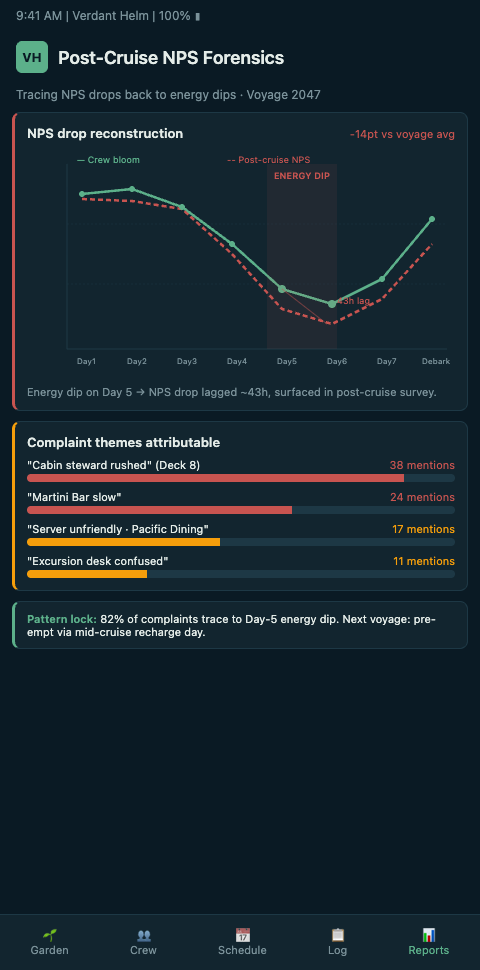
A garden reading ran against the same voyage produced a different output. Three named servers in the steakhouse venue had simultaneously bent their energy curves downward between 21:00 and 23:00 on day five — the same night seven negative mentions of "rushed service" and "distracted server" appeared in the post-cruise Carnival-style survey that lines send 1-2 days after disembarkation. The three servers had absorbed an unexpected 14-guest walk-in overflow that the steakhouse manager had accepted to hit covers. The reservation system showed the decision. The energy data showed the cost. The NPS drop showed the consequence.
This specific trace is not what most cruise analytics produces. The Hospitality Technology survey found 0.4 correlation between employee engagement and intent-to-recommend, with a 10% engagement rise tied to a 4% recommend lift. The macro correlation is well-established. The micro trace — one server, one night, one survey response — is not yet standard practice on most cruise lines.
The trouble with stopping at "service consistency in specialty dining" as a finding is that it directs the recovery effort to a population rather than a cause. The shoreside analyst's conclusion pushes the Hotel Director toward a general training refresh, a blanket schedule adjustment, or a fleet-wide policy revision — none of which address the specific triggers that produced the drop. A month later a similar drop happens, the same generic finding gets logged, and the cycle repeats. The specificity the garden trace produces breaks that cycle because the intervention now has a named target.
The Garden View of NPS Drops
Verdant Helm models post-cruise NPS as the delayed signal from the garden. Guest survey responses arrive 24-48 hours after disembarkation, long after the shipboard team has moved on to the next voyage's embarkation load. By the time the VP sees the number, the garden that produced it is already a different garden. The goal of the garden-NPS fusion is to compress that feedback loop — to trace the post-cruise dip back to the specific perennials that wilted during the voyage so the shipboard team learns before the next sailing.
The Bain Net Promoter 3.0 framework ties promoter scores to frontline employee behavior — a link the Harvard Business School service profit chain work established decades earlier and the 2022 SAGE meta-review confirmed. The theoretical chain runs: crew state → service quality → guest satisfaction → NPS. Most cruise lines measure the last link and guess at the first three. Verdant Helm measures all four and lets the guess collapse.
The garden view treats each post-cruise NPS response as a beam of light pointing back at specific perennials in specific beds on specific nights. A guest writing "rushed service at the steakhouse on night five" is a beam pointing at three servers, a 120-minute window, and a bed. The system matches the beam against the energy curve data for those perennials during that window. When the beam lands on a perennial that was already showing wilt during the specified window, the trace is complete.
This works because the MDPI analysis of cruise traveler service perceptions found food and staff ranked highest in satisfaction while embarkation and excursions ranked lowest — meaning the NPS dips cluster in specific touchpoint categories the garden view can map. The Deloitte industry analysis of cruise passenger-experience drivers reinforces that the drivers are uneven across the voyage — some venues carry disproportionate NPS weight. Verdant Helm knows which beds carry the weight for each ship class and weights the trace accordingly.
The botanical frame resists the averaging trap that shoreside analytics tends toward. A 4.2-point NPS drop is not "the ship got worse." It is three named perennials in one bed on one night absorbing an unexpected load they couldn't deep-act through. The generic finding erases the specifics. The garden view preserves them. And the preservation is what lets the shipboard team fix the bed before the next voyage sails.
The fusion also handles the survey-verbatim noise problem. Post-cruise NPS responses often contain comments that describe an experience without naming a server, venue, or night. "The service was a bit off near the end" is a real comment that appears in nearly every voyage's verbatim. Verdant Helm parses verbatim ambiguity by reading the response alongside the guest's Medallion journey — if the guest's tagged interactions cluster around a specific venue and time window, the "a bit off" can be resolved back to that cluster with confidence. The verbatim stops being noise and becomes a directed beam.
The fusion also respects that NPS itself is a lagging measure. Reading backward from survey to crew state diagnoses the past voyage, which matters, but the more valuable use is forward: the garden view flags the wilt-risk patterns that historically correlate with post-cruise NPS drops, so the maître d' or Hotel Director can intervene before the survey arrives. This parallels the turnaround-day NPS ceiling playbook, which caps the embarkation-day load before the post-voyage signal can show the damage.
The forward-prediction version of the fusion runs continuously through each voyage. Verdant Helm reads shift-level energy data in near-real-time, compares current perennial trajectories against historical NPS-producing patterns, and flags beds where the current voyage is trending toward a post-cruise dip. The Hotel Director sees a specific warning: "steakhouse on night five is tracking 0.6 points below predicted based on energy absorption today." That warning comes 36-48 hours before the guests who produced the problem will even receive the post-cruise survey email.
Advanced Tactics for Score-to-Crew Tracing
Three tactics make the trace routine.
The first is pre-trace tagging of voyage anomalies. The garden view captures operational events as they happen — the 14-guest walk-in overflow, the last-minute stateroom upgrade, the compressed turnaround-day window. When NPS survey responses arrive, these tags pre-structure the trace so the analyst doesn't search a flat log. The system already knows that night five had a steakhouse overflow event; responses mentioning the steakhouse on night five route directly to the pre-tagged event.
The second is contract-month compounding. A server in month four of a nine-month contract absorbs load differently than the same server in month one. The month-four cliff playbook details the characteristic drop in tolerance that shows up roughly 16 weeks into a guest-facing contract. When a trace lands on a perennial in month four or later, Verdant Helm weights the finding more heavily — the wilt in that window is more expensive than the same wilt in month one.
The third is near-miss learning across niches. The wind technician near-miss reporting playbook describes a pattern where fatigue troughs predict subsequent near-miss events. The same pattern holds for NPS dips in hospitality — a voyage with unusual garden-wilt patterns that didn't produce a survey-visible drop is a near-miss. Verdant Helm tracks these near-miss voyages and uses them to tune the predictive model, so the next drop is caught earlier.
A fourth tactic is the promoter-detractor split view. Raw NPS averages collapse a bimodal distribution into a single score, hiding the fact that the same voyage might have produced both more promoters and more detractors than average. Verdant Helm splits the post-cruise response stream into promoter-origin and detractor-origin traces, then maps each back to the garden state during the voyage. Promoters and detractors often originated from different beds on different nights — the voyage-level average obscures the divergence. Separating them produces a cleaner trace for each direction and lets the Hotel Director double down on what created the promoters while intervening on what created the detractors.
Start With One Drop and Work Backward
A VP of Guest Experience or Hotel Director running this trace for the first time should pick the most recent voyage that showed a post-cruise NPS drop of 2+ points. Load the voyage's shift-level energy data and the full survey verbatim. Verdant Helm will match the verbatim against the shift data and produce the specific-night, specific-bed, specific-perennial trace within an hour. The finding that comes out will be concrete enough to act on — a named bed to redistribute, a named perennial to reassign, a named event to pre-structure next time. Run that trace once. Decide whether to run it on every voyage.
The review meeting after the trace is where the shoreside-ship handoff either strengthens or stays stuck. Pull the Hotel Director, F&B Director, and shoreside guest-experience analyst into the same 30-minute conversation with the trace on screen. The analyst typically enters expecting "service consistency" again and leaves with three named servers, one named night, one named overflow event, and one named steakhouse manager decision.
The next voyage's embarkation brief carries a specific instruction — no walk-in overflows accepted at the steakhouse past the covers threshold without a compensating rotation — and the post-voyage survey on that sailing is the test. Cruise HR Leaders who institute this handoff as a monthly standing review across the fleet see the generic-finding frequency drop sharply inside two cycles. The shoreside analytics team does not object; they get a sharper brief and their recommendations start landing as actual changes. The specificity is what makes the change stick.