Heli-Deck Arrival Rituals That Decode Incoming Crew Energy
The Missed Measurement on the Helideck
A crew of eight steps off an AW189 onto a North Sea semi-sub helideck at 11:40 on a Monday. Two have just completed a 90-minute flight from Aberdeen. All of them endured pre-flight check-in starting at 07:30, a overnight delay the previous evening due to a cancelled connection, and — for three of them — a six-hour drive from the north of Scotland to Aberdeen the day before. The HLO signs them in, the steward shows them to their cabins, and the induction starts at 13:00. By 14:00 all eight are on shift. Nobody has measured the baseline any of them arrived with. The 21-day hitch has started from an unknown starting point, and the OIM will not know how much of the first week's fatigue is rotation-induced versus travel-residual.
The travel-residual cost is real and documented. A 2025 ScienceDirect paper on offshore worker fatigue as a safety concern at sea specifically notes that pre-arrival travel fatigue is underassessed, supporting the case for a helideck-level baseline check. An Offshore Injury Firm legal analysis documents that most offshore worker fatalities occur during travel — a fact that raises the stakes of arrival readiness assessment in two directions. First, the helicopter flight itself is the highest-risk segment. Second, the post-flight crew member who walks onto the rig with residual stress from that segment is a different operational unit than the same person at mid-hitch steady state. Treating them the same masks risk.
The Helideck as the First Garden-Tile Reading
The Verdant Helm approach treats the helideck arrival as the moment the new crew member is transplanted into the garden. A transplant does not bloom immediately. It needs water, a check for transplant shock, and a gardener's eye on the first three shifts. The arrival ritual on a well-run rig already does some of this — the induction, the medical sign-in, the HLO briefing. What Verdant Helm adds is a structured crew-state baseline that feeds the garden display from the first 30 minutes on board.
The baseline check is a five-question tablet flow the crew member completes during the induction. It asks about sleep in the 24 hours before flight, number of flight legs, overnight transit disruption, subjective readiness on a Karolinska-aligned scale, and any headache or musculoskeletal complaint. The IOGP Report 697 standard for offshore helidecks and facilities sets the industry design and operations standard for helideck arrival handling, and the baseline check slots into the existing induction flow rather than adding a new one. UK HSE's guidance on offshore helicopter travel (INDG219) covers the induction and arrival briefing requirements the baseline check reinforces. The regulatory scaffolding exists. The measurement is the missing piece.
The garden view of arrival reads cleanly. A crew member whose baseline check shows solid sleep, single-leg travel, and green subjective readiness opens as a fresh planting in the bed — normal hitch progression expected. A crew member who shows disrupted sleep, stacked travel, and amber subjective readiness opens as a transplant under stress — the first three shifts get a partner, an extended break, or a deferred high-risk task. The OPITO BOSIET and HUET training standards define the baseline training every inbound crew member has completed before arriving offshore, which gives the rig a known floor to build the energy baseline on top of. The Flight Safety Foundation's BARS Offshore Helicopter Operations standard v3 covers pre-arrival communications, landing rituals, and passenger checks that can be augmented with the energy check-in.
CAP 437, the UK CAA offshore helideck safety standard explained by a recent industry briefing, defines the helideck briefings and handling rituals that can be extended with energy check-ins without disrupting existing safety-of-flight discipline. The operational insertion point is the induction classroom — already scheduled, already resourced, already the place where HSE, medical, and operational information lands. Adding the five-question pulse adds 90 seconds to a 45-minute induction. The marginal cost is negligible. The marginal value is the first tile of the garden for the new hitch.
Verdant Helm's baseline flow produces a garden tile for every arriving crew member that is visible on the OIM's dashboard by the end of induction. The toolpusher running the afternoon handover at 18:00 on arrival day can see which crew members arrived green, amber, or under stress — and the first-night task allocation reflects that. A derrickhand who arrived amber is not put on a night trip on day one. A roustabout who arrived green can take the standard induction shift and begin normal rotation.
The Helideck Baseline Check
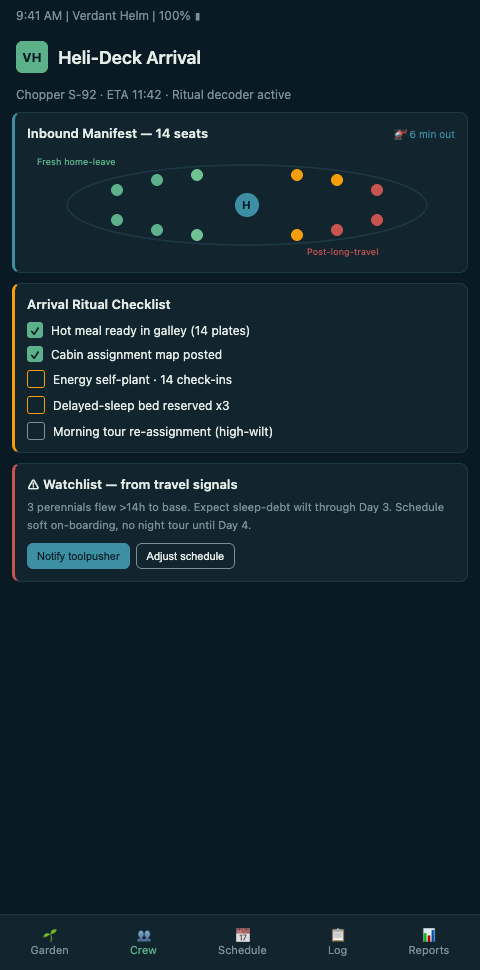
The baseline check interface is deliberately minimal — three screens of two to three choices each, finger-sized buttons, and a final summary the crew member can review before submitting. The HLO and HSE coordinator see the aggregate arrival state for the day's inbound flight without seeing individual responses unless a red-flag pattern triggers escalation to the rig medic. Privacy-by-default is the design principle, with the medic as the escalation point rather than line management. That design is what gets honest baseline responses instead of "everyone is fine" defaults.
The tablet is positioned at the induction classroom's entrance, not at the helideck itself. A crew member walking from the helideck to the induction room has already handed over their HUET card, been issued a cabin key, and taken a breath in a warm space. That transition gives the baseline check a fair measurement window — not the adrenaline of a just-landed rotor downwash, not the inertia of a long seated induction, but the early induction moment when the crew member is still holding their own travel memory clearly.
Verdant Helm's flow takes 90 seconds to complete and produces the garden tile before the HSE coordinator starts the first briefing slide. OIMs who have deployed the check report that the crew response rate sits above 95% from hitch one, because the check is positioned as part of the induction rather than as an additional ask. The interface is where the honesty lives. A baseline check that feels like a clinical survey will get clinical answers. A check that feels like a quick garden reading the crew member is familiar with will get the answer the rig actually needs.
Advanced Tactics: Closing the Loop Across the Hitch
Three tactics make the arrival baseline do ongoing work. First, the baseline feeds hitch-end analysis. When a crew member files an incident report or a near-miss in the first 72 hours, the analysis can check whether the baseline was amber or stressed. The toolpusher first-week energy dashboard post covers how the toolpusher reads the arrival baseline into the first-week operations plan.
Over dozens of hitches, the pattern either confirms that stressed arrivals generate front-loaded incidents (in which case the mitigation gets standardized) or confirms they do not (in which case the baseline check can be simplified). Either way, the data earns the ritual.
Second, pair the baseline with the flight-planning loop. The crew-change flight planning post covers how garden-state data upstream — at the logistics base, before the flight — can reduce stressed arrivals by catching travel-disruption patterns. A crew whose connection was cancelled the night before flight can be rerouted, re-manifested, or given an extended pre-flight rest before helicopter departure. That upstream intervention is what separates a rig that tolerates stressed arrivals from one that prevents them.
Third, learn from adjacent-industry arrival practice. Deep-sea cargo crews scheduling vessel arrivals at congested traffic separation schemes face the same "handoff into a high-load operation with unknown crew state" problem. The TSS transits and scheduled crew energy post documents the cargo-industry discipline on timing high-risk transits against crew-state curves. The pattern transfers. An inbound rig arrival is a cargo-style transit entry from the crew's perspective.
The common mistake is to treat the helideck as a logistics checkpoint — bags, ID, boots — and not an operational measurement point. The induction classroom is where the crew member becomes a member of the rig's garden, and the garden needs to know what it is receiving. Verdant Helm's baseline check makes that reception legible. The OIM who reads the arrival board before dinner on arrival day is setting the first three shifts up correctly.
A fourth tactic is to pair the arrival baseline with a departure baseline at hitch end. The same five-question flow run in the transit lounge as the crew flies off closes the loop — what state did the crew leave the rig in, and did the hitch's garden trajectory match the departure measurement. Over dozens of hitches, the comparison builds a model of how the rig itself affects crew state beyond the expected fatigue curve. Rigs with systematically better departure states than their arrival-plus-hitch-curve prediction are doing something right operationally. Rigs with systematically worse departure states are absorbing some hidden cost the arrival baseline cannot see. The departure measurement surfaces it.
A fifth tactic is to feed the arrival baseline into the logistics team's own schedule. When the arrival data shows a pattern of stressed baselines from crew members routed through a specific transit hotel or a specific flight connection, the logistics team has a concrete supplier-management signal. A transit hotel that is generating amber arrivals hitch after hitch needs to be rotated out of the contract. A flight pattern with repeated overnight disruptions deserves re-routing. The arrival baseline is not only an operational tool. It is a supply-chain feedback loop for the crew transit infrastructure.
A sixth tactic is to train the HLO team on reading the arrival board so the helideck becomes an active measurement surface, not a passive checkpoint. An HLO who knows that today's inbound flight is carrying two amber arrivals handles the crew differently at the landing pad — with a quieter induction pace, a longer orientation, and a more attentive eye during the boot-changing walk to the accommodation block. That first 15 minutes of on-rig time is where the garden's first tending happens. HLO teams that embrace the role report better first-day compliance with self-logging and fewer first-week near-miss reports — the arrival handling is the first intervention.
CTA: For OIMs Running High-Traffic Rig Crew Changes
For OIMs on rigs with bi-weekly or weekly crew changes and a persistent pattern of front-loaded first-week incidents, the next move is a single-hitch trial of the helideck baseline check. Verdant Helm provides the tablet flow, the induction-room insertion script, and the dashboard view the OIM reads at end-of-induction. Run the baseline for one full crew change cycle and correlate the first-72-hour incident count against baseline color. The delta will make the case for making the check standard on every inbound flight.
The setup for the single-hitch trial runs in under a week. Verdant Helm ships the tablet preconfigured, the HLO and HSE coordinator receive a 15-minute induction-insertion briefing, and the first inbound flight's arrivals complete the baseline during their regular induction. The trial captures three data streams for comparison: the baseline color for each arriving crew member, the specific tasks each crew member performed in the first 72 hours, and any near-miss, first-aid, or handover-note exception the toolpusher flagged during the same window. At hitch end, the OIM reviews the three streams together with the rig medic.
Rigs that find a 40%+ difference in first-72-hour incident rate between green and amber arrivals typically make the check standard within the following rotation. Rigs that find no difference tune the check or drop it — either answer is useful because the data decides rather than the vendor's pitch. Book a 30-minute scoping call with an HLO who has run the trial — the conversation covers the specific induction-room insertion point and the dashboard handoff from HLO to OIM to toolpusher that keeps the signal flowing after the crew leaves the classroom.