Traffic Separation Scheme Transits Scheduled by Crew Energy
The 22:40 Dover Strait transit that should have been at 19:40
A 10,000 TEU container vessel approaches the southwestern lanes of the Dover Strait TSS at 22:40 on voyage day six of a Shanghai-Rotterdam leg routed via Suez. The traffic picture from the Channel VTS feed shows 34 targets in the relevant area, six of them southbound in the adjacent lane, two ferry crossings expected in the next 90 minutes. The OOW on watch is the Filipino Second Mate, who has been on the 4-on-8-off rotation with disrupted sleep for three days across the Mediterranean segment and is currently the most wilted perennial on the bridge. The British Chief Mate is off-watch, asleep in a consolidated window that ends at 03:40. The voyage plan had the Dover Strait transit falling where the schedule put it. Nobody scheduled the transit against the bridge's energy state.
The Skuld P&I brief on Malacca and Singapore Strait collisions documented the same pattern across chokepoint transits worldwide: congestion and collision risk concentrate in predictable lanes, and the bridge-team state during the transit is a first-order determinant of outcome. Marine Insight's industry guide on common TSS mistakes noted that error rates rise sharply when the OOW is running solo during dense TSS transits. The Nautical Institute's TSS collision case study surfaced the same mechanism: OOW workload mismatched with bridge resource available. The MAIB's Dover Strait case files across the 2019-2023 window included multiple near-miss reports where the transit time was fixed by the voyage ETA and the OOW on the conn carried three or more days of accumulated sleep debt.
The garden as a transit-scheduling instrument
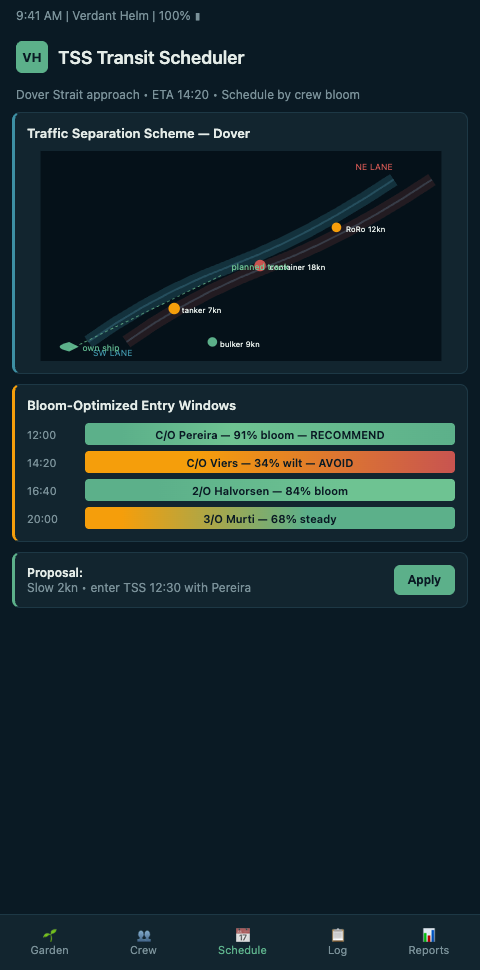
Verdant Helm treats a TSS transit as a high-demand tending event and schedules it against the bridge garden's collective bloom state, not against the voyage plan's default ETA. A Dover Strait crossing that would have fallen at 22:40 with the wilted Second Mate on the conn gets re-proposed at 19:40 with the Chief Mate on the conn and the Second Mate as lookout, or at 05:30 the next morning with the Chief Mate coming on watch at peak bloom. The garden renders the three options side-by-side: predicted transit time, predicted bridge bloom state, predicted traffic density from the VTS feed, and a composite risk reading. The same mechanism applies at Malacca on a Singapore-Long Beach VLCC run, at the Bosphorus on a Black Sea-Mediterranean tanker run, and at the Singapore Strait westbound.
The Master chooses the option. The garden surfaces it. This is the core mechanic. A TSS transit is not an event that happens to a bridge — it is an event a Master schedules, within the envelope of voyage-plan flexibility, charterer constraints, and tidal windows. The garden adds bridge-team energy state to the scheduling inputs. It does not remove the Master's discretion. It adds a data stream that was previously invisible. On a chartered voyage with a fixed laycan at Rotterdam, the voyage-plan flex may be only three or four hours — but within that window, the garden's reading is what chooses between transit options rather than a coin-flip.
IMO's COLREGs Rule 10 obligations and the MCA MGN 364 guidance on Dover Strait navigation set the regulatory frame. The MGN explicitly calls for voyage planning advance preparation for TSS transits. Advance preparation has historically meant passage planning, waypoint verification, and traffic pattern review. The garden extends it to bridge-team readiness — which officer is on the conn, how their bloom state matches the predicted transit window, what lookout and support posture the bed needs.
The peer-reviewed Singapore Strait collision-risk model from ScienceDirect supports the same framing: risk is a function of traffic, ship, and bridge-state parameters combined. Recent Singapore Strait near-miss cases involving eastbound container vessels on the final approach to the PSA terminals showed the bridge-state factor as the first-order separator between "close quarters" and "no incident" across otherwise comparable traffic pictures. The same framing applied to Malacca westbound encounters with small-craft traffic off Port Klang produces similar results — the transit's physical geometry is identical across passages, so the variable explaining incident outcomes is the bridge's collective bloom reading at the transit moment.
The GOV.UK Channel VTS traffic data and the MCA's MGN 364 set staffing-demand peaks for TSS transits — the objective "this is a high-demand window" reading. The garden provides the subjective complement — "this bridge, on this voyage, today, is at this readiness level." The combination is what produces the re-schedule decision. A transit at 22:40 with a wilted Second Mate on the conn has a materially different risk profile than a transit at 19:40 with a peaking Chief Mate on the conn, even though COLREGs Rule 10 compliance is identical in both cases.
The garden's tending move is rarely a full transit re-schedule. More often, it is a staffing re-schedule. The transit stays at 22:40. The Chief Mate comes on watch at 22:00 for the transit window, returns to sleep at 00:00, and the Second Mate takes the watch back once the ship is clear of the TSS. Verdant Helm renders this as a tending event on the bed — a pruning decision tied to a specific high-demand window, with the bloom outcomes of both officers tracked forward through the next watch cycle. On a VLCC transiting Hormuz inbound with the bunkering-related demand falling on the same 48-hour window, the staffing re-schedule couples the TSS transit with the pre-bunkering brief so both events fall on the Chief Mate's peak window.
Advanced tactics for energy-aware TSS scheduling
Three tactics separate a garden-scheduled transit from an ad-hoc one. First, tag the TSS in the voyage plan with its demand profile at voyage start. Dover Strait is a high-demand TSS with significant crossing traffic; Ushant is demanding but well-lane-separated; Malacca is demanding and dense with small-craft and fishing vessel interactions; Bosphorus is pilot-mandated but still demands bridge-team focus on the approach and the post-pilot-disembark segment. Each TSS has a demand signature. Verdant Helm's TSS tags feed the garden's risk-composite reading. A wilted bed approaching a high-demand TSS is a different decision than a wilted bed approaching a lower-demand one. The tags carry route-specific historical incident density, so Dover's tag reads differently in April than in August when ferry traffic peaks.
Second, pair the transit decision with a pre-briefed staffing runbook. The Master should not be improvising staffing at 22:00 on the conn approach to the TSS. The runbook specifies: for a high-demand TSS with Chief Mate bloom above threshold and Second Mate bloom below, the Chief Mate takes the conn. For a high-demand TSS with both wilted, the Master takes the conn and both officers support. For a medium-demand TSS with a peaking Second Mate, the Second Mate retains the conn with a lookout posted. The runbook translates the garden's reading into an action the bridge executes without debate. On Greek-owned Panamax container vessels running the Far East-Europe trade, the runbook pattern has been adopted as a company-level bridge resource management standard.
Third, log the post-transit bloom recovery. A Chief Mate who was pulled in for a four-hour TSS segment needs a recovery window scheduled forward. The garden prompts the swap and tracks the Chief Mate's bloom recovery across the next 36 hours. If the recovery is slow — perhaps because the TSS transit fell during his otherwise-protected sleep window — the next high-demand event within 48 hours may need a different staffing call. The bed is a living system, and tending decisions have downstream effects the garden surfaces.
On a voyage with Dover, Ushant, and Gibraltar TSS transits within a 72-hour window, the post-transit recovery tracking is what prevents the Chief Mate from entering Gibraltar on a seven-hour accumulated debt from Dover and Ushant. On a Hormuz-Singapore VLCC run with a single high-demand transit bracketed by blue-water legs, the recovery tracking is sparser but the same principle applies to the post-bunkering approach at Fujairah, where the anchor watch and STS preparation demands compound the transit-recovery profile.
The pattern connects to running COLREGS drills without crashing tired watchkeepers for the training-event side of demand-aware scheduling. Ballast watch planning with predictive circadian data extends the principle to the different demand profile of ballast-only legs, where TSS transits still occur but bridge state differs. The offshore wind fleet equivalent — the fatigue cost of a failed transfer attempt — shows the same demand-matching principle applied to walk-to-work transfers, where the event is shorter but the bloom-state sensitivity is similar.
What deep-sea cargo fleet leaders should do next
Masters, Chief Mates, and DPAs running cargo voyages through Dover, Malacca, Singapore, Gibraltar, or Bosphorus can schedule TSS transits against bridge energy using Verdant Helm. The garden renders the transit window, the bloom state, and the staffing runbook in a single view before the conn approach. Fleet superintendents overseeing multi-vessel transits get a chokepoint risk board across the whole fleet. Send our deep-sea team a voyage plan with a TSS transit in the next seven days and we will overlay the predicted garden state at transit time — the re-schedule case is usually obvious once the two are in the same frame.
Before the overlay, ask the Master to mark the voyage plan's flex window against the charterer's laycan and the tidal constraints. The garden renders the three or four viable transit options side by side, each annotated with the predicted bloom state of the officer who would be on the conn. On a Rotterdam-Singapore leg with the Dover, Ushant, and Gibraltar transits falling inside 72 hours, the overlay typically reassigns two of the three to the Chief Mate's bloom window and drops the Second Mate's load to supervised lookout for the third.
The DPA gets a chokepoint board that ranks every in-progress voyage's next high-demand transit by predicted bridge state, with a staffing runbook the Master has already endorsed attached to each flagged transit. P&I clubs reviewing TSS incident claims read the same record against the voyage log and see the scheduling discipline that separated a near-miss from an incident, which changes how the next charter-party vetting and the next OCIMF SIRE conversation open.