Running COLREGS Drills Without Crashing Tired Watchkeepers
A drill run at 02:30 measures exhaustion, not rule-knowledge
The Chief Mate meant well. He had read the IMO COLREG convention page that morning and noted Rule 5 on lookout and Rule 6 on safe speed. He wanted to refresh his Second Mate on crossing-situation give-way obligations before the ship entered busier waters. He chose a realistic time — 02:30 watch change — because real traffic encounters happen at realistic times, and drills should feel like the real thing. The reasoning has weight. The execution did not.
The Second Mate was seven days into a Pacific transit on a 4-on-8-off. He had worked the 20:00 to 00:00 watch, handed over at midnight, slept for 75 minutes, and was now back on the bridge for the 04:00 to 08:00 with a surprise scenario. He ran the first bearing, saw a simulated target crossing from starboard at two miles, identified the give-way obligation, started the turn — and then the real AIS showed three targets in a converging pattern approaching the Taiwan Strait TSS. He muted the drill to focus on the real traffic. The Chief Mate logged the drill as completed because a response was given. The Master, reading the drill log at 07:00, ticked it as evidence of training.
Neither man was wrong. The drill was wrong. What it measured was not the Second Mate's COLREGS knowledge. It was his ability to switch contexts while in a deep cognitive wilt. The MCA Safety Spotlight on bridge navigational safety documents exactly this category of failure — lookout failures driven by fatigue producing collisions with fatalities. Drilling a wilted watchkeeper into a context switch does not test the rule. It tests the wilt. On a ULCC bridge with three ECDIS overlays running concurrently, the wilt test fails faster than in a simulator. The Chief Mate recording the drill as passed may have documented nothing more than the Second Mate's capacity to keep his mouth moving while his eyes tracked the real plot, and that documentation is exactly what the next internal audit will rely on when the next near-miss is reviewed six months later.
Timing the drill against the garden, not the clock
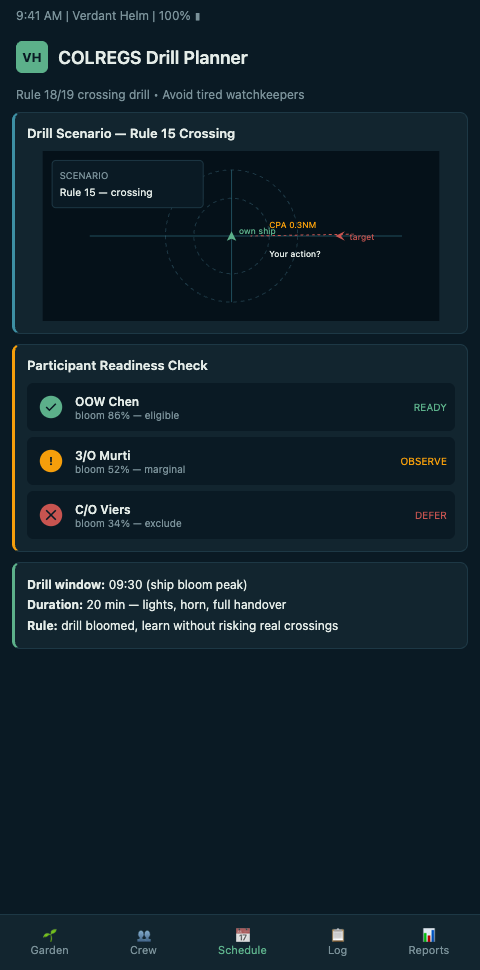
The Verdant Helm approach treats COLREGS drills as a cognitive-load decision, not a calendar decision. The ship's botanical garden shows every bridge watchkeeper's perennial, current bloom, and forecast wilt across the next 72 hours. The Master or the bridge trainer schedules the drill into a window where the target watchkeeper is in bloom and has spare cognitive capacity for a context switch. The scheduler renders candidate windows in green; forbidden windows overlay in the same amber-to-russet wilt scale used across the garden, so a Chief Mate scanning the view can pick the right slot without a briefing.
That window is usually 30 to 90 minutes into a watch, when the perennial has stabilised and the bloom is at its peak. It is almost never a watch change, because watch changes are when the incoming perennial is still dormant and the outgoing perennial is wilting. It is almost never the last hour of a watch, because the wilt has already started. It is almost never between 02:00 and 06:00 on an open-ocean transit day, because the circadian pressure compounds the watch wilt.
For a Master whose training programme still sits on a quarterly calendar, this is the shift — the garden replaces the calendar as the scheduling surface. A Chief Mate who wants to drill his Second Mate on TSS entry procedure reads the next 72-hour garden, finds the 14:30 to 15:30 bloom slot on voyage day 5, and books the drill into that window rather than hunting for a convenient calendar gap.
The garden also lets the Master pick a drill that matches the remaining cognitive budget. A full crossing-situation scenario requires a Second Mate who is in strong bloom. A simpler lookout-focus drill — identify three targets on radar, prioritise by CPA — can run on a moderate bloom. A rule-recall quiz can run on a weaker bloom. The Frontiers marine science paper on human errors in collision avoidance taxonomises the failure modes; the Verdant Helm scheduler maps each mode to the cognitive tier that drill should target. A bosun's deck-watch brief on Rule 5 can sit comfortably at a lower tier than a TSS-entry drill for an OOW about to take the Singapore Strait at 06:30. A cadet's rule-book recall quiz can be scheduled into a moderate bloom band in the afternoon, leaving the high-bloom slots for the OOW who is carrying real-time responsibility.
Over a voyage, the garden produces a drill record that the Master can defend to the fleet superintendent. Each drill is time-stamped with the watchkeeper's cognitive state at the start. A Second Mate who has been drilled three times in his last five voyages — all in bloom, all with measured response quality — is a different entry in the training record than a Second Mate who has been drilled once at 03:00 and muted the drill. The record supports the IMO's Bridge Resource Management evidence base, which correlates BRM drill quality with navigational safety outcomes.
On a VLCC fleet running TransPacific and Europe-Asia rotations in parallel, the drill record becomes comparable across trades. A Chief Mate promoting to Master can carry a cognitive-tagged drill history as evidence of BRM capability, and a cadet promoting to OOW can present a drill record that shows growth under measured conditions rather than a count of drills completed.
Advanced: drill as deposit, not withdrawal
The deeper move is to stop treating drills as a cost to crew energy and start treating them as a deposit. A well-timed COLREGS drill in a strong bloom window builds confidence, refreshes rule knowledge, and strengthens the perennial. A badly-timed drill — same rule, same scenario, same grading rubric — in a wilt window consumes what little energy remains and reduces the Second Mate's margin for the rest of the watch. Masters who have tracked both patterns across two voyages report the difference in qualitative handover notes from Chief Mates on the following leg; the Second Mate who was drilled well arrives on the next watch in better shape, not worse.
The Verdant Helm drill tracker records both sides of the ledger. Each drill is tagged with the cognitive state at the start, the cognitive state at the end, and the garden's prediction of the next 12 hours. When the drill consistently leaves the watchkeeper stronger — perennial still in bloom, no post-drill wilt, good recovery into the next watch — the drill is a deposit. When the drill leaves the watchkeeper weaker, the drill design needs to change. The design change is usually small — shorter scenario, lower CPA complexity, pair the drill with a bosun-led lookout practice so the OOW is not carrying the whole context switch alone. Chief Mates report that the pair-drill pattern also improves lookout quality on the following watch because the bosun and the AB on the bridge share a recent rule-refresh reference in their own working memory, not just the OOW's.
This matters for fleet superintendents who track EMSA's EMCIP safety analysis data on the 83.5% human-action contribution to collision events. The objective of the COLREGS training programme is to reduce that figure on the specific fleet. A drill regime that burns watchkeepers during the drill itself is not moving that number. A drill regime that builds the perennial is. The Researchgate study on simulator training effectiveness shows that simulator drills do translate to real watchkeeping when the training load is calibrated. Verdant Helm calibrates the load per-officer and per-day.
DPAs preparing STCW and ISM audit packages have the additional benefit of tamper-evident records that flag state inspectors can verify against actual watch logs. A fleet superintendent running a quarterly review across 14 Panamax container vessels reads the aggregated drill trace and can see whether the drill calendar is a performative artefact or an operating instrument — the perennial trends across the quarter answer the question without interpretation.
Post 8 on TSS transits scheduled against crew energy covers the adjacent problem of timing the real TSS crossings, and post 12 on scheduling bunkering ops around the ship's cognitive low shows how the same bloom-window logic applies to deck operations. The method ports cleanly to hospitality operations as well, where post 13 on F&B waitstaff rotation tied to service scores uses bloom windows to time service training.
For deep-sea cargo fleet leaders redesigning bridge training
If your COLREGS drill programme is running on calendar dates and your last internal casualty review named watchkeeper fatigue, Verdant Helm will rebuild a single vessel's drill calendar against the garden for one voyage cycle. Schedule the drill-window redesign with your Chief Mate for a vessel currently on a transpacific passage, and bring the last two voyages of drill logs so the comparison is concrete rather than theoretical.
Before the redesign, pull the drill logs alongside the OOW rest-hour forms for the 48 hours preceding each drill. The calendar-driven pattern almost always shows a cluster of drills landing in the last hour of a watch or within two hours of a handover, which is precisely where the bloom curve is weakest and the context-switch cost is highest. On a Panamax container vessel running Europe-Asia with Singapore and Suez transits inside a single round voyage, the redesigned calendar typically places TSS-entry scenarios into the 14:30-15:30 bloom window of the Second Mate on days three, eleven, and eighteen, and puts the bosun-led lookout refresh into the early-afternoon bloom window on day seven.
The DPA gets a drill-quality report that pairs each drill with the cognitive state at start and end, so the drill-as-deposit versus drill-as-withdrawal pattern becomes measurable across a full year. ISM auditors and flag-state surveyors reviewing the STCW training evidence see a drill calendar that operates as a bridge-resource-management instrument rather than a performative artefact, which changes the next DOC renewal conversation.