Scheduling Bunkering Ops Around the Ship's Cognitive Low
A bunker transfer scheduled against the tide, not the crew
The Hong Kong Marine Department casualty report records the event soberly. A container vessel took on low-sulphur fuel oil alongside a bunker barge in April 2022. The receiving tank overflowed. The engineer on the sounding station did not recognise the rising ullage in time to isolate the transfer line. The vessel had been on the bunkering schedule for 14 hours of pre-arrival, docking, and transfer preparation. The engineer who held the sounding pipe had been awake for 18 hours. The Chief Engineer was on the phone to the terminal about cargo restart timing when the overflow was called.
The schedule had been built around the tide, the barge availability, and the cargo operations that had to restart at 22:00. The schedule had not been built around when the engine room watchkeepers would be at their cognitive trough. The bunkering window fell squarely in the 03:00 to 05:00 slot. Across the cargo fleet, this is the norm rather than the exception. Pole Star bunkering guidance reports that bunker spills accounted for 18% of Gard pollution incidents from 2014 to 2018, with an average cost above 100,000 USD per incident. Spills on VLCC and ULCC hulls taking on HFO in Fujairah have produced claims well above that average once terminal standby and clean-up vessels are billed in. A Feeder container vessel spilling LSFO at a Hamburg bunker quay will take a smaller direct claim but a heavier regulatory response under the local harbour authority's pollution regime.
ISGOTT sixth edition codifies the human factors issues that make bunkering deceptively risky. The transfer itself is slow. The attention demand is uneven — long periods of checking gauges punctuated by moments where a valve misalignment becomes an overflow in minutes. Checking a gauge every ten minutes is exactly the task where a fatigued engineer looks at a rising ullage and sees the previous reading because the brain has stopped updating.
On a Panamax container ship bunkering at Singapore after 16 days of TransPacific transit, the receiving crew has usually been through a cargo exchange, an agent visit, a chandler delivery, and a crew change — all inside 18 hours of arrival. The transfer starts with every bed in the garden already drawn down. The Master reading the watch board sees four engineers on standby and assumes capacity; the garden reads the same four engineers as four wilted perennials and a bloom that is still recovering from the Hong Kong port call two days prior.
Read the garden before you read the bunker plan
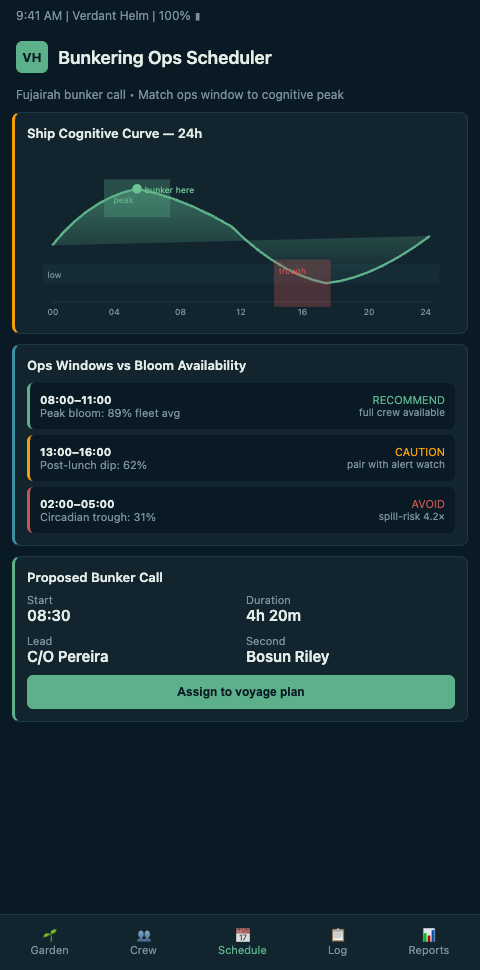
The Verdant Helm approach treats bunkering as a three-hour operation that should be scheduled against the crew's predicted cognitive bloom, not against the berth. The ship's botanical garden is a standing forecast of every watchkeeper's and every engineer's energy band across the next 72 hours. Perennials carry voyage history. Blooms carry the next six hours of expected alertness. Wilts carry the predicted troughs.
A bunker transfer needs four cognitive beds in bloom — a Chief Engineer or Second Engineer at the manifold, an engineer on the sounding station, a deck officer on the mooring watch, and a cadet or AB on the tank farm round. The Verdant Helm scheduler looks at the next 72 hours of the garden and highlights the windows where all four beds will be in bloom simultaneously. Those are the windows where the bunker request to the barge should be tendered. The bloom-band colour is a deliberate fresh green that contrasts against the amber-to-russet wilt scale, so the scheduler's recommendation is readable at a glance on a wheelhouse tablet.
If the tide and the barge availability force the transfer into a cognitive low, the scheduler raises a counter-plan. Prune a pre-arrival task from the bunker team. Redirect the wilted sounding-station engineer to rest. Substitute a daywork engineer whose perennial is strong and whose previous 24 hours have been protected. The SFMX communication procedures study recommends PIC-to-PIC contact every 20 minutes during transfer; that cadence only works if the PIC is in bloom for the duration.
A wilted PIC on a 90-minute barge-side conversation about valve sequencing is the exact setup the Hong Kong overflow exposed. A VLCC Master bunkering in Rotterdam with a fresh bridge team and a tired engine-room watch can use the scheduler to insert a deck officer into the PIC role for the opening 45 minutes of the transfer while the Chief Engineer takes a protected 30-minute reset, which keeps the PIC-to-PIC cadence intact without drawing against wilted engineers.
The garden also makes the pre-arrival sequence visible. Washington State Ecology guidance on safe bunkering stresses scheduling around weather and tide and minimising watch handovers mid-transfer. Verdant Helm adds the cognitive layer. A handover that looks routine on the watch board may cross a wilt line for the incoming engineer who worked a cargo operation until 23:00. The garden shows that directly — incoming perennial still wilted, outgoing perennial in recovery, transfer should not start for another 90 minutes. The Master and the Chief Engineer read the same view; the bunker plan becomes a joint decision rather than a Chief Engineer handover note. The bosun, given notice that the deck officer will be supporting the manifold watch for the first 90 minutes, adjusts the deck round so that a lashing inspection or a hold-preparation task does not compete for the deck officer's attention during the critical opening phase.
Advanced: the bunker schedule as a negotiable against terminal and charterer
Once the Master has a cognitive-bloom window in hand, the bunker schedule becomes a negotiable rather than a fixed input. The Master can send the barge request with a preferred 90-minute window and a flex-limit of six hours. The terminal replies with berth availability and tide constraints. The garden then tells the Master which berth slot keeps the bunker in bloom and which slot forces a wilt. On a VLCC bunkering in Fujairah against a tight laycan, the negotiation may add six hours to the schedule; against a Feeder container vessel bunkering in Rotterdam with a three-day window, it usually costs nothing. The Chief Engineer holding the same view can also negotiate with the barge PIC on transfer rate; a slower rate across a longer window keeps the sounding-station engineer's bloom intact where a faster rate on a shorter window would have forced a wilt cross-over.
That negotiation is where the fleet superintendent joins the loop. The Port of Rotterdam ISGOTT sixth edition bunker checklist breaks the operation into pre-arrival, pre-transfer, during, and post phases with designated PICs. When the Master's chosen window pushes the transfer start from 18:00 to 22:00, the superintendent can see which charter-party clauses bind and which are soft. The IIMS guide on safe bunkering stresses that key bunkering staff must be briefed in advance and properly rested; the garden is the evidence that they are. A Master holding a garden screenshot with the chosen window annotated has substantiation to present back to the charterer.
For DPAs preparing ISM audit evidence, the bunker schedule becomes a documented case of crew-energy-informed planning. Three bunkers rescheduled in a quarter because the cognitive window would not align — that is the kind of objective evidence the auditor wants to see. A class-society surveyor reviewing the same record sees an SMS that responds to fatigue signals rather than one that files paperwork after the fact. For a fleet preparing for PSC focused inspection on bunker operations, the garden record shortens the inspector's interview from hours to minutes because the decisions and the data sit in the same view.
The record also carries insurance weight; when a P&I club reviews a pollution incident and asks whether the bunker was scheduled against operational readiness, a garden trace answers the question directly rather than routing the conversation into a reconstruction of crew statements. A fleet that has rescheduled 12 bunkers in a year against the cognitive window and taken no overflow has a defensible story for its next TMSA assessment and its next vetting by a major charterer's safety committee.
Post 13 on running COLREGS drills without crashing tired watchkeepers covers the adjacent discipline of scheduling bridge drills against the same garden. Post 17 on ballast watch planning with predictive circadian data extends the method into the passage legs where bunkering often gets queued up. The same scheduling discipline appears in the upstream sector, where post 12 on scheduling BOP tests against fatigue troughs applies the same bloom-window logic to well-control testing on drilling rigs.
For deep-sea cargo fleet leaders managing bunker liability
If your fleet has taken a bunker spill in the last 24 months and you want the next bunker transferred only when the cognitive garden allows it, Verdant Helm will run a single vessel's next three bunker windows through the scheduler and deliver a before-and-after plan. Book the bunker-window pilot and bring the last casualty report as the baseline for a forensic comparison against the forecast window the garden would have recommended.
Before the pilot, pull the last three bunker checklists alongside the Chief Engineer's rest-hour records for the 48 hours preceding each transfer. The scheduler almost always reveals that the transfer that produced the closest-to-incident paperwork fell squarely inside an engine-room wilt window the bunker plan had no instrument to see. On a VLCC taking HFO at Fujairah against a tight laycan, the forecast window typically pulls the transfer forward by four to six hours so the Second Engineer on the sounding station and the Chief Engineer on the manifold are both in bloom during the opening 45 minutes.
The DPA and fleet superintendent get a bunker-window report ranking each upcoming transfer by the predicted bloom alignment of the PIC pair, with the bosun's deck support and the mooring watch layered into the same view. P&I clubs reviewing the record against pollution-claim history see a bunker posture that reads operational readiness before the transfer starts, which shortens the next TMSA assessment and the next vetting inspector's bunker-operations interview.