How to Schedule BOP Tests Around Drill Floor Fatigue Troughs
The 03:20 BOP Test on Day 18
A deepwater semi-sub started its 14-day blowout preventer pressure test at 03:20 on day 18 of a 21-day rotation. The test had been deferred 48 hours for weather, and the drilling plan needed the next hole section to start before crew-change. The BOP cycled cleanly through low-pressure and high-pressure sequences on each component. Two tours later, a sheave liner fell from the derrick's racking board and missed a roustabout by roughly two meters.
The DROPS investigation found the liner had been incorrectly re-seated during the pressure-test prep, by a derrickhand who had worked the BOP sequence through his entire night tour. The test documentation was complete. The fatigue state of the crew who executed the test prep was not part of the scheduling decision. The same crew had been pulled onto the prep work because they were the ones most familiar with the stack's current configuration, which is exactly the kind of operational logic that concentrates cognitive load on the wrong perennials at the wrong time.
BSEE's technical assessment of BOP failure modes runs through the latent defects that pressure tests are meant to detect, and notes how readiness of both the stack and the crew drives the validity of the test (BSEE Summary of BOP Failure TAP report). The National Academies' Macondo analysis is sharper: neither Transocean nor BP tested BOP emergency systems adequately for latent failures before the blowout, and the investigation flagged gaps in operational readiness as part of the chain (National Academies Macondo Well Deepwater Horizon Blowout Lessons). IADC's hosted report on the same incident documents inconsistent training and decision-maker readiness across the crew in parallel (IADC Macondo Well Deepwater Horizon Blowout). When toolpushers look at their own schedules, the pattern recurs in smaller form: BOP tests issued at 03:00 to fit weather or well progression, executed by crews already inside a fatigue trough.
Reading the Floor Like a Garden Bed
A drill floor has tempo. Over a 21-day rotation, crew energy rises, blooms, wilts, and partly recovers in cycles shaped by night tours, stand-down periods, and weather-driven shifts. Verdant Helm renders that tempo as a garden bed where each crew member is a perennial with a current state. Some plants bloom through the middle of the hitch and wilt on day 18. Others sink on day 6, recover by day 10, and stay steady. The BOP test is a piece of critical work that asks those plants to perform at peak. Scheduling the test into a trough is like pruning a rose during a frost; the cut happens, but the plant loses more than it should, and the garden carries the damage into the next week.
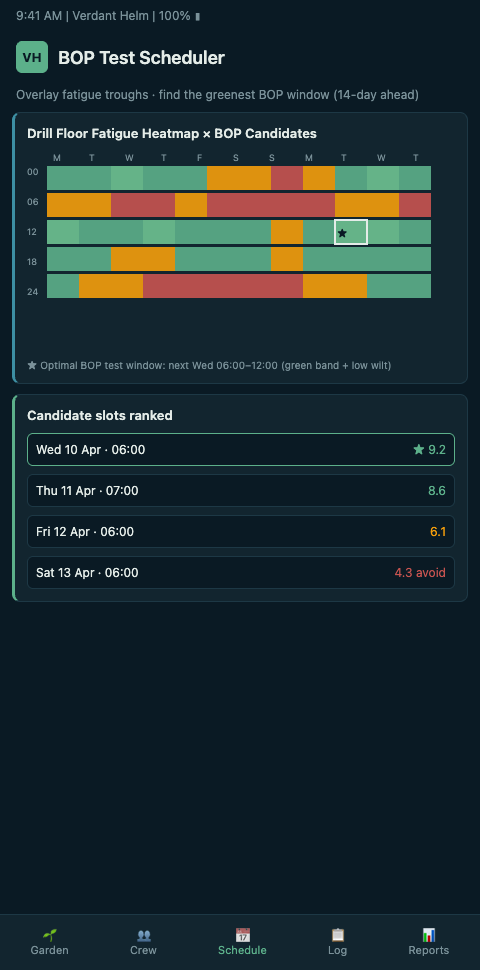
The scheduling framework has three parts. First, visibility: the driller, toolpusher, and OIM can see, 72 hours ahead, which 6-hour windows sit in a trough for which crews. The window does not lock the schedule — it informs it. The visibility runs across both tours, so the toolpusher can see that the day tour is bloomed and the night tour is in a trough, and can plan the test accordingly.
Second, soft constraints: the BOP test scheduler prefers windows where the executing crew's aggregate energy sits in the top quartile for the current hitch. If the test must land in a trough for weather or well reasons, the system flags which mitigations fit (additional standby, simplified test sequence within regulatory bounds, extra supervisor on the floor). Third, evidence: the test record captures the crew state at each pressure phase, so post-test review links performance to readiness. When the next BSEE inspection reviews the test history, the garden overlay is part of the evidence package, not a separate report.
BSEE's analysis of 14-day versus 21-day BOP test frequency walks through the risk-exposure trade-off and shows why the industry landed on the current cadence, with readiness of the test crew assumed as a baseline (BSEE Examination of Blowout Preventer Pressure Test Frequency). The federal rule at 30 CFR 250.737 fixes the cadence and scope of the test; it does not fix the hour of the day (30 CFR 250.737 BOP System Testing Requirements). That gives OIMs and toolpushers room to sequence the test inside a window that aligns with crew readiness, as long as the interval between tests respects the rule. Work on stress, fatigue, and situation awareness in drilling crews finds that higher fatigue correlates with lower hazard perception precisely during the sequenced, rule-driven activities that BOP tests represent (Stress, fatigue, situation awareness and safety in offshore drilling crews).
Advanced Tactics for the Scheduler
Three tactics change the outcome in practice. The first is pre-test prep protection. The pressure test consumes 6 to 10 hours, but the prep work — line-up, lock-out, tagging — can consume another full tour. Protect the prep tour the same way as the test tour; do not run the prep on an exhausted crew and hope the test tour is fresh. The prep sets up the latent conditions that the test either reveals or hides.
Drilling contractors offering structured BOP test services already sequence the mechanical side; the garden layer adds the human sequencing that vendors typically leave to the rig (Nabors BOP Testing Services). A prep tour run by a wilted crew produces test-ready conditions that look correct on the log but contain subtle gaps — a fitting torqued to the low end of spec, a tag not verified on secondary inspection — that the test sequence itself may not catch.
The second tactic is test sequencing within the window. Rigs routinely run the low-pressure sequence first, then the high-pressure. If the crew is sliding into a trough across the shift, re-order so the most cognitively demanding checks land in the first hour, not the sixth. The regulation fixes what must be tested, not the internal order. The subsea engineer often carries the most complex cognitive load during the test, and protecting their first two hours of peak attention has disproportionate value. Some rigs also run function tests alongside pressure tests; these can be split across tours when the regulatory interval allows.
The third is cross-role handover. BOP tests pull the derrickhand, driller, assistant driller, toolpusher, and subsea engineer into a tight sequence. Each role has its own energy curve. The garden view shows the weakest link, and the supervisor can rebalance the team for the window — swapping in a rested assistant driller from the other tour for the critical pressure-up moments. The swap is not a staffing shortcut; it is a considered decision that the garden data supports with specific state evidence rather than general impression.
A fourth tactic is communication-loop hardening. During a BOP test, radio traffic between the driller, the subsea engineer, and the test supervisor follows specific sequences. A fatigued crew condenses these sequences or skips confirmation steps. The garden view can prompt the toolpusher to assign a dedicated communications observer during troughs — typically a supervisor or HSE lead who monitors the loop and flags any drift from the standard sequence. This is a low-cost intervention that catches exactly the kind of omission that BOP tests are designed to surface.
Common mistakes include scheduling the test immediately after a jarring operation (which leaves the floor crew cognitively depleted), scheduling into the first sleep-adjustment window after a crew-change (when new arrivals are still debt-loaded), and skipping the prep-tour check. Another common trap is defaulting to the same start time across hitches, regardless of where that time lands in the current crew's rotation curve. The start time is a scheduling variable, not a fixed input. The same fatigue-aware scheduling logic applies to JSA reviews on fatigued drill crews ahead of the test, and to derrick team trip-out scheduling, because BOP tests often sit inside the same 96-hour block as the trip. The parallel practice on cruise fleets — sequencing muster drills without collapsing crew energy — shows the same pattern in a different regulatory frame.
Book the Window Differently
If you are a toolpusher or drilling supervisor running a 14-day BOP cadence, pull your last six tests and map each to the executing crew's hitch day. The ones that closed in the top half of the hitch tend to finish faster and clean; the ones that closed deep in a trough tend to surface precursors in the following 72 hours.
Verdant Helm gives OIMs the forward view to book the next test into the right window before the weather or the well decides for you. The forward view does not eliminate the weather pressure or the well-schedule pressure, but it surfaces the trade-off so the decision is visible and defensible. Schedule a short walk-through and bring your last BOP test timeline; we will show the energy overlay against your actual crew roster and identify which of the next three test windows lands the executing crew in a bloom rather than a trough.