Scheduling Muster Drills Without Collapsing Crew Energy
The Drill That Cost Three Stewards
The 3,200-guest Mediterranean ship sailed at 17:00 on a Sunday. The Hotel Director, pushing to raise compliance numbers that had flagged on the prior voyage audit, moved muster drill to 16:00 — right into the window when cabin stewards were simultaneously turning 800 staterooms for first-night service and running last-call embarkation bags. Muster compliance climbed three points on the post-voyage report. By day four, three stewards had gone to the medical center with stress-related complaints, the specialty dining venues had lost a combined 19 service-hours to crew backfill, and the mid-voyage NPS reading on the two specialty restaurants had fallen five points against trend.
The Hotel Director had done exactly what the 2015 SOLAS amendment requires — passenger muster before or immediately on departure. The compliance-first framing is correct. The energy-blind framing isn't. IMO MSC/Circ.1014 explicitly warns that drills should not be scheduled in ways that induce fatigue, and the ISF Watchkeeper clarification that drills and musters count as work means the hour pressed into the drill window is an hour subtracted from recovery.
The muster itself didn't cost the voyage. The placement of the muster inside the embarkation-day load did.
The tradeoff also isn't unique to this one Mediterranean ship. Hotel Directors across Caribbean, Alaska, and transatlantic itineraries report the same pattern: drill placement optimized for guest compliance on the post-voyage audit creates a recovery deficit that shows up in specialty dining and concierge-level service scores mid-voyage. The audit passes. The NPS silently bends. The connection between the two rarely gets drawn because the audit owner and the NPS owner are different functions reporting through different channels.
Drill Day As a Garden Under Stress
Verdant Helm models embarkation day as the single highest-load garden day of the voyage. Seatrade Cruise reports that the 2015 SOLAS drill update added measurable embarkation-day crew load on top of existing turnaround tasks. The garden frame makes the stacking visible: every perennial in every bed is asked to bloom on the same day, at the same intensity, while the soil is simultaneously being rebuilt for the next voyage.
The stacking is not unique to drills. Embarkation day already carries the turnover load — thousands of rooms cleaned and inspected, provisioning to be received and stowed, embarking guests to be welcomed and oriented, pre-departure checks across ops and safety. Every one of these activities is a necessary draw on crew energy. Drills add one more on top. The garden view makes the stack visible so the Hotel Director can see, at a glance, which beds are being asked to bloom through three or four simultaneous draws and which are under just one. The same stack-visibility principle the F&B waitstaff rotation playbook applies to dining-bed load distribution.
In the garden view, muster drill is a weather event — a one-hour thunderstorm that every bed experiences together. Stewards are perennials doing heavy turnover work in their deck beds. F&B crew are perennials in dining beds preparing for first-night service. Guest services are perennials at the embarkation desk absorbing the peak inbound flow. A drill dropped into any bed at 16:00 pulls the perennials out of their soil for the duration — and pulls them back in with less water than they had before.
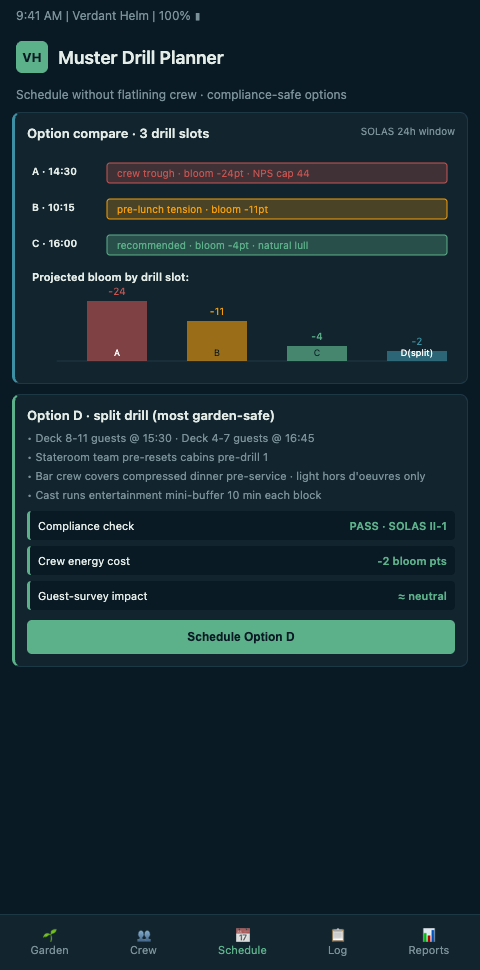
Verdant Helm renders drill scheduling as a weather overlay on the embarkation-day garden map. The Hotel Director can drag the drill block earlier or later and see which beds turn amber, which turn green, and which go brown. A 14:30 drill, for example, lands in the window where cabin stewards have mostly finished turnover but F&B hasn't started first-seating setup — minimizing the number of beds under simultaneous stress. A 10:30 drill, scheduled as part of a port-side drill under CLIA's operational safety policies that exceed SOLAS post-Concordia, shifts the load to a moment when most crew beds are still in low-bloom prep.
The garden frame also surfaces the invisible follow-on. A drill isn't over when the crew returns to station — the perennials that were uprooted during the drill bloom less vigorously for the next four hours. Verdant Helm models this tail by reducing the predicted energy floor for drill-participating crew for the remainder of the shift. The Hotel Director sees, before the voyage sails, that a 16:00 drill doesn't just cost the drill hour — it costs four hours of degraded energy in the specialty dining beds that then absorb the tail.
Teams that have moved to the virtual-muster pattern that Norwegian reintroduced post-pandemic can model the energy impact of e-muster versus physical muster inside the same frame. The virtual version distributes the load across the embarkation arrival window rather than concentrating it into a single hour. The IMO SOLAS Chapter III summary allows both patterns; the garden view quantifies which one costs the rest of the voyage less.
Verdant Helm also models the post-drill safety debrief — the crew-only walkthrough that typically runs 20-30 minutes after muster concludes, where the staff captain and safety officer review actions and note any crew performance issues. The debrief carries real operational value and absolutely belongs on the calendar. The garden view simply ensures the debrief is scheduled against beds that are not simultaneously in peak-bloom service. A debrief scheduled 16:00-16:30 while F&B is in first-seating prep drains the same F&B leads a second time. Moving the debrief to 21:00 after first seating closes prevents the double hit without reducing debrief quality.
The botanical metaphor matters here because it holds the two constraints together without collapsing one into the other. Safety compliance is non-negotiable — the drill runs. Crew energy is also non-negotiable — the perennials wilt under stacked load. A single-axis spreadsheet can't hold both; it defaults to compliance and lets energy go brown silently. The garden view insists that both axes stay visible, and then asks the Hotel Director where to place the weather event to minimize damage.
Advanced Tactics for Drill Placement
Three further moves make the scheduling work.
The first is bed-rotation within the drill itself. Not every crew member is needed at full intensity for every minute of the muster. Verdant Helm supports a staggered drill protocol where cabin stewards enter first, complete their role in 25 minutes, and return to deck while guest-services crew rotates through the back half of the hour. The total muster runs the full required duration. The individual load on any one bed is halved. This pattern mirrors the experience-balanced rotation that INFORMS documented for F&B scheduling, and it applies cleanly to drill design.
The second is port-day drill recovery. When drills must run on embarkation day, the Hotel Director can pre-fund a compensating recovery window on day two — typically a three-hour shoreside release for the most drill-loaded beds. The port-day recovery playbook details how the release blocks are read from the garden data, and Verdant Helm's drill-placement model automatically proposes the compensating release when the embarkation drill can't be moved.
The third is cross-voyage drill spacing for returning crew. A steward completing his third consecutive Caribbean turnaround is not the same perennial as one on her first voyage. Drill placement optimal for the new joiner is suboptimal for the returning third-voyage steward whose energy floor is already lower. Verdant Helm tracks drill-hour history per named crew member across the contract and flags when the stacking would push a specific perennial below the wilt threshold. This is the same pacing logic that the wind technician blade-inspection playbook applies to inspection cycles — contract-level pacing rather than voyage-level pacing.
A fourth tactic that deserves specific mention is new-joiner protection. Crew members on their first voyage carry different muster-absorption profiles than experienced crew. The first muster is also often their first shipboard emergency-exercise experience, adding cognitive load unrelated to the drill content itself. Verdant Helm tags new joiners and schedules their drill participation with an experienced-crew buddy, which lowers cognitive load during the drill and speeds up new-joiner onboarding into the broader muster protocol. The benefit shows up across subsequent voyages, not just the first one.
Pick One Voyage and Shift the Drill Thirty Minutes
Hotel Directors on megaships who want to see the impact in a single sailing can run a bounded test. Pick the next voyage. Shift the embarkation-day drill by 30 minutes into the lower-load window the garden view identifies. Hold every other variable constant. Read the mid-voyage specialty dining NPS against the prior sailing. Verdant Helm's drill-placement module produces the shift-and-hold proposal automatically, so the Cruise HR Leader reviewing the change sees the predicted energy floor for every bed before the drill moves. That's the test. Run it once, read the numbers, decide whether to extend.
The setup takes 20 minutes if the safety officer, Executive Housekeeper, and F&B Director are in the room together. Pull the prior voyage's drill time, pull the predicted bed-state overlay from Verdant Helm, and pick the 30-minute window that shifts the drill into the smallest overlap with cabin turnover and first-seating prep. Write the new drill time into the Sunday morning operations brief, notify the staff captain, and confirm the post-drill debrief moves accordingly. Hotel Directors who have run this once tend to run it again the following voyage with a different 30-minute adjustment, comparing three consecutive sailings against the baseline.
The pattern that typically emerges is a two- to four-point specialty dining NPS lift without a compliance change, plus a measurable drop in medical-center visits from cabin stewards in the 48 hours following muster. Cruise HR Leaders should attach this test to the quarterly safety review so the drill-placement discussion carries the NPS and medical-center evidence alongside the compliance audit. The point is not to move every drill forever; it is to prove the placement lever exists and to pull it when the garden shows a stacked load.